
salt chlorine generator
Leading swimming pool salt generator Manufacturers in China
If you are sourcing a high-quality salt chlorine generator for pool projects, Century is a China-based manufacturer of swimming pool salt chlorinator equipment. The product range includes several output ratings for pools of different sizes and operating demands. Century focuses on build quality, reliable operation and efficient electrolysis, giving contractors, distributors and OEM buyers a practical pool chlorine generator manufacturing partner. Contact our team to discuss the right configuration for your application.
- Pool capacity compatibility ranging from 15,000 to 40,000 gallons (custom sizing available for larger volumes).
- Proprietary MMO-coated titanium plates to ensure an industry-leading lifespan.
- Premium Ruthenium-Iridium (Ru-Ir) coating for extended durability.
- Self-cleaning salt chlorinator technology (automatic reverse polarity) with a self-timer shutoff.
- Wide range of chlorine outputs (15g/h - 50g/h+) and dual-voltage (110V/220V) configurations.
CENTURY’s salt water chlorinator for sale
A Century salt chlorine generator system is intended for residential and commercial pool-chlorination projects. Buyers can compare chlorine output, power input, plumbing requirements, controls and service needs to select a configuration that fits the site.
Century offers a range of standard products for common pool applications. If the required specification is not listed, provide the application, target chlorine output and plumbing requirements. The team can then review a salt chlorinator system configuration for the project.
Century supports customers in multiple markets with design experience, established machining processes and an experienced assembly team. These capabilities help the company prepare commercially practical quotations for both small and larger production programs. Lead time and pricing depend on the confirmed scope, quantity and destination. OEM and ODM cooperation is also available. Contact Century with your project requirements for review.

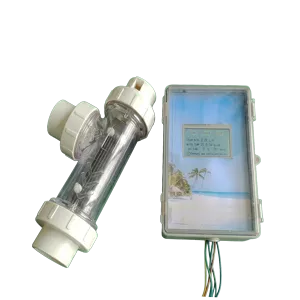
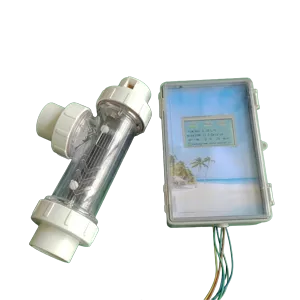
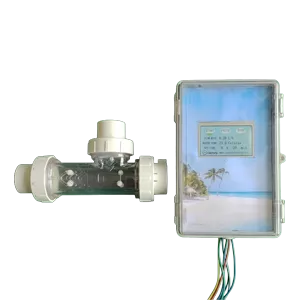
50g/h Commercial Salt Chlorinator | Heavy-Duty Pool System
Provides excellent resistance to heavy bather loads in commercial applications. Designed for 24/7 continuous operation in hotels and resorts. Low maintenance cost with maximum output.40g/h Self-Cleaning Salt Chlorinator | Electronic Chlorine Generator
Offers superior chlorine production for large pools up to 40,000 gallons. Engineered for heavy usage, weathering, and aging. It serves as the core of a robust residential system providing a lifetime of comfortable swimming.25g/h Complete Salt Chlorinator System | Residential Salt Water
Built to keep standard mid-sized pools crystal clear. Handles up to 25,000 gallons. Highly resistant to scaling and corrosion in harsh pool environments. A highly reliable residential salt water chlorinator system.15g/h Pool Chlorine Generator Kit | Salt Water Pool Conversion
Used for sanitizing compact and above-ground pools up to 15,000 gallons. Features intelligent reverse polarity self-cleaning and real-time salinity display. Handles 110V/220V wide voltage input. An excellent entry-level pool chlorine generator kit.
pool chlorinator system Comparison & Selection Guide
Century offers a wide range of Salt Chlorinator System for your selection, as listed in the table below. We also welcome custom requests—our team will develop tailored solutions to meet your specific needs.
| Model Number | Chlorine Output (g/h) | Ideal Pool Size (Gallons) | Cell Life (Hours) | Operating Salinity |
|---|---|---|---|---|
| CT-SCG-15 | 15g/h (0.79 lb/day) | 15,000 | 8,000 - 10,000 | 2700-3400 ppm |
| CT-SCG-25 | 25g/h (1.32 lb/day) | 25,000 | 8,000 - 10,000 | 2700-3400 ppm |
| CT-SCG-40 | 40g/h (2.12 lb/day) | 40,000 | 8,000 - 10,000 | 2700-3400 ppm |
| CT-SCG-50 | 50g/h (2.65 lb/day) | 55,000 | 10,000+ | 2700-4500 ppm |
chlorine generator for pool Specifications & Use Cases
Below is a table of Century’s available models and their use cases.
| Residential Series (Small-Mid) | High-Capacity Series (Large) | Commercial & Smart Series |
|---|---|---|
| 15g/h - For pools up to 15k Gal | 40g/h - For pools up to 40k Gal | 50g/h+ - For Luxury/Commercial |
| 25g/h - For pools up to 25k Gal | / | / |
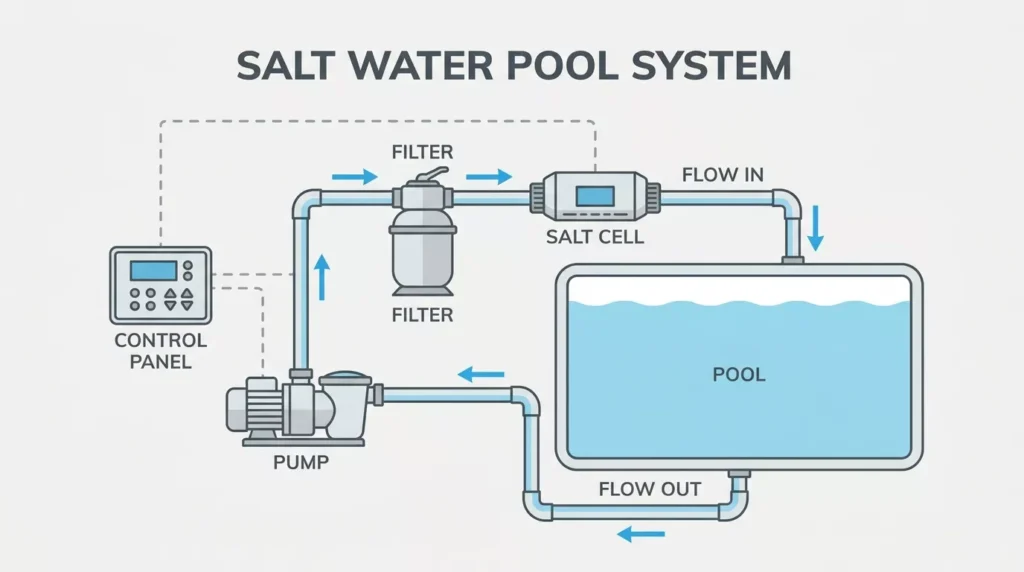
How a simple salt pool system Works: The Pool Chlorination Process
- Set the Pool Water and Salinity: Use pool-grade salt and set salinity according to the approved documentation for the installed unit. Century product pages list an ideal salinity range of 2,700-3,400 ppm and operation up to 4,500 ppm; the purchased model's manual and controller settings govern the actual setpoint.
- Circulate and Filter the Water: The pool pump moves water through the filtration loop and into the generator's electrolytic cell. Before selection, confirm required flow, available straight-pipe length, union standard and installation space. Chlorine production must stop when adequate flow is not confirmed.
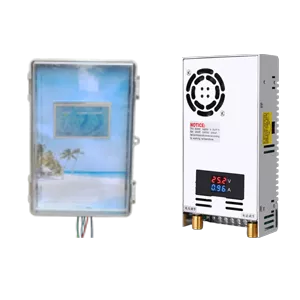
- Convert AC Power to Controlled DC Power: The power center supplies the low-voltage DC current required by the cell. Century model pages list 110 V or 220 V AC input options. The cell, power center, timer or automation interface, and flow-protection device must be electrically compatible.
- Generate Chlorine in the Cell: Saline water passes over energized MMO-coated titanium electrodes, and electrolysis produces chlorine in the treated flow. Century lists 15 g/h, 25 g/h, 40 g/h and 50 g/h output models with automatic reverse polarity to help manage scale on the plates. Reverse polarity does not replace routine inspection or balanced pool water.
- Return Treated Water to the Pool: The circulation system distributes chlorinated return water around the pool. Do not size a salt water pool generator by a nominal gallon rating alone. Match output to actual chlorine demand, pump runtime, climate and bather load.
- Test, Adjust and Record Operation: Operators should continue testing free chlorine and pH, then adjust output, runtime and water chemistry as conditions change. The U.S. Centers for Disease Control and Prevention (CDC) notes that sunlight, bathers and contaminants consume chlorine. Follow local rules and the operating procedures applicable to the facility.
Why Operational Sustainability Matters in Saltwater Pool Chlorination
Electrolysis uses dissolved pool-grade salt to produce chlorine in the water-treatment loop. This changes the supply model from relying entirely on repeated purchases and dosing of manufactured chlorine products.
- Generate Sanitizer Within the Circulation Loop: A salt water pool system uses dissolved pool-grade salt to produce chlorine in the treatment loop. This reduces dependence on repeated purchases and dosing of manufactured chlorine products, but it does not eliminate chemical handling, water testing or the possible need for supplemental treatment.
- Match Chlorine Production to Actual Circulation and Disinfection Demand: A salt chlorine generator should operate only when proper water flow is confirmed. Output and runtime should be matched to pool volume, water temperature, sunlight, bather load and the operating plan. The U.S. Department of Energy (DOE) notes that timers can reduce unnecessary pump runtime.
- Protect Water Quality and Equipment Through Routine Testing: Consistent water management supports both sanitation and equipment protection. The CDC treats free chlorine and pH as a first line of defense against germs and explains that poor pH control can reduce chlorine effectiveness and increase corrosion risk. Automated chlorine production does not replace testing or adjustment.
- Choose Serviceable Components: Complete pool salt systems combine a power center, a salt cell and the required flow hardware. Century supplies power centers and replacement cells as separate product categories, helping buyers plan spare parts and future service. Automatic reverse polarity can help manage mineral scale, but inspection, cleaning and eventual component replacement still belong in the maintenance plan.
- Assess the Whole Pool System, Not One Component: A credible lifecycle review should include generator electricity use, pump runtime, salt additions, water-balance chemicals, cleaning, replacement parts and backup sanitation. A salt water pool chlorine generator is only one part of that operating picture. U.S. Environmental Protection Agency (EPA) and DOE guidance indicates that circulation, leaks, evaporation and operating practices also influence pool water and energy performance. Without project measurements, overall pool savings should not be attributed solely to the generator.
Century salt water chlorinator systems vs Conventional Chemical Dosing
| Evaluation Area | Century Salt Chlorine Generator System | Purchased-Chlorine Dosing System | Buyer Considerations |
|---|---|---|---|
| Chlorine source | Generates chlorine in the circulation loop by electrolyzing pool-grade salt. | Chlorine is purchased as a finished chemical and added manually or through dosing equipment. | Compare salt supply, chemical delivery, storage and handling. Neither option makes the pool chlorine-free. |
| Equipment scope | Uses a matched power center, electrolytic cell and required unions or flow hardware. | Equipment depends on chemical form and may include a feeder, metering pump, storage tank or manual procedure. | Request a complete bill of materials that defines controls, accessories and installation boundaries. |
| Output and control | Published output ratings are 15, 25, 40 and 50 g/h. Production works with circulation and the project's control arrangement. | Feed rate is set by a feeder, metering pump or operating procedure and adjusted to actual demand. | Define required output, adjustment range, safety interlocks, runtime and monitoring. |
| Maintenance | Inspect the cell, manage scale and water balance, verify sensors and controls, and plan component replacement. | Inspect dosing equipment, tubing, injection points, chemical storage and controls as applicable. | Compare procedures, labor skills, spare parts, cleaning supplies and service access. |
| Site conditions | Requires compatible power, flow protection, plumbing space, matched unions and operation within the approved salinity range. | Requires storage, handling and dosing provisions suited to the selected chlorine product and local rules. | Have qualified professionals review electrical, plumbing, chemical-handling and code requirements. |
| Supply and lifecycle planning | Plan for electricity, salt additions, water-balance chemicals, cell service and replacement parts. | Plan for recurring chlorine purchases, storage controls, dosing spares and site procedures. | Model lifecycle cost with local prices and taxes; do not apply a generic savings percentage. |
| Project selection | Treat published gallon ratings for the 15, 25 and 40 g/h models as an initial screen only. | Select dosing capacity and redundancy from required feed rate, chemical form, facility class and operating plan. | Provide pool volume, climate, bather load, runtime, controls and local compliance criteria. |
✷Salt Water Chlorinator for Pool Applications ✷
Century offers several output ratings for different project types. Selection of a salt water chlorinator for pool applications should be based on chlorine demand and installation conditions rather than a single marketing label. When evaluating a saltwater chlorinator, match production capacity to the planned operating window and allow practical room for output adjustment.
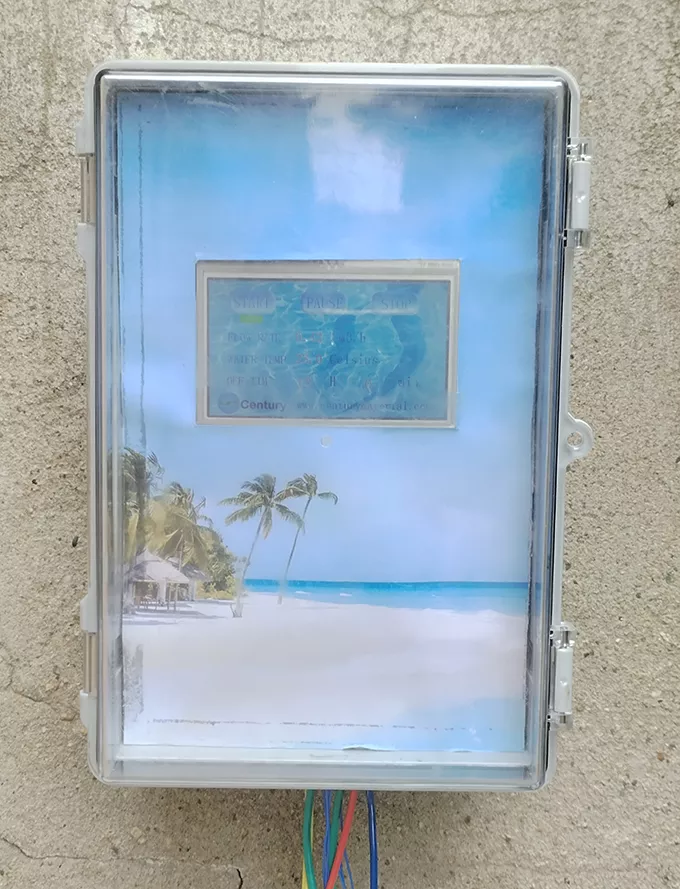
- Small residential and above-ground pools: Consider the 15 g/h model when the published pool-volume range and installation conditions are suitable.
- Standard new residential pools: A complete 25 g/h system can serve as a mid-range starting point for a typical backyard pool.
- Larger residential or higher-load private pools: Evaluate the 40 g/h model, particularly where heat, long operating seasons or hard-water scale place greater demand on the equipment.
- Hotels, resorts, swim schools and public facilities: Evaluate the 50 g/h commercial system from calculated chlorine demand, planned runtime and local requirements. Do not select it from a nominal gallon figure alone.
- OEM and private-label programs: Before design review, define chlorine output, plumbing, enclosure, interfaces, branding, documentation and order-volume requirements.
A salt water pool conversion involves more than adding salt. The contractor should review circulation, available straight-pipe length, flow detection, power supply, controller or timer interfaces, bonding, grounding, material compatibility and local rules. The pool salt chlorine generator must produce chlorine only when confirmed flow passes through the cell. Early project assessment is especially important for older pools, flexible-hose plumbing and commercial equipment rooms.
Swimming Pool Chlorine Generator Related Resources
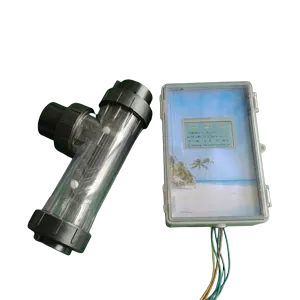
Why Source Swimming Pool Salt Chlorine Generator from Century?
Century’s manufacturing pages describe an integrated production chain that includes titanium-substrate preparation, MMO precious-metal coating, electrode assembly, plastic injection molding, CNC machining, power-center assembly and complete-system integration. OEM and ODM projects can be reviewed for custom chlorine output, design-life targets, ports, plumbing structure, private-label features and interface requirements.
Century also describes several quality-control methods, including coating-thickness and precious-metal loading analysis, hydrostatic and leak testing, electrical continuity checks, and accelerated electrochemical aging tests.
- Published standard output ratings span 15-50 g/h, giving buyers an initial range for residential and commercial swimming pool salt chlorine generator projects.
- In-house manufacturing capabilities include ruthenium-iridium MMO coatings and titanium electrodes.
- OEM and ODM programs can include engineering review of custom output, design-life targets, plumbing and interface requirements.
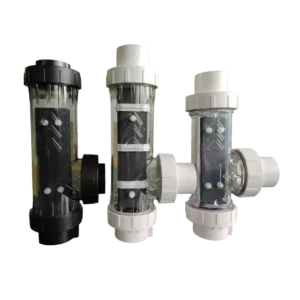
- Power centers, salt cells and cell housings are available as separate product categories, supporting flexible sourcing and service planning.
Expert Guidance for Salt Water Pool Generator Buyers
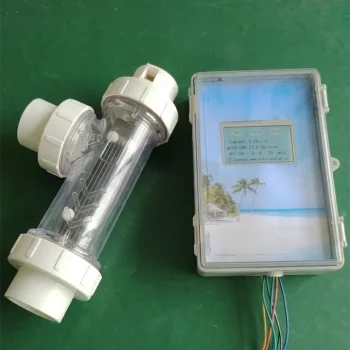
Define the Complete System and RFQ Boundary
A salt chlorine generator system combines a power center with an electrolytic cell installed in the circulation line. Century lists complete systems, power centers, replacement cells and cell housings as separate product categories. In the RFQ, define target chlorine output, AC input, plumbing and union size, flow protection, control interfaces, enclosure environment, spare-parts expectations and required technical documents. The quoted bill of materials should state what is included and what the installer must supply on site.
- Hydraulics: Pool volume, circulation flow, pipe size, available straight-pipe length and union standard.
- Electrical and control: Available power, timer or automation interface, cable route, bonding and the division of installation responsibility.
- Operating conditions: Planned runtime, climate, bather load, salinity range, water chemistry, service clearance and spare-parts strategy.
Keep Water Testing and Chemistry Control in the Operating Plan
A saltwater pool remains a chlorine-sanitized pool. Set chlorine output and pump runtime from actual free-chlorine and pH test results while accounting for sunlight, bather load and contaminants. CDC guidance treats testing and adjustment as routine pool operations. Follow the equipment manual and local rules for the facility; reverse polarity, automation and timers do not remove the need for testing, inspection or qualified installation.
Match OEM and Aftermarket Parts Carefully
For distributor and private-label programs, match parts to the architecture of the complete pool salt chlorine generator system rather than relying on a generic cell-model label. Confirm power-center compatibility, terminal or plug type, housing dimensions, union standard, output rating, controller parameters, packaging and required quality records. Century’s public pages describe product categories and manufacturing capabilities; before production, request project-specific drawings, samples and validation records.
Before issuing a purchase order or releasing an OEM production run, ask the supplier for the exact product revision and technical documents for the quoted configuration. Depending on the project, the file set may include dimensional drawings, wiring instructions, a bill of materials, interface definitions, packaging and nameplate artwork, a spare-parts list, and agreed quality or test records. If the destination market requires certification or specific installation standards, request evidence for the quoted product rather than relying on a general product page. This keeps sales claims, engineering validation and compliance review clearly separated.
Comprehensive Pool Salt Generators Guide
Request a Configured Pool Salt Chlorine Generator Systemm Quote
For a swimming pool salt generator quotation, tell Century what the system must do, where it will operate and how it will be purchased. Include pool volume, use profile, required output, daily runtime, salinity range, pipe size, AC input, control requirements, quantity, destination market and OEM needs. Century can then review the model, package contents and project-specific documentation before order placement.
Frequently Asked Questions About Pool Salt Water Generator
Q: What is the difference between a salt chlorine generator and a salt cell?
The salt cell is the electrolytic component through which saline water flows. A complete salt chlorine generator includes the cell and the power equipment that supplies controlled DC current; the package may also include flow sensing, unions and control hardware. Confirm exactly what is included in the quotation.
Q: Does a saltwater pool still use chlorine?
A: Yes. The system generates chlorine from dissolved sodium chloride through electrolysis. Sanitation remains chlorine-based, so the operator must routinely test and maintain free chlorine and pH. Saltwater does not mean chlorine-free water.
Q: Which Century model should I choose?
A: Treat the published pool-size ratings for the 15 g/h, 25 g/h and 40 g/h models as an initial screen. Select the 50 g/h commercial model from calculated demand and site requirements. Account for runtime, bather load, climate, sunlight and local operating rules before final selection.
Q: What salinity range do the published models use?
A: Century’s four model pages list 2,700-3,400 ppm as the ideal range and state operation up to 4,500 ppm. The approved documentation and controls for the ordered unit should govern the actual setpoint. Maintain salinity within the manufacturer’s required range.
Q: Does reverse polarity eliminate cell cleaning?
A: No. Automatic reverse polarity helps release mineral buildup and may reduce cleaning frequency, but scale still depends on hardness, pH, temperature and water balance. Inspect the cell and follow the approved maintenance procedure; avoid unnecessary acid exposure.
Q: Can I order 110V or 220V versions?
A: Century model pages list 110 V and 220 V AC input as specified options. State the site supply and destination market when requesting a quote. Do not assume every unit is field-switchable unless that capability is confirmed for the exact power center.
Q: Can a traditional chlorine pool be converted to a saltwater system?
A: Often yes, but the conversion requires more than adding salt. A contractor should review plumbing space, circulation, flow sensing, equipment compatibility, power, controls, bonding, grounding and local requirements. The completed system must operate only under approved flow conditions.
Q: Can the 50g/h model be used for a public or commercial pool?
A: Century positions the 50 g/h model for commercial and higher-load applications. Suitability depends on required chlorine production, operating schedule, facility rules and any mandated equipment listings or backup plan. Ask the project engineer and local authority to confirm compliance requirements; equipment selection alone does not guarantee compliance.
Q: What information should an OEM buyer provide?
A: Provide the target output, cell architecture, plumbing and enclosure requirements, electrical and control interfaces, sensors, expected operating conditions, design-life target, branding, packaging, documentation, quantity and destination market. Century can then identify which items are standard and which require engineering review.
Related Products
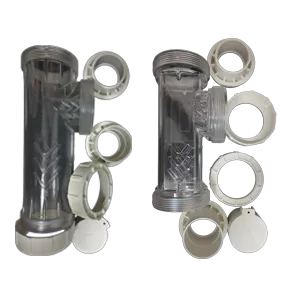
Notice: Century is an independent manufacturer of high-performance water treatment systems. All OEM trademarks (including Hayward®, Pentair®, Jandy®, and Zodiac®) are the property of their respective owners and are used here for cross-reference and compatibility purposes only. Product performance is subject to local water chemistry and bather load. We recommend installation by a licensed pool professional to ensure compliance with local electrical codes.