
Industrial Electrolyser Vessels & Housings
Your Trusted Industrial Electrolyser Vessels & Housings Manufacturer
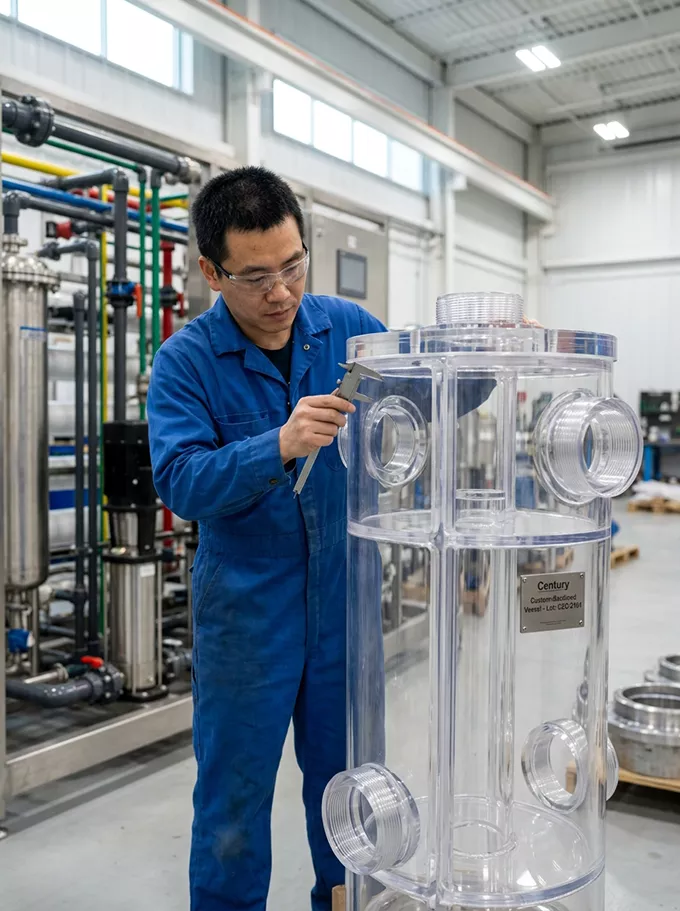
When engineering large-scale, on-site sodium hypochlorite generation systems, standard off-the-shelf plastic molds simply cannot accommodate the required electrode dimensions or hydraulic flows. Century is a premier manufacturer of industrial electrolytic cell housing units, providing custom-fabricated chambers designed exclusively for heavy-duty brine electrolysis.
We do not force your skid design into a pre-existing box. Instead, we utilize advanced CNC machining and expert solvent-welding techniques to build a Custom Electrolytic Chamber that perfectly houses your large-scale titanium anode arrays. From municipal water treatment plants to industrial cooling tower disinfection, our custom vessels provide the secure, transparent, and chemically resistant foundation your multi-thousand-dollar MMO stacks require.
Explore Our Industrial Housing Catalog

Machined Sodium Hypochlorite Housings | 100g-3000g/h Capacity
Dive into the technical specs of our glued PVC and Acrylic tubular housings. Ideal for skid-mounted municipal and heavy industrial brine electrolysis.
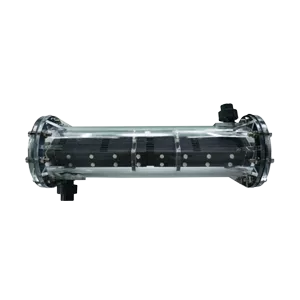
Technical Specifications (Overview)
| Engineering Parameter | Custom Machined & Welded Specifications |
|---|---|
| Manufacturing Process | CNC Machining & Manual Solvent Welding (Gluing) |
| Material Construction | Heavy-Wall Clear Acrylic (PMMA) Tube & UPVC Manifolds |
| Chlorine Output Capacity | 100g/h up to 3000g/h (3 kg/h) |
| Max Operating Pressure | 0.2 MPa (approx. 29 PSI) |
| Target Application | On-site Sodium Hypochlorite Generation, Chlor-Alkali |
| Interface Customization | ANSI Flanges, Metric Slip, NPT Threads, Custom Ports |
Fabrication Methodology: Machined & Solvent-Welded
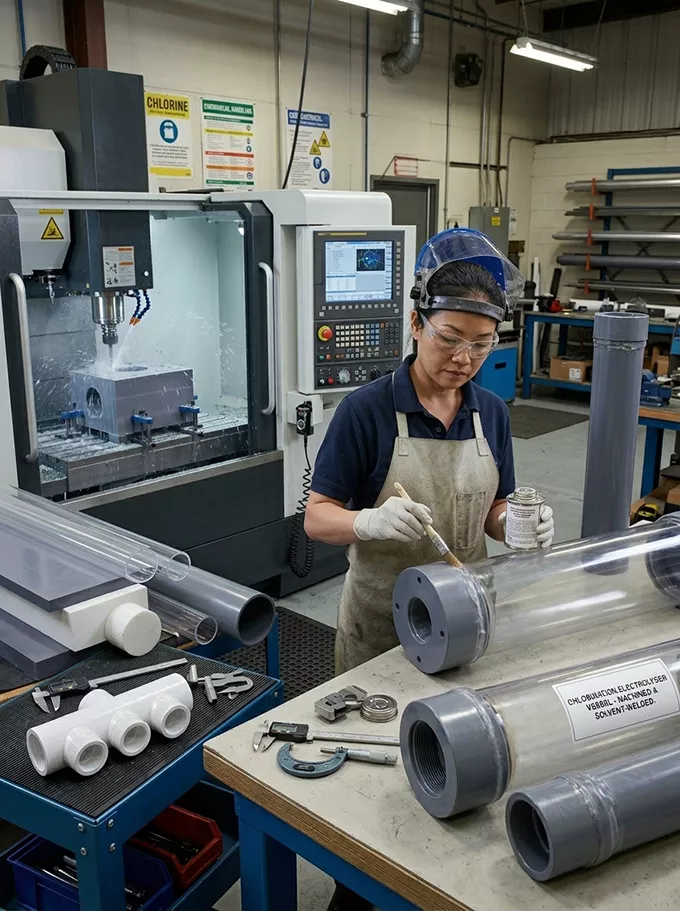
Unlike mass-produced injection molded parts, industrial chlorination demands scale and specific geometry. Our Machined Electrolyser Vessel production relies on raw extruded pipe and solid plastic billet, transforming them into precision engineering components.
- Precision CNC Machining: We start with thick-walled UPVC blocks and extruded Acrylic tubes. Our multi-axis CNC routers bore ports, face flanges, and thread connections with exact dimensional tolerances, ensuring a perfect fit for internal electrode supports.
- Industrial Solvent Welding (Gluing): The assembly of a tubular electrolyzer vessel requires highly skilled technicians. The machined UPVC end-caps and port manifolds are chemically fused (glued) to the main body. This manual, meticulous process ensures a leak-proof monolithic structure capable of handling harsh, highly concentrated caustic and chlorine gas environments.
Material Selection: Acrylic and UPVC
Visibility and chemical resistance are the two non-negotiable requirements for a chlor-alkali electrolyzer housing.
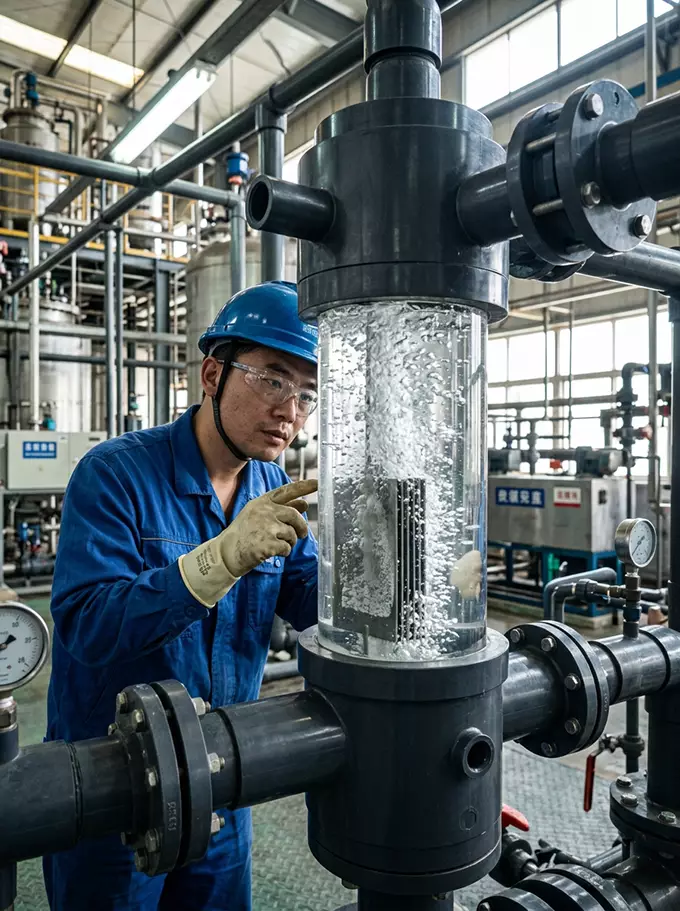
- Clear Acrylic (PMMA) Main Tubes: For the main reaction chamber, we utilize heavy-wall transparent acrylic. This provides engineers and plant operators with crucial visual access to monitor brine flow, hydrogen gas dispersion, and inspect for scale buildup on the titanium plates without shutting down the system.
- Machined UPVC Manifolds: For the end-caps, structural supports, and plumbing interfaces, we use industrial-grade UPVC. Known for its exceptional resistance to concentrated sodium hypochlorite and sodium hydroxide, UPVC ensures the structural integrity of the vessel’s connection points.
Operating Parameters & Engineering Traits
Because these are custom-fabricated units built via bonding rather than a single molded piece, they exhibit specific operational characteristics tailored for on-site generation:
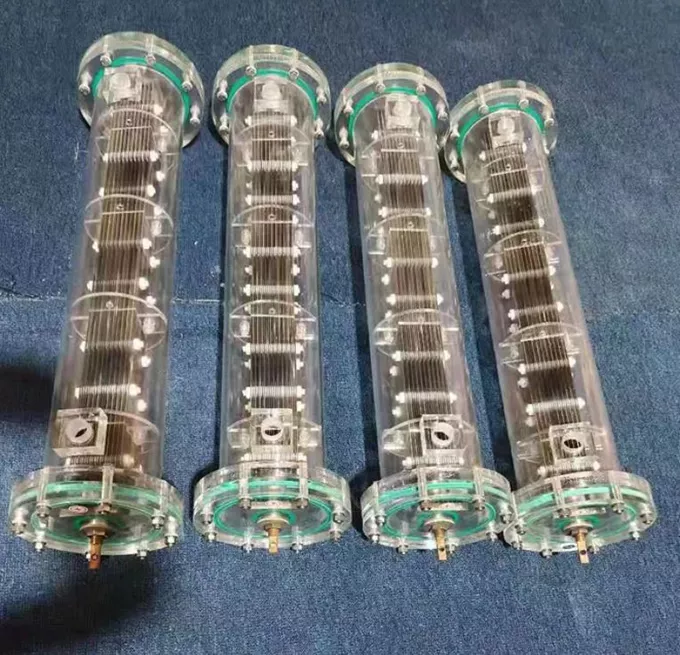
- Massive Output Capacity: These vessels are designed to scale. We fabricate chambers capable of housing massive electrode assemblies that produce anywhere from 100g/h up to an incredible 3000g/h (3kg/h) of active chlorine.
- Low-Pressure Rating (0.2 MPa): Industrial brine systems typically operate in open-loop or gravity-fed configurations rather than highly pressurized forced-flow lines. Our glued Acrylic Electrolyser Vessel designs are structurally rated for a maximum operating pressure of 0.2 MPa (approx. 29 PSI), which perfectly aligns with standard on-site hypochlorite skid parameters.
- Versatile Interfacing: We machine the inlet and outlet ports to match your exact piping specifications—whether that requires ANSI standard bolted flanges, deep-socket true unions, or NPT threaded connections.
The Investment in Custom Fabrication
Procuring a custom Custom Electrolytic Chamber represents a higher initial component cost compared to standardized molded shells. This cost reflects the labor-intensive CNC machining, the premium cost of thick-walled acrylic extrusion, and the specialized manual solvent welding required for assembly.
However, this investment guarantees that your multi-million dollar water treatment skid functions flawlessly. An off-the-shelf workaround is a liability; a Century custom-machined vessel is a guarantee of system compatibility and long-term chemical resilience.
Due to the nature of solvent-welded acrylic and PVC construction, these industrial chambers are strictly engineered for low-pressure brine environments. The standard maximum continuous operating pressure rating is 0.2 MPa.
Yes. As a fully integrated manufacturer, Century can supply the empty housing based on your CAD drawings, or we can deliver a fully populated electrolyzer complete with our custom ruthenium/iridium coated titanium electrode stacks.
Absolutely. Because every manifold is CNC machined from solid UPVC billet, we can customize the orientation, size, and type of fluid and gas venting ports to integrate seamlessly into your existing system layout.
Related Products
Contact our engineering team today to discuss your industrial water treatment needs and receive a detailed quote.