
System Optimization: Matching Electrochlorination Power Supplies to Custom MMO Titanium Anodes
The long-term operational stability of any salt water chlorination system hinges entirely on the precise calibration between the rectification equipment and the custom MMO titanium anode. The electrical output profile, load capacity, and environmental operating conditions of these two components are inextricably linked. Arbitrary pairing frequently results in erratic free chlorine output, premature electrode degradation, and recurrent systemic failures. Rooted in electrochemical principles, this guide outlines the critical matching criteria—spanning current parameters, power delivery modes, and dynamic load adaptations—empowering water treatment integrators to optimize equipment configurations for diverse field applications.
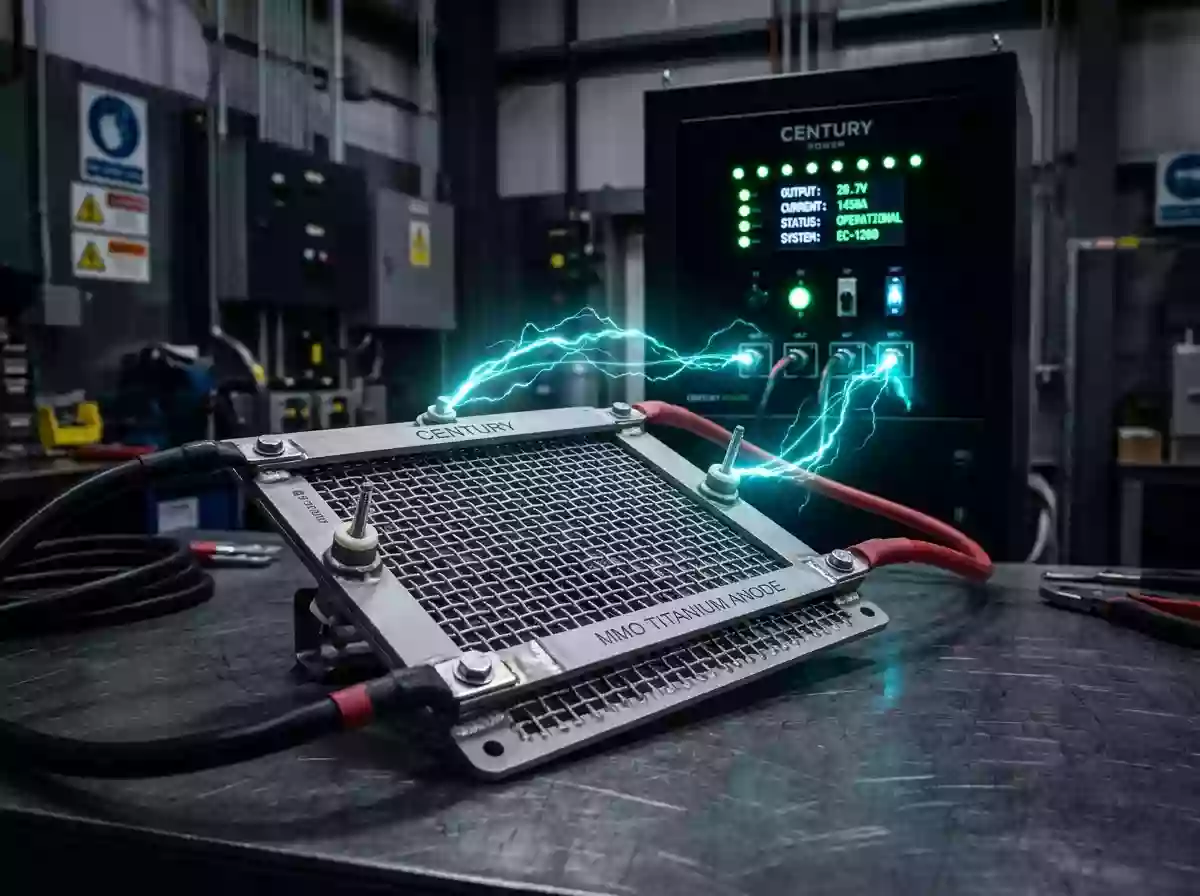
The Electrochemical Synergy: Why Power Supply Specifications Dictate Anode Lifespan
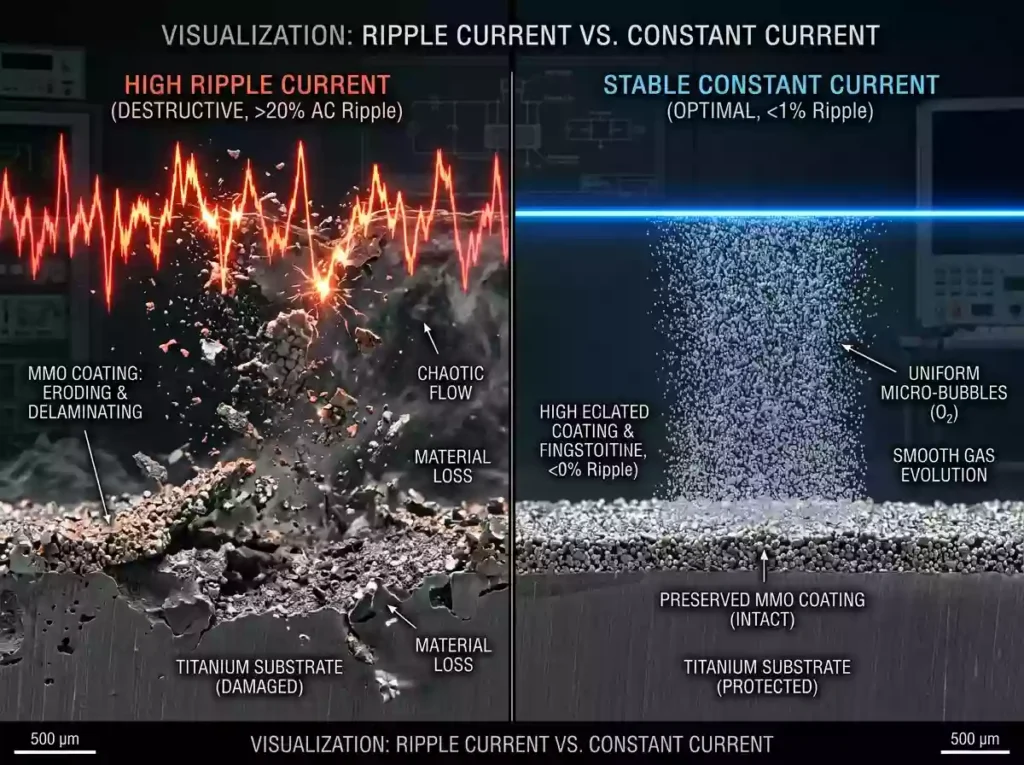
Within a saltwater electrolysis matrix, the rectifier and the titanium anode are not isolated replacement parts; they form a tightly coupled electrochemical synergy where the operational state of one dictates the survival of the other. Procurement teams frequently invest heavily in premium custom MMO titanium anodes, only to drive them with low-tier power units exhibiting poor output quality. These substandard rectifiers are plagued by high current ripple, erratic voltage transients, and frequent inrush surges that continuously bombard the active anode coating. Under these harsh electrical conditions, the precious metal catalytic layer experiences rapid delamination, proving that the output integrity of the electrochlorination power supply is the absolute determinant of the titanium anode’s actual consumption rate and structural lifespan.
Understanding Current Density Limitations in Custom MMO Titanium Anodes
Anode current density, measured in Amps per square meter (A/m²), defines the electrical load applied across the active surface area and serves as the ultimate threshold metric for any MMO coating. Different Ruthenium-Iridium formulations possess strict, engineered safe-operating windows; exceeding these limits catastrophically accelerates catalytic wear. Consequently, the maximum output current of the power unit must be mathematically locked to the actual conductive surface area of the tailored anode. If a power system possesses excessive wattage headroom without strict constant-current clamping, a sudden spike in water salinity will drop the circuit resistance. The resulting instantaneous current surge will violently overload the active layer, triggering irreversible electrochemical passivation and entirely destroying the electrode’s ability to generate chlorine.
Selecting the Right Electrolysis Rectifier: Voltage, Ripple, and Constant Current
Electrochlorination circuits strictly require a Constant Current (CC) driving mode. Locking the amperage output is the only mechanism that guarantees a stable, predictable electrochemical reaction rate, which is the prerequisite for maintaining uniform free available chlorine (FAC) concentrations in the water. Furthermore, the ripple coefficient is a critical specification. When ripple exceeds the 5% threshold, the highly fluctuating current shatters the electrolytic equilibrium, aggressively triggering parasitic reactions such as the Oxygen Evolution Reaction (OER). The corrosive byproducts generated during OER relentlessly attack the noble metal coating and subsequently compromise the underlying titanium substrate. Specifying a premium, high-frequency electrolysis rectifier suppresses this ripple to negligible levels, stabilizing the reaction matrix and providing comprehensive structural protection for the electrode.
Engineering for Scale: From Replacement Salt Cells to Municipal Water Treatment
In the residential and commercial aquatics sector, standardized replacement salt cells are ubiquitous. However, even during routine cell replacement, the hardware must perfectly align with the voltage parameters of the existing control unit. Specification mismatches immediately lead to component-destroying power overloads or severely deficient chlorine yields. Scaling up to municipal water networks and heavy industrial treatment facilities demands a drastically elevated engineering standard. These intensive applications typically deploy modular anode bank configurations driven by high-capacity, high-frequency industrial rectifiers equipped with Modbus communication protocols. This integrated, system-level design ensures the durability required for high-volume, 24/7 continuous chlorination environments.
Custom Power Supply Branding and Integrated Electrochemical Solutions
Deploying commercial chlorination equipment extends far beyond simply bolting hardware together; it requires the construction of a cohesive engineering architecture built on rigorous electrochemical theory. Century does not merely supply isolated titanium plates and standalone rectifiers; we deliver comprehensive, integrated system design services. For OEM/ODM white-label partnerships seeking to build proprietary product lines, we offer deep electrical matching and custom power supply branding services. Every solution we deliver is empirically validated across three critical vectors: thermal dissipation, electrical output stability, and electrochemical reaction efficiency. This integrated approach equips our clients to deploy ultra-reliable complete systems, maximizing their competitive edge and brand equity in both local and global markets.