
Maximizing Electrochlorination Cell Efficiency: How Voltage Drop Affects Chlorine Production
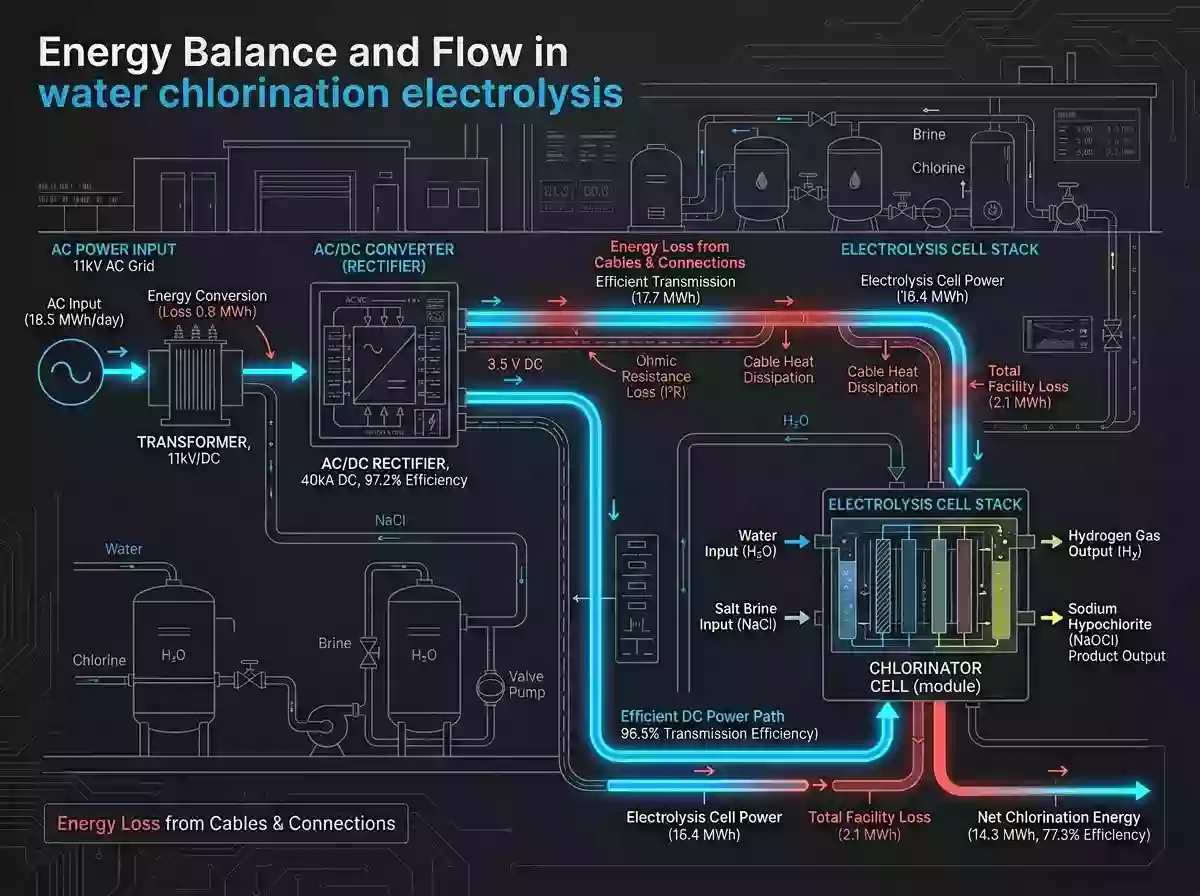
High operational energy consumption remains a persistent pain point across industrial chlorination projects, where real-time electrochlorination cell efficiency is directly penalized by improper voltage-to-current alignment. Throughout the power delivery loop, non-electrolytic components—including transmission cabling, copper busbars, and termination blocks—introduce parasitic resistance, causing systemic voltage drop. This electrical loss does not merely manifest as wasted utility power; it fundamentally destabilizes the internal electrochemical equilibrium of the cells, degrades reaction kinetics, and significantly increases the kilowatt-hour consumption per kilogram of chlorine generated (kWh/kg Cl2), driving up the overarching operational expenditures (OPEX) of water treatment assets.
The Physics of Resistance: Identifying the Causes of Voltage Drop in Electrolysis
The manifestation of voltage drop in electrolysis is mathematically bound to localized impedance bottlenecks within the primary conduction circuit. When a significant physical distance separates the primary distribution switchgear from the electrolysis cells, or when undersized, lower-gauge cabling is selected to save on initial capital costs, the inherent linear resistance of the conductor continuously drains the driving potential during high-amperage transfer.
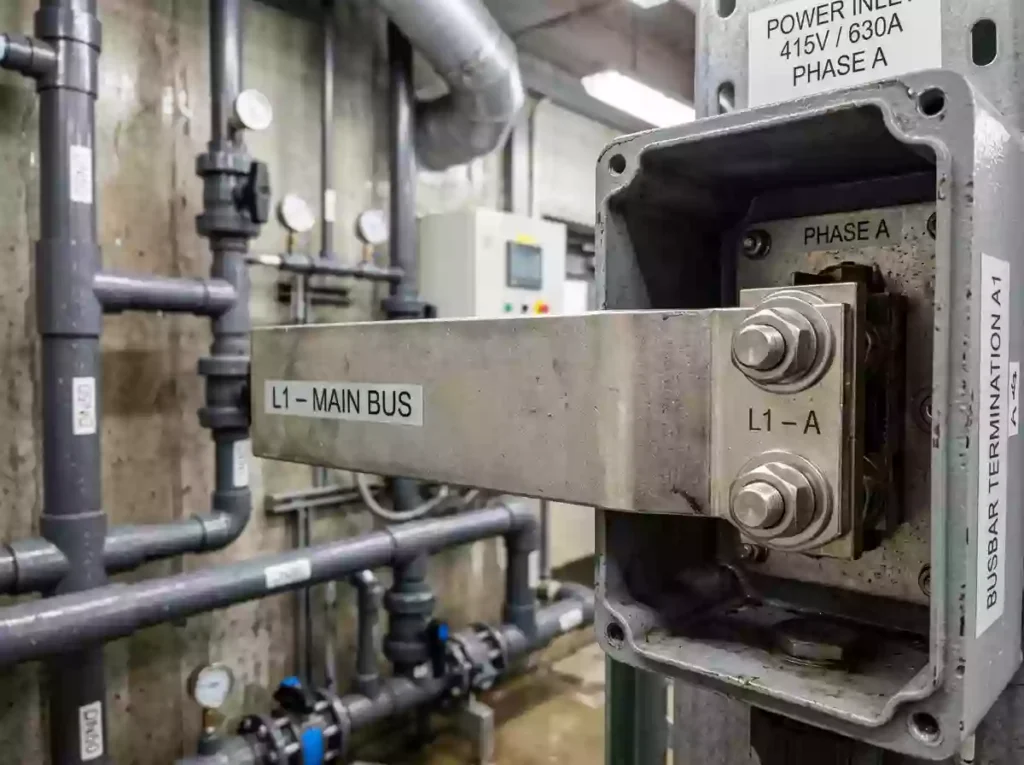
In humid, coastal, or enclosed pump rooms containing trace ambient chlorine gas, copper-to-aluminum junctions and termination points suffer rapid galvanic corrosion and localized passivation. This surface degradation causes contact resistance to climb exponentially, forming a major source of erratic loop voltage drop.
Beyond external distribution networks, internal reactor configurations present built-in fluid and electrical resistances. Improper inter-electrode spacing or non-uniform fluid velocity profiles skew the electrolyte’s localized conductivity, inflating the total loop impedance and consuming vital voltage required for the catalytic reaction.
Quantifying the Loss: Energy Consumption vs. Chlorine Production Calculation
Modern water treatment lines predominantly utilize Constant Current (CC) driving topologies to fulfill the mass-transfer mandates of Faraday’s Law and secure a steady chlorine production calculation. To preserve the target amperage across a degraded line, the rectification system must automatically step up its total output voltage to neutralize the line losses.
The comprehensive power consumption of the active system follows the standard electrical formula:
P=I×(Vcell+Vdrop)
Where Vcell represents the actual, useful voltage driving the electrochemical conversion, and Vdrop encompasses the cumulative losses from cabling and oxidized contact surfaces. Even if the nominal voltage required to synthesize active free chlorine remains stable, any inflation in the Vdrop coefficient forces a linear surge in total system power consumption P.
From an operational cost perspective, industrial electrolyzers manipulate immense running currents. A seemingly negligible 0.5V of unintended voltage drop translates into massive blocks of wasted power over thousands of hours of continuous operation. This parasitic load contributes absolutely zero yield to the active electrolysis reaction; it is completely dissipated as heat, inflating the long-term utility overhead of the plant and directly compressing the operator’s profitability margins.
Disrupting Equilibrium: How Distorted Amperage Alters Electrochlorination Cell Efficiency
When multiple electrolysis arrays are arranged in parallel configurations off a centralized power grid, localized discrepancies in contact resistance and cable lengths alter the driving voltage delivered to each individual cell block. This variance triggers a severe current crowding effect across the cluster.
Electrolysis cells receiving a choked voltage supply fail to meet their engineered reaction velocity, resulting in a deficient yield of active sodium hypochlorite that falls short of safety sanitization thresholds.
To offset this volumetric deficit, plant operators are forced to increase the global output profile of the power system. This action drives the cells connected to lower-resistance lines into severe overcurrent states, forcing them to absorb amperages far beyond their engineered boundaries. This operational imbalance causes a catastrophic drop in global electrochlorination cell efficiency. Over extended periods, these localized overcurrent conditions accelerate titanium anode degradation, drastically shortening the asset life cycle of the electrode arrays.
The Hidden Toll: Accelerating Titanium Anode Degradation Through Electrical Stress
Sustained loop voltage drops force the upstream rectifiers to operate at their absolute voltage limits to maintain current stability. This continuous maximum-load state severely stresses the power electronics, resulting in an inflated output ripple factor and a high concentration of high-frequency harmonic distortion.
When this dirty, unstable DC waveform is delivered to the catalytic surfaces, it shatters the optimal electrocatalytic potential window, severely accelerating the parasitic Oxygen Evolution Reaction (OER). The resulting aggressive micro-environment and hydroxyl radicals fiercely attack the mixed metal oxide (MMO) matrix layered onto the mmo titanium anode. This corrosive stress induces rapid coating passivation, macro-cracking, and physical delamination of the noble metal oxides.
Even when sourcing premium-grade titanium substrates, inadequate layout designs and poor voltage drop management subject the electrodes to brutal electrical stresses. This mismatch forces premature passivation long before the engineered service life is reached, escalating emergency equipment replacements and field maintenance liabilities.
Engineering Blueprints: Mitigating System Volatilities in Commercial Water Treatment
Mitigating voltage drop demands strict adherence to heavy-duty industrial hardware installation standards. Layout designs must minimize the physical distance of high-amperage runs, substituting standard cabling with heavy, nickel-plated copper busbars for primary distribution. These conductors must be sealed within multi-layered, anti-corrosive insulation sleeves to block moisture and chlorine gas ingress, permanently halting contact oxidation.
Century eliminates these systemic vulnerabilities through integrated, system-level design methodologies, moving beyond the simple supply of unlinked components. In the pre-engineering phase, Century executes comprehensive simulations mapping cable impedance, termination tension metrics, and the active voltage compensation capabilities of the industrial electrolysis power supply. By optimizing loop resistance before hardware deployment, actual field voltage drop is locked to a compliant, ultra-low minimum, securing long-term, high-efficiency, low-consumption operations for industrial scale and municipal infrastructure alike.