
Thermal Management in Industrial Electrolysis Power Supplies: Optimizing Electrochlorination Rectifier Reliability
Industrial electrolysis rectifiers continuously generate significant thermal energy during AC-to-DC conversion and power regulation, a phenomenon heavily magnified under high-current electrochlorination loads. Failure to dissipate this heat efficiently accelerates the degradation of internal power semiconductors, capacitors, and printed circuit boards (PCBs), drastically truncating equipment lifespans and inducing output voltage instabilities or systemic failures. This analysis breaks down the root causes of thermal loads in electrolysis systems, evaluates practical cooling designs, and details environmental mitigation strategies to secure long-term operational uptime for electrochlorination rectifier units.
The Thermodynamic Challenge: Why Electrolysis Power Supply Units Generate Intense Heat
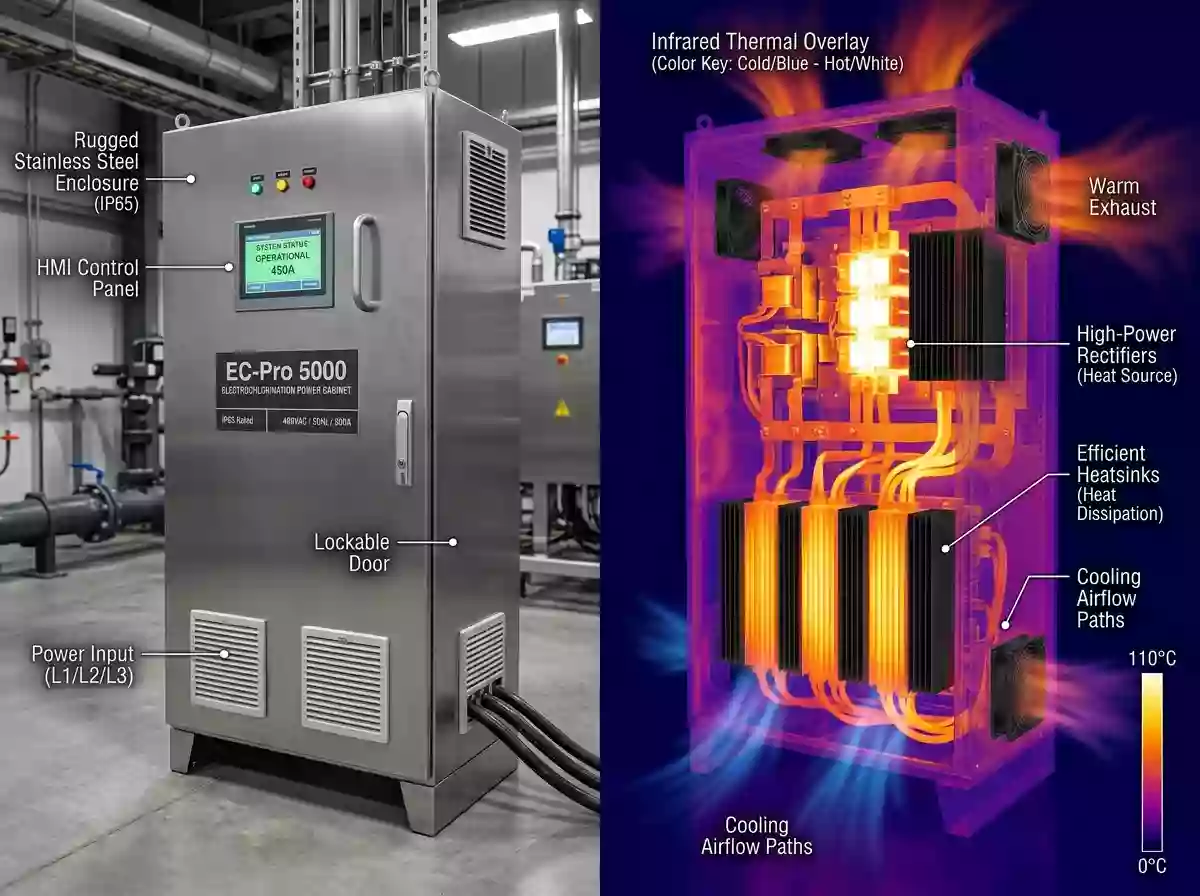
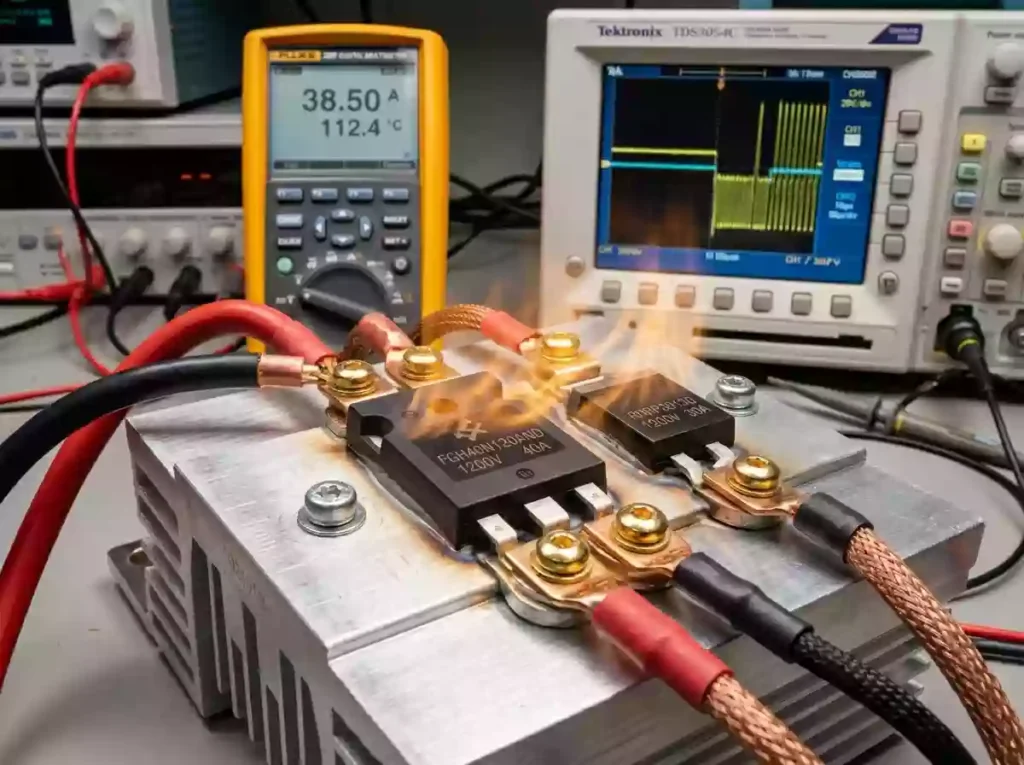
Rectifiers configured for salt cell electrolysis must transform high-voltage grid AC into high-amperage, low-voltage DC to match the precise operational demands of the salt cell. This continuous heavy power conversion is the primary source of thermal accumulation within the system. Internal power components, specifically diodes and IGBTs, exhibit an inherent forward voltage drop during conduction. When a massive continuous current passes through these semiconductor junctions, it generates substantial ohmic losses, leading to a relentless release of thermal energy.
Commercial aquatic centers and municipal water purification facilities typically run these systems on 24/7 continuous full-load duty cycles, keeping thermal generation rates high. If the internal cooling paths are restricted or poorly managed, this trapped heat drives up the semiconductor junction temperature ($T_j$) of the power chips. Prolonged exposure to these elevated thermal states degrades power regulation accuracy, lowers electrical conversion efficiency, and forces premature component failures. Therefore, robust thermal management in power supplies is a baseline engineering requirement for total system reliability.
Forced Air vs. Liquid Cooling: Selecting the Right Industrial Rectifier Cooling Architecture
Within the scope of industrial rectifier cooling, the choice between an air cooled rectifier vs water cooled system represents the two dominant structural cooling architectures in the water treatment market.
Forced air cooling relies on extruded aluminum heatsinks combined with high-velocity convection fans to drive thermal dissipation. This setup is highly valued for its mechanical simplicity, lower upfront capital costs, and ease of field maintenance—typically requiring only periodic dust clearing. However, forced air has strict thermal transfer ceilings and struggles to manage the concentrated heat fluxes of ultra-high-power systems.
Liquid cooling, by contrast, utilizes closed-loop fluid circuits mounted flush against the heat-generating power modules, transferring internal thermal loads directly to an external heat exchanger. Liquid cooling offers vastly superior heat transfer coefficients, allowing for higher power density and more compact cabinet footprints. Yet, it introduces higher system complexity, increased upfront costs, and operational risks such as fluid leaks or internal coolant clogging. For small-to-medium commercial salt water systems, optimized forced-air cooling safely handles long-term thermal loads. For high-capacity municipal sodium hypochlorite generators handling massive currents, liquid-cooled architectures have become the industry standard.
The Corrosive Interface: Protecting the Electrochlorination Rectifier from Chlorine Gas Ingress
Facility pump rooms and municipal chemical feeds are highly corrosive environments, saturated with acidic chlorine gas, high humidity, and airborne brine mist. These ambient factors are the primary silent killers of industrial electronics and explain why generic, off-the-shelf power units fail prematurely in water treatment applications.
Standard direct-suction air cooling poses a massive engineering vulnerability: the intake fans pull ambient, corrosive air directly across the PCB traces, component leads, and electrolytic capacitors, causing rapid oxidation, trace bridging, and catastrophic failures.
A practical and robust protection strategy requires placing the power conversion hardware in an independent, clean control zone physically isolated from the corrosive gas generation area. Furthermore, utilizing a segregated internal airflow design—where twin convection fans drive air through an isolated cooling tunnel across the heatsink—efficiently evacuates heat without exposing sensitive electronics to ambient air. This balances high thermal dissipation with uncompromising environmental defense.
Thermal Runaway Mechanisms: Mitigating Heat Dissipation Risks in Power Supplies
When a cooling architecture fails or becomes severely degraded by environmental debris, it triggers thermal runaway in electronics. Prolonged exposure to extreme operating temperatures accelerates the dry-out and evaporation of the liquid electrolyte within filtering capacitors. This degradation collapses their filtering capacity, causing the output ripple current to spike uncontrollably and severely degrading the quality of the DC power delivery.
This resulting electrical instability and high-frequency harmonic noise travel directly down the line to the connected salt cell. Erratic current distributions destabilize the electrocatalytic matrix, intensifying the parasitic oxygen evolution reaction (OER) and directly degrading the precious metal coating of the mmo titanium anode.
Consequently, a thermal management failure inside the power unit does not just destroy the rectifier components; it prematurely passivates the high-value titanium electrode assembly, escalating total asset replacement costs and shortening the operational window of the entire chlorination loop.
Procurement Strategy: Engineering Specifications to Demand from Your Rectifier Sourcing Partner
Evaluating an electrolysis power supply solely on upfront acquisition cost is a high-risk procurement strategy. Many low-cost units are rated based on 25°C laboratory conditions; once installed in a 45°C field equipment room, they suffer severe thermal de-rating or trigger frequent over-temperature protections (OTP), interrupting critical disinfection schedules.
Century ensures that all integrated electrochlorination solutions feature a minimum 30% thermal design margin, engineered to sustain continuous full-load operations in hot, real-world conditions. To combat corrosive degradation, all system electronics feature heavy, multi-layered conformal coatings to seal out salt spray and chlorine gas. Rather than viewing power components as isolated hardware, Century focuses on the precise thermal matching and electrochemical alignment between the electrical drive and the titanium anode grid, delivering highly reliable, long-life, integrated water treatment solutions.