
Constant Current vs. Constant Voltage for Electrochlorination: The B2B Guide to Stable Chlorine Output
While constant voltage configurations dominate generic electrical equipment grids, constant current topologies are fundamentally integrated across the industrial electrochemical chlorination sector. The volumetric output of electrolytic chlorine generation correlates directly with applied amperage; consequently, the choice of power delivery mode dictates free chlorine stability, electrode degradation rates, and overall system energy efficiency. This guide evaluates the operational trade-offs between constant voltage (CV) and constant current (CC) power supplies across commercial pools and municipal water works, offering data-driven procurement and sourcing blueprints for global system integrators.
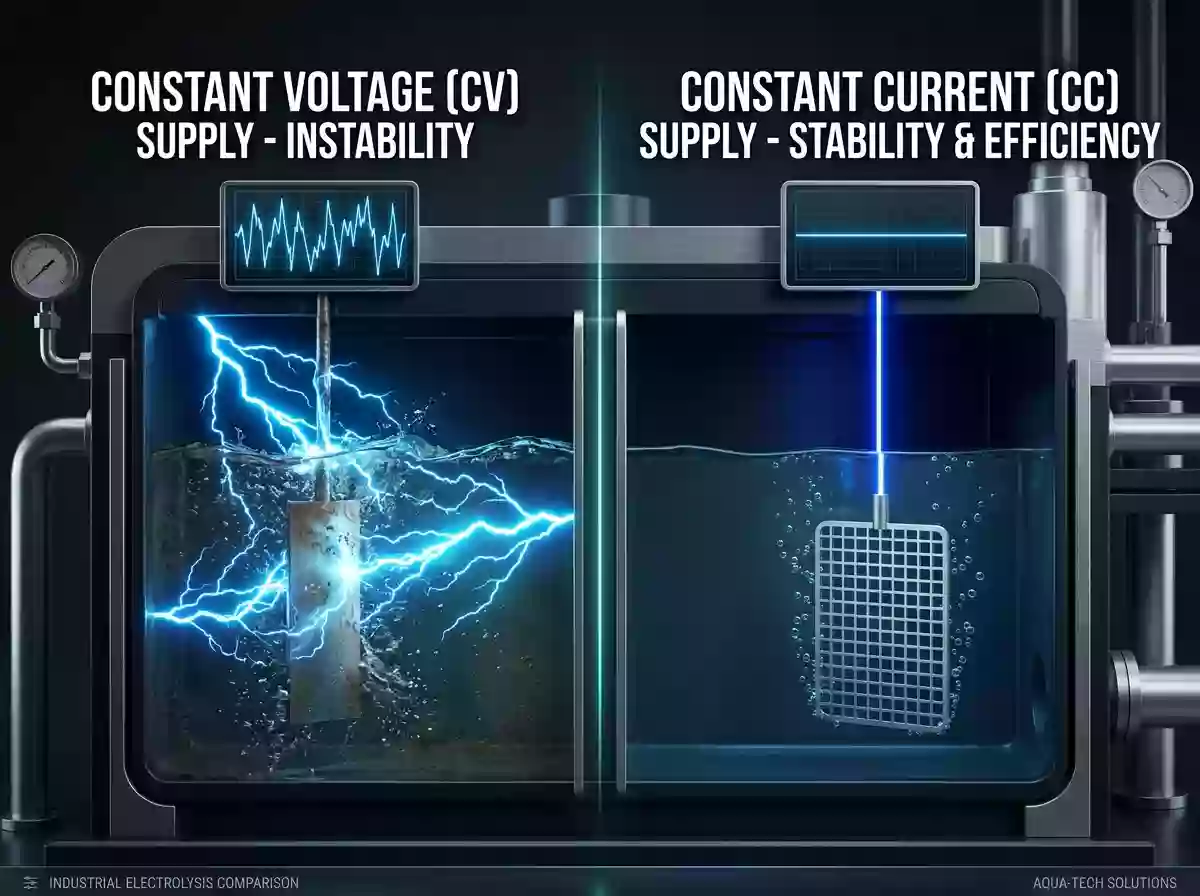
The Electrical Foundations: How Constant Current vs. Constant Voltage Topologies Operate
In electrochemical processing lines, the core divergence of constant current vs constant voltage architectures lies in how they handle shifting electrical resistance.
A constant voltage (CV) configuration anchors the output potential at a static volt parameter, forcing the driving amperage to fluctuate entirely based on the circuit’s total resistance, governed strictly by Ohm’s Law:
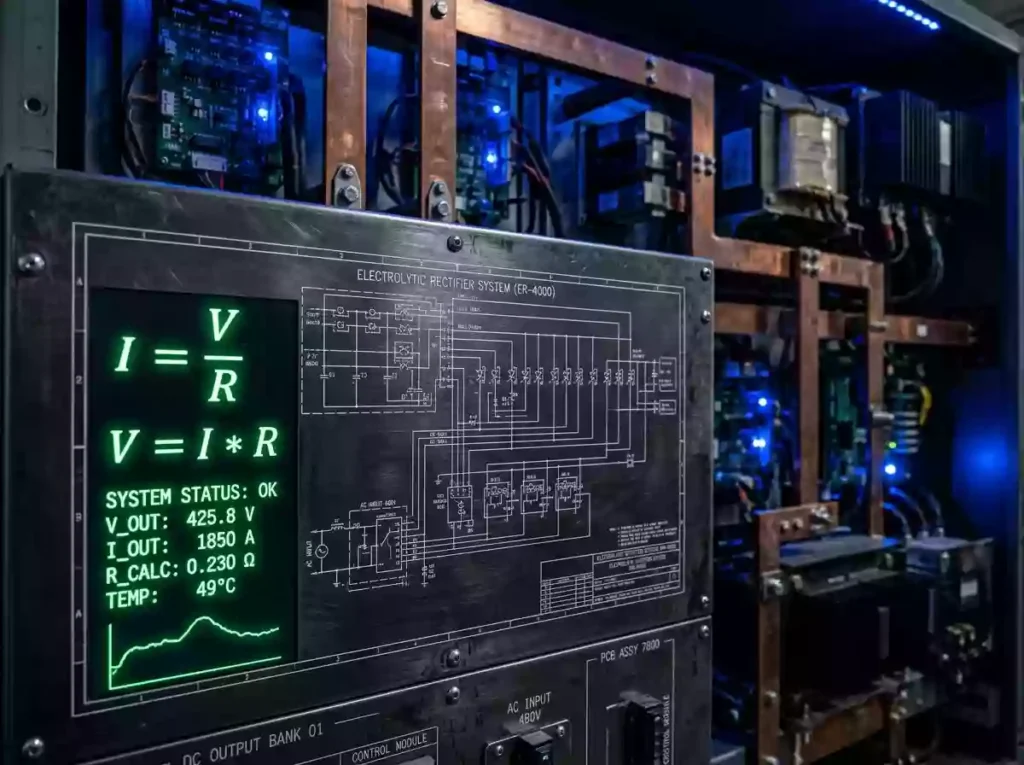
I=V/R
Within an active electrolysis cell, variable parameters like mineral scaling or fluctuating total dissolved solids (TDS) cause localized shifts in electrical resistance ($R$). Under a CV setup, even a minor drop in loop resistance triggers massive current spikes, destabilizing the electrochemical equilibrium.
Conversely, a constant current power supply locks the output amperage at a precise value. Following the inverse transposable Ohm’s Law:
V=I×R
The power supply dynamically recalibrates its output voltage to match the real-time shifts in internal cell resistance, ensuring a perfectly linear and unyielding current profile.
Because saltwater electrolysis represents a highly dynamic electrolyte matrix, variables such as temperature shifts, salt consumption, and electrode passivation continuously alter the total circuit impedance. The operational divergence between these two electrical topologies magnifies during continuous operation, directly impacting chlorination throughput, process repeatability, and the structural lifespan of the mmo titanium anode.
Faraday’s Law of Electrolysis: Why a Constant Current Power Supply Generates Predictable FAC
According to Faraday’s Law of Electrolysis, the mass of a substance altered at an electrode during a chemical reaction is directly proportional to the total electrical charge passed through the circuit. In electrochlorination, the generation rate of free available chlorine (FAC) is explicitly determined by the current ($I$) flowing through the cell, rendering the output voltage electrochemically irrelevant to the chemical yield. When the amperage remains locked, the real-time production rate of active sodium hypochlorite becomes fully predictable and mathematically fixed.
For commercial aquatics and municipal water disinfection plants, achieving a steady, verifiable chemical dosing rate is the baseline for environmental safety and regulatory compliance. Integrating an electrochlorination power supply executing true constant current regulation ensures that even when encountering low salt levels, localized plate scaling, or natural electrode aging, the system guarantees a uniform chlorination curve.
This steady output eliminates the hazards of chemical undersurfacing or dangerous chlorine spikes, ensuring steady pathogen inactivation while allowing plant operators to accurately schedule runtime blocks and manage chemical balances without constant manual recalibration.
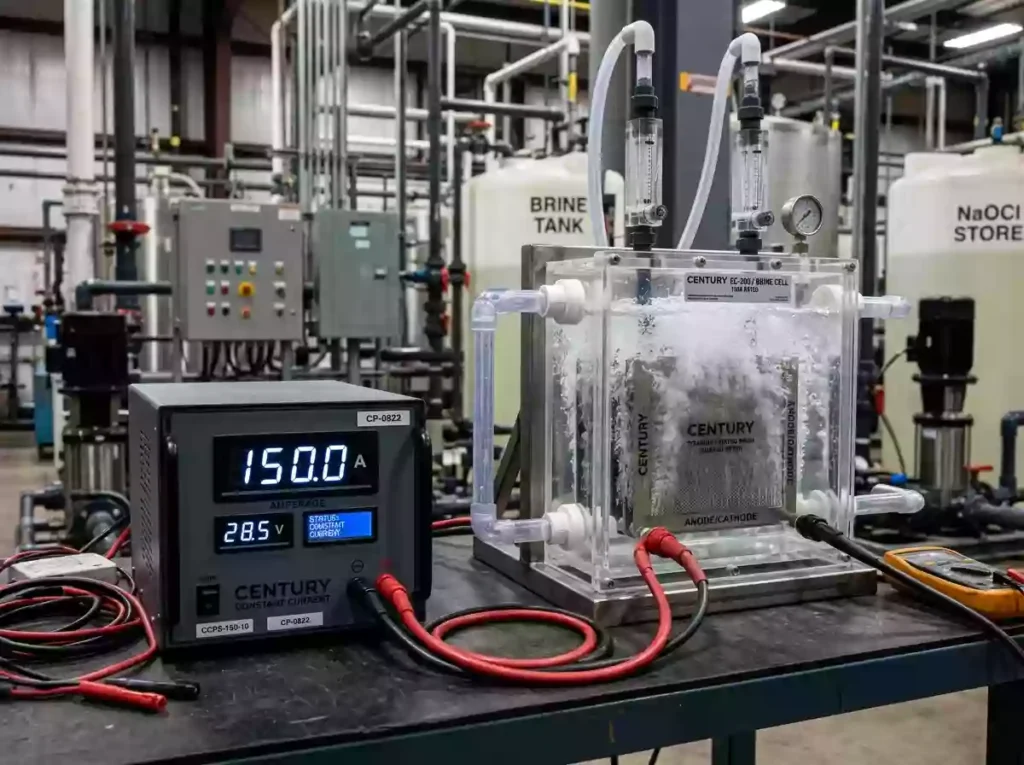
The Volatility of Water Chemistry: Driving Salt Water Chlorinator Troubleshooting
The internal electrical resistance of an electrolysis cell is in a state of constant flux, heavily driven by three critical water chemistry variables. First, lower electrolyte temperatures decrease ion mobility, raising fluid resistance, whereas warmer water minimizes resistance. Second, low salinity and compressed TDS levels starve the solution of charge-carrying ions, driving up circuit impedance. Third, calcium hardness precipitation and localized scale accumulation on the cathode surfaces physically choke the conductive pathways, forcing a drastic surge in loop resistance.
Conventional constant voltage configurations are fundamentally ill-equipped to handle these dynamic environment shifts, creating immense vulnerabilities during salt water chlorinator troubleshooting. In winter conditions, as water temperatures drop and resistance climbs, a CV supply suffers a catastrophic plunge in driving current, collapsing the FAC output below safe sanitization thresholds. In summer operations, elevated salinity drops the cell resistance, triggering immediate current overloading that can induce thermal runaway or overcurrent semiconductor failures. This electrical volatility is the root cause behind the high field-failure rates seen in low-end, non-regulated chlorination hardware.
Guarding the MMO Coating: Mitigating Anode Degradation via an Advanced Electrolysis Rectifier
The mixed metal oxide (MMO) coatings sintered onto custom Century titanium anodes are engineered for precise current density ceilings; exceeding these thresholds catastrophically accelerates catalytic wear.
Constant voltage rectifiers frequently expose the cell to unregulated current spikes. These temporary overcurrent surges violently accelerate the parasitic oxygen evolution reaction (OER) on the anode surface, creating a harsh micro-environment characterized by localized pH drops and aggressive oxygen free radicals. This corrosive environment strips away the active Ruthenium-Iridium matrix layer by layer, leading to premature electrode passivation and structural failure. An advanced industrial electrolysis rectifier running in constant current mode acts as an electrical firewall. If severe scaling pushes circuit resistance upward, the rectifier safely steps up the driving voltage to maintain the target amperage while ensuring the current density never breaks the safety envelope of the MMO coating. This strict current distribution uniformity shields the catalytic layers from overcurrent stress, maximizing the service life of the titanium substrate.
Engineering Sourcing Guidelines: Integrating the Correct Electrochlorination Power Supply
Procurement managers must align power topology selection with distinct operational scales and long-term financial targets. Low-capacity, cost-sensitive residential pool systems occasionally opt for traditional constant voltage configurations to lower initial CAPEX (Capital Expenditure), balancing the system through manual salt testing and frequent operator intervention.
For automated commercial aquatic facilities and large-scale municipal drinking water loops, a high-frequency switching power supply operating in dedicated constant current mode is mandatory to protect system uptime and lower long-term OPEX (Operational Expenditure).
However, constant voltage architectures are not entirely obsolete in industrial water treatment. When budget constraints dictate engineering choices and field repairs must remain highly simplified, a modern CV supply outfitted with integrated overcurrent trip circuits and paired with tightly controlled water chemistry parameters can still deliver acceptable, basic electrolysis performance.