
Linear vs. Switching Power Supplies for Electrolysis: The B2B Sourcing Guide to Electrochlorination Rectifiers
The rectifiers paired with salt cell electrolysis loops are broadly categorized into linear and switching topologies. These two configurations exhibit profound performance trade-offs regarding voltage regulation precision, output ripple, long-term stability, and operational power dissipation. Electrochlorination applications demand exceptionally stable current profiles; the magnitude of the electrical ripple directly dictates the interfacial electrochemical reaction state and the ultimate lifespan of the catalytic coating. This guide evaluates the core engineering advantages and drawbacks of both rectifier types within commercial swimming pools and municipal water treatment plants, steering global buyers toward the optimal salt cell power supply configuration.
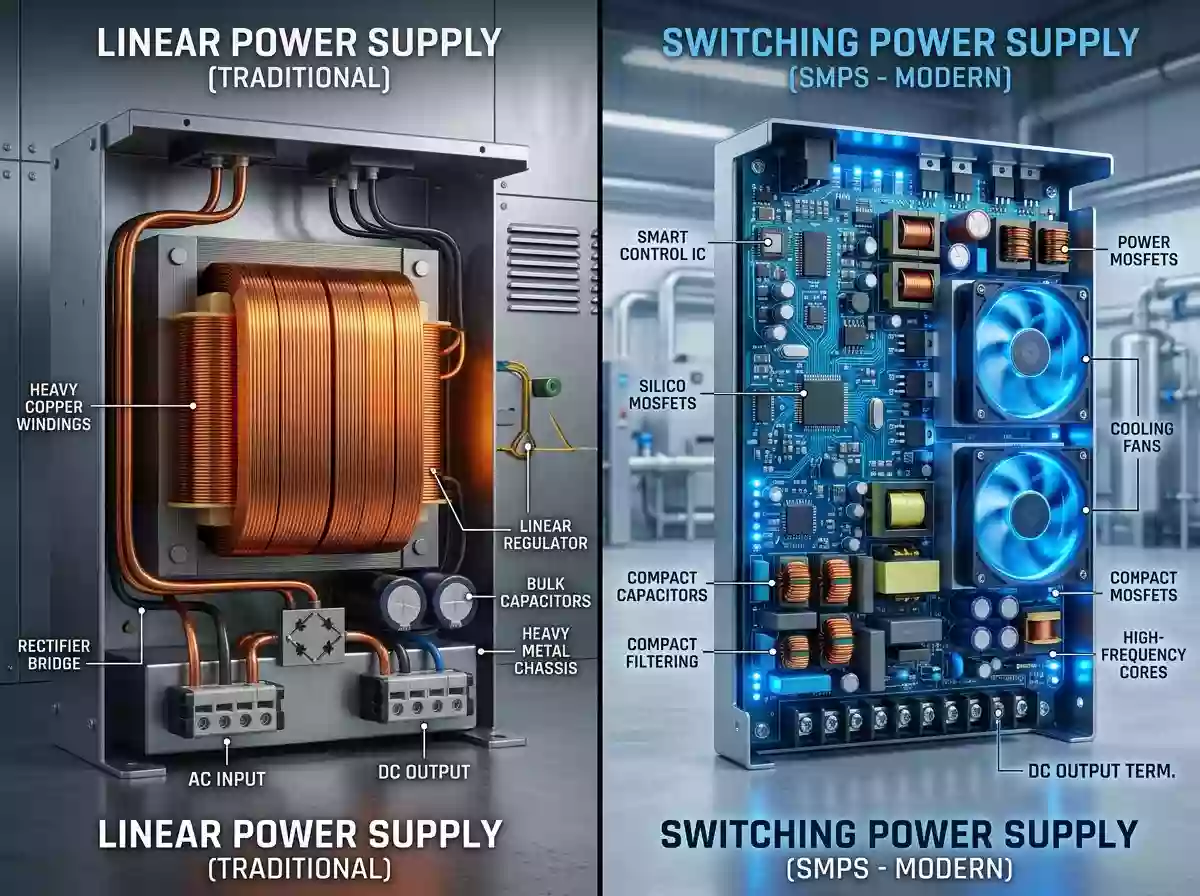
Electrical Architecture: How Linear and Switched Mode Power Supplies Work in Electrolysis
In heavy-duty electrochemical operations, the debate of linear vs switching power supply centers on completely polarized electrical topologies.
Linear power supplies rely on massive line-frequency (50/60 Hz) transformers to step down voltage, utilizing linear power transistors to regulate output. During operation, any excess voltage drops across the regulatory elements and is directly dissipated as wasted ohmic heat. While this passive regulation mechanism yields a highly linear, smooth output waveform with a resiliently simple circuit architecture, its thermal inefficiency is a major drawback.
Conversely, a switched-mode power supply (SMPS) rectifies the incoming AC line voltage directly into high-voltage DC. It then employs high-frequency switching semiconductors—such as MOSFETs or IGBTs—to chop the DC voltage at tens or hundreds of kilohertz before passing it through a compact high-frequency transformer for secondary rectification. By adjusting the high-frequency duty cycle to modulate output power, internal energy losses are kept to an absolute minimum.
Metaphorically, a linear architecture behaves like a heavy vehicle regulating its speed through continuous braking—smooth but highly inefficient. An SMPS acts like a modern rapid transit system utilizing high-frequency, precision velocity adjustments. This intrinsic difference in energy throughput directly dictates how each electrolysis power supply behaves under variable cell loads.
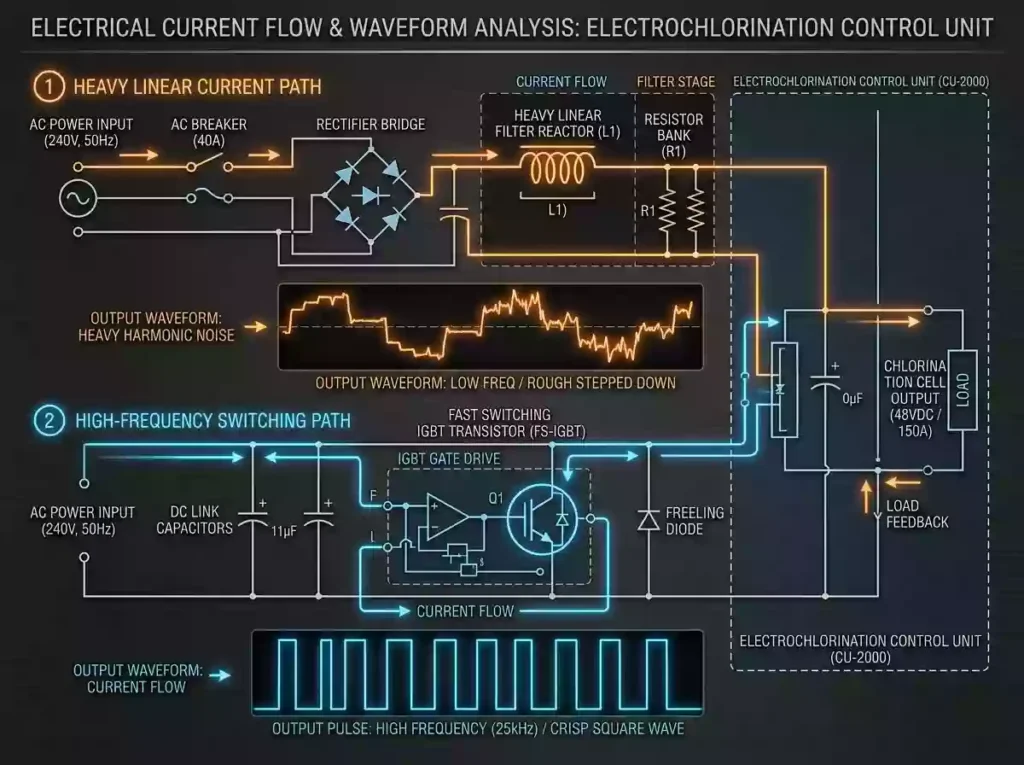
Efficiency Metrics: Evaluating Switched Mode Power Supply Advantages
From an operational expenditure (OPEX) perspective, the switched mode power supply advantages become overwhelmingly clear. Under high-current electrochlorination loads, conventional linear rectifiers struggle with efficiencies topping out between 40% and 60%, turning the majority of purchased electricity into problematic ambient heat. In contrast, industrial-grade switching supplies regularly break 85% to 95% efficiency barriers, drastically maximizing electrical energy conversion.
This efficiency variance of up to 30% becomes financially massive over time. Because municipal and industrial water treatment hardware typically runs on continuous 24/7 cycles, transitioning to switching rectifiers trims immense megawatt-hour figures from a facility’s annual utility bill. Furthermore, by eliminating bulky laminated iron cores and heavy copper wire spools, an SMPS boasts a fraction of the mass and volume—often 10% to 20% of an equivalent linear unit. This drastic leap in power density and footprint optimization simplifies logistics, field installation, and enables highly compact, integrated control enclosure layouts.
The MMO Longevity Factor: Ripple Current and Electrolysis Power Supply Selection
Output ripple current is a silent killer of Mixed Metal Oxide (MMO) anode coatings and serves as a prime metric during electrolysis power supply procurement. Linear units naturally output a pristine, low-ripple DC waveform, providing the steady, predictable current environment required for uniform electrocatalysis.
Standard, low-cost switching supplies operate via high-frequency chopping, which inherently introduces significant high-frequency electrical noise and current ripples. Without rigorous multi-stage LC filtering, these severe current ripples create localized micro-current surges across the titanium plate surface. This uneven loading accelerates the destructive oxygen evolution reaction (OER), micro-chemically attacking and undermining the precious Ruthenium-Iridium catalytic lattices. The result is rapid coating delamination and premature anode death.
Electrochemical systems mandate a perfectly balanced DC feed to sustain steady mass transfer. Today, premium industrial rectifiers for electrolysis implement heavy filtering stages to throttle current ripple to under 1%. This engineering feat preserves high-efficiency operation while supplying a smooth current profile that shields the MMO coating, safely balancing low operating costs with maximum anode wear life.
Thermal Management in Harsh Environments: The Hardcore Electrochlorination Rectifier
Commercial pool pump rooms and municipal chlorination blocks are inherently hostile settings, constantly subjected to high humidity, salt spray, and highly corrosive ambient chlorine gas. These environments place extreme demands on the sealing of any electrochlorination rectifier.
Linear architectures benefit from basic, rugged construction devoid of complex micro-electronics. Driven by industrial-grade transformers, they withstand massive incoming voltage surges and offer a naturally high immunity to atmospheric corrosion, leading to lower component-level field failures in unconditioned spaces.
Conversely, standard switching systems rely on intricate control microchips and temperature-sensitive electrolytic capacitors, making them vulnerable to chlorine gas ingress and localized heat traps. To make an SMPS highly resilient in these conditions, Century builds these units with high IP65/IP66 enclosure ratings, isolating the sensitive switching topology from the external corrosive atmosphere while optimizing localized heatsinks and thermal paths to ensure long-term, zero-fault operation.
Sourcing Strategy: Choosing the Right Industrial Rectifier for Electrolysis
Aligning the rectifier choice with specific B2B operational parameters ensures maximum return on investment. For low-capacity residential or simple light-commercial pool equipment where enclosure footprint and electrical efficiency are secondary to upfront capital expenditure (CAPEX), linear power supplies remain a viable choice due to their simple troubleshooting thresholds.
However, for intelligent commercial pool networks and large-scale municipal disinfection infrastructure, a modern SMPS is mandatory. These systems natively support industrial communication protocols like Modbus and RS485, allowing seamless SCADA integration. Crucially, they operate in precise constant current power supply modes, dynamically adjusting output voltages to offset fluctuations in water temperature and brine salinity, securing fully automated and energy-optimized water treatment workflows.