
Commercial vs. Residential Salt Cell Technologies: Engineering Specifications and TCO Analysis
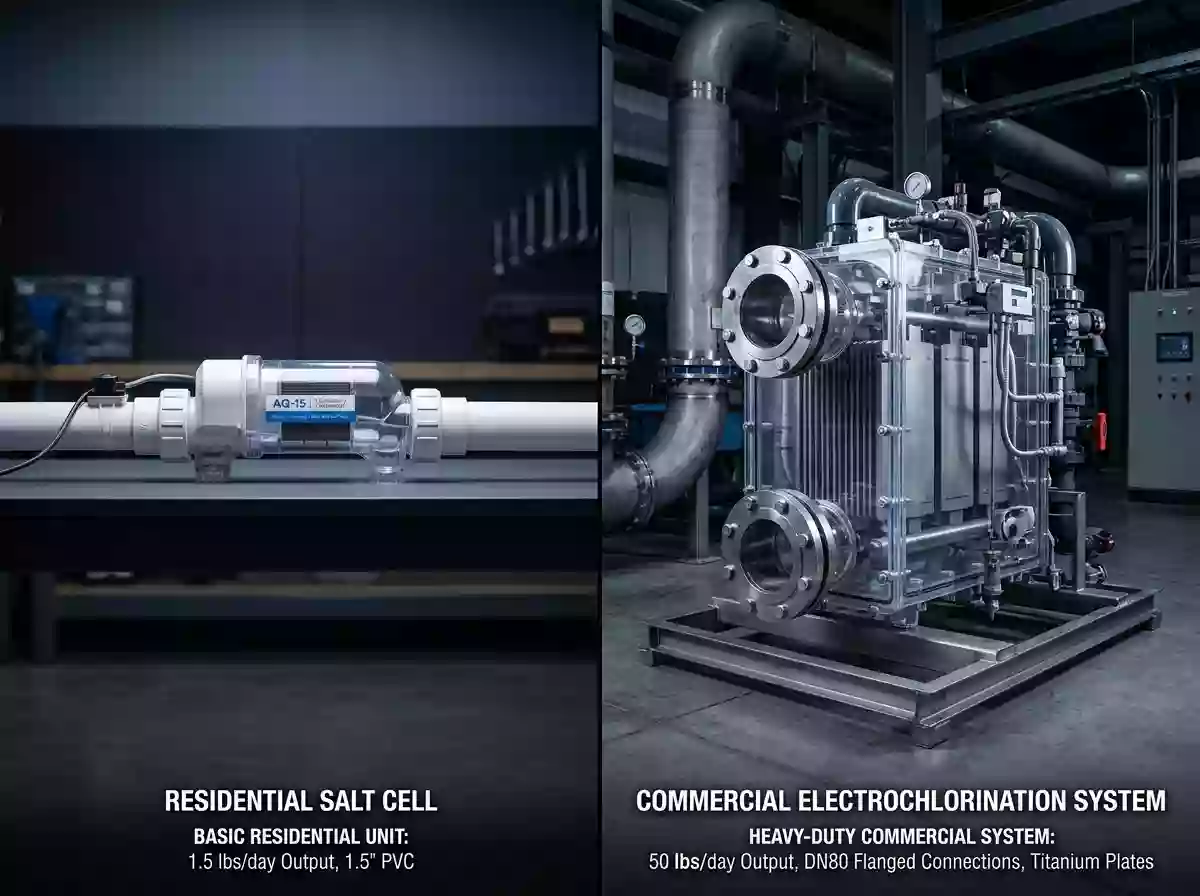
To reduce initial capital expenditure, many project managers attempt to build commercial water purification networks by manifolding multiple residential residential vs commercial salt cell comparisons. This is a classic engineering misconception. Although both commercial and residential units share the same electrolytic chlorine generation principles, their material construction, current-carrying capacities, and fatigue endurance are vastly different. This article evaluates these systems from the perspectives of core electrochemistry and coating durability, paired with a Total Cost of Ownership (TCO) analysis. By clearly delineating their intended application parameters, facility operators can avoid severe operational hazards, such as premature equipment failure and skyrocketing maintenance costs driven by improper specification.
Continuous Duty Cycles and MMO Anode Lifespan
Residential salt cells are exclusively engineered for intermittent duty cycles. Their design parameters assume daily operation of merely 4 to 8 hours, which is sufficient for the light disinfection requirements of low-traffic private pools. In contrast, commercial environments experience rapid chlorine depletion. A commercial pool chlorinator must reliably support 24/7 continuous, full-load operation to constantly offset the massive free chlorine consumption caused by intense UV exposure and heavy organic loads (such as bather sweat, urea, and cosmetics).
The fundamental divergence lies in the Mixed Metal Oxide (MMO) coating formulation and application process. Residential units utilize a thin Ruthenium-Iridium topcoat with low precious metal loading, yielding an expected mmo anode lifespan of only 5,000 to 8,000 hours. Conversely, commercial titanium anodes undergo a rigorous multi-layer, high-temperature sintering process. By optimizing the precious metal ratio and coating density, these commercial-grade plates can withstand sustained electrolytic stress, achieving a stable operational lifespan of 10,000 to 12,000 hours. This robust titanium anode coating drastically delays catalyst dissolution and delamination, significantly reducing replacement frequency.
Scaling Salt Cell Chlorine Output and Current Density Optimization
A standard residential unit generates a salt cell chlorine output of just 15 to 50 grams per hour (g/h), satisfying only small private installations. Commercial aquatic facilities demand massive disinfection volumes; a single industrial unit must output at least 200 g/h, with heavy-duty municipal applications requiring over 2,000 g/h.
Achieving this massive capacity is not accomplished by simply increasing the supply voltage—doing so immediately causes localized plate overheating and accelerates coating degradation. Instead, an authentic commercial electrochlorination system expands the effective reactive surface area of the titanium plates and tightly controls the inter-electrode gap to 3 to 4 millimeters. This geometry maintains the current density within an optimal window of 600 to 800 A/m². This structural precision evenly distributes the electrical load, minimizes the Specific Power Consumption (SPC) per kilogram of chlorine produced, and suppresses destructive oxygen evolution reactions (OER), thereby protecting the electrode coating during high-yield operations.
Advanced Reverse Polarity Logic and Scale Mitigation
During electrolysis, the pH level localized at the cathode boundary layer sharply increases. This environment triggers the precipitation of minerals like calcium carbonate, forming stubborn alkaline scale on the electrode surfaces and severely restricting electrolytic efficiency.
Residential equipment typically relies on standard mechanical relays for direct polarity switching. This abrupt, hard-switching action generates a violent current shock that physically damages the delicate MMO catalytic layer and accelerates electrode failure.
Premium commercial models, functioning as a true reverse polarity chlorinator, utilize sophisticated, logic-driven inversion controllers. These systems program a dedicated “dead-time” discharge sequence (typically 15 to 30 seconds). The controller smoothly drops the operational current to zero, waits for the internal acidic/alkaline boundary to neutralize and accumulated gas to dissipate, and only then slowly ramps up the reverse polarity. This flexible self-cleaning protocol highly efficiently strips scale while completely preventing capacitive electrical shocks, maximizing scale removal without compromising the structural integrity of the electrodes.
Capital Expense vs. Long-Term Chlorinator Replacement Cost
Many facility managers focus exclusively on initial procurement CAPEX, mistakenly believing that manifolding multiple residential cells will lower upfront financial barriers. This is a severely short-sighted financial strategy.
When residential units are forced into continuous, full-load commercial operation, the electrodes degrade aggressively. This results in unstable chlorine production and persistent system failures. Consequently, the OPEX associated with manual plate acid-washing, diagnostic labor, and soaring chlorinator replacement cost rapidly outpaces any initial savings.Furthermore, manifolding multiple small units creates uneven water flow and imbalanced current distribution across the array, amplifying operational risks. Analyzing the salt water pool system cost through the lens of a complete lifecycle reveals that specifying an integrated Century commercial system drastically reduces maintenance intervals and replacement overhead. By minimizing energy waste and revenue-losing facility downtime, the industrial approach delivers a far more stable and lucrative long-term Return on Investment (ROI).