
Expert Visual Guide: What Does a Dead Pool Salt Cell Look Like? (Identify MMO Failure)
Many pool salt cell “failures” are actually expensive misdiagnoses. Visual inspection is the standard first step in assessing equipment health, but surface illusions frequently mislead technicians, resulting in unnecessary pool salt cell replacement and wasted resources.
For professional service technicians, the core skill is distinguishing between “surface contamination” (scaling) and “core failure” (MMO coating depletion). Surface scaling is merely an external buildup; it’s a temporary issue that can be reversed with a proper acid wash without impacting the equipment’s core functionality. Conversely, the salt cell plate coating (the MMO layer) is the engine of electrolysis. Once this coating is depleted, the cell permanently loses its ability to generate chlorine. This is an irreversible, fundamental failure.
Visual Diagnostics: What Does a Dead Salt Cell Look Like?
Before you jump to conclusions and purchase a new unit, you need to know exactly what does a dead salt cell look like compared to one that just needs a routine acid wash. A truly depleted cell will show physical degradation on the titanium plates, such as exposed raw metal, noticeable pitting, or completely missing black MMO catalytic coating at the edges. In the comparison visual below, we illustrate the stark differences between easily removable calcium scaling and irreversible core coating failure.
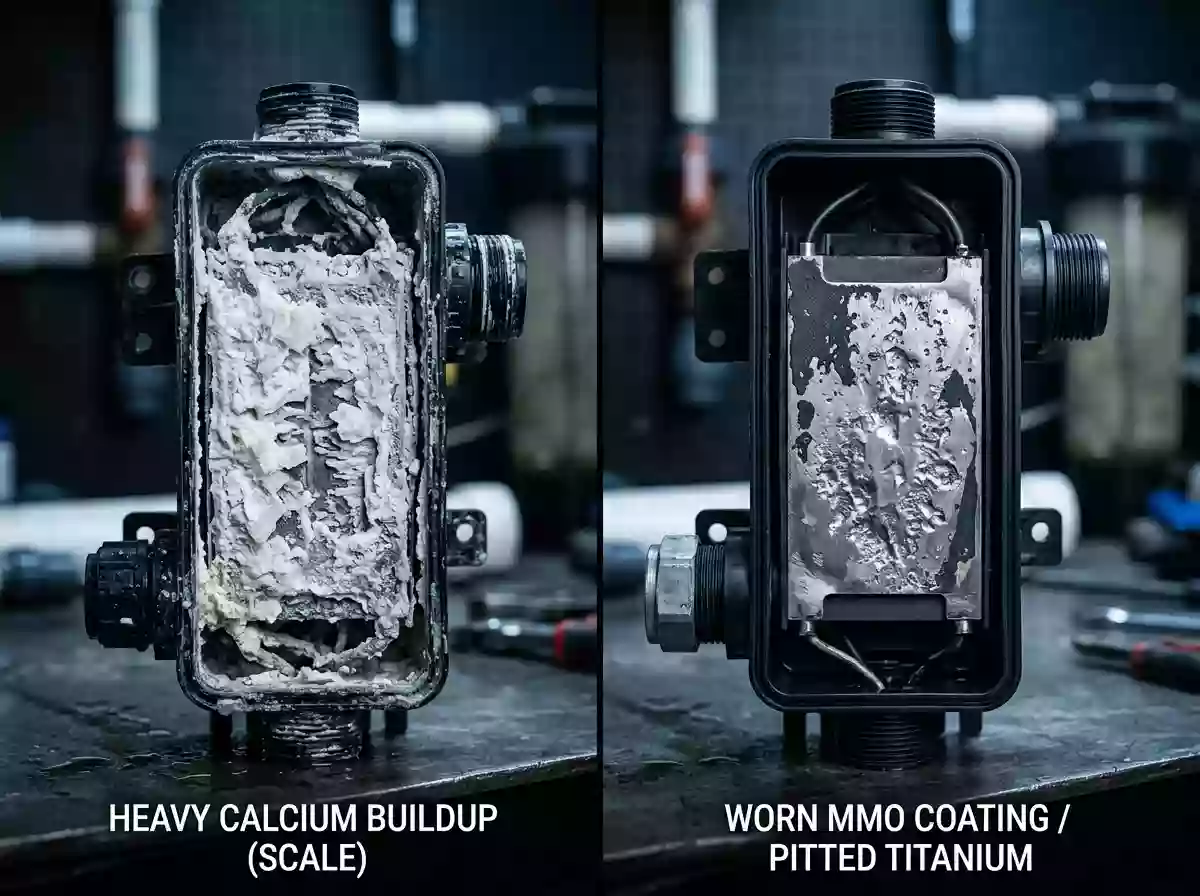
The Illusion of Failure: Calcium Scaling vs. True Coating Depletion
The most common trap in daily maintenance and troubleshooting is confusing white calcium scale with structural damage to the titanium plates. This mistake drives up replacement costs for no reason.
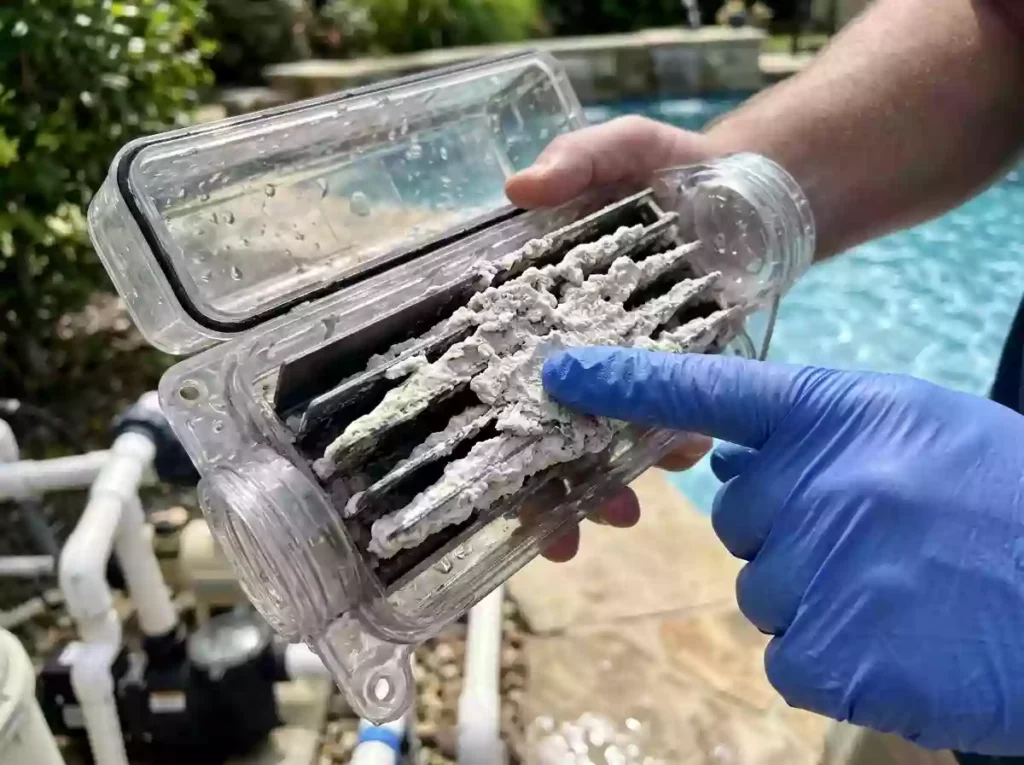
When comparing calcium scaling vs dead cell symptoms, scaling is obvious. It forms as a raised, chalky, hard white deposit where calcium and magnesium ions precipitate out of the water onto the electrode surface. It feels rough to the touch. However, this scale only attaches to the surface; it does not damage the underlying titanium plates or ruin their core function.
Its primary negative effect is restricting water flow and physically blocking the electrolytic reaction. This does not mean the cell is dead. You do not need a new cell. A standard procedure of acid washing a salt cell will completely dissolve the scale and restore normal operation. True cell failure is the exhaustion of the functional coating, not the presence of removable surface calcium. The two are fundamentally different and must not be confused.
Visual Sign 1: The Fading of the MMO Coating (The Exposed Substrate)
Under normal operating conditions—either when the cell is new or after a thorough cleaning—a healthy ruthenium-iridium MMO coating presents a matte, dark black, deep blue, or dark brown finish. The color is uniform and dense. This is what a fully functional, catalytically active layer looks like.
When a salt cell reaches the end of its pool chlorinator cell lifespan, a distinct visual failure pattern emerges. You will notice the dark MMO coating fading away, usually starting at the plate edges, corners, or the direct center. This exposes the raw, underlying salt cell titanium plates. Grade 1 Titanium has a bright, clean, silver-white metallic shine. Once exposed to current without its protective coating, this raw titanium corrodes, forming white pitted craters that create a stark visual contrast against any remaining dark coating.
If your flashlight reveals large, continuous patches of shiny silver or shallow white pitting, the diagnosis is final: the precious metal catalytic coating is exhausted. The cell has lost its electrochemical activity. This is irreversible chemical wear. No amount of acid washing or system recalibration will fix it; the cell is dead and must be replaced immediately.
Visual Sign 2: Plate Warping and Structural Deformation
Healthy titanium anode plates are perfectly parallel with uniform spacing. There should be zero bending or shifting. This precise geometry is the foundation of stable electrolysis. If you look inside the housing and see warped, twisted plates, or notice adjacent plates touching each other, you are looking at a critical structural failure.
This deformation is not normal wear and tear. It typically stems from three specific issues:
- Poor Equipment Design: The manufacturer used inadequate support structures or excessively thin titanium.
- Spacer Degradation: Over time, the internal plastic spacers that maintain the gap between plates become brittle, snap, and lose their holding power.
- Short-Circuiting & Heat: If plates touch and short-circuit, the localized extreme heat can literally boil the water inside the housing, causing severe physical warping and scorching of the surrounding coating.
Structural deformation is irreversible. Even if the MMO coating still looks dark and active, you must inspect and replace the broken spacers to restore proper gaps. If a short circuit caused the warping, accompanied by scorch marks and fused plates, the damage is catastrophic. You must replace the cell immediately; running a shorted cell will continuously trigger system faults and eventually fry the main control board.
The Blind Spot: Why Visual Inspection Must Pair with Electrical Testing
While looking directly at the plates is a necessary first step, it has significant blind spots. Signs of a bad salt cell aren’t always visible. Sometimes a coating looks intact but has “passivated” (lost its catalytic ability). Relying solely on your eyes is not a safe diagnostic protocol.
Professional evaluation requires a dual approach. Visual inspection must always be paired with our core diagnostic protocols:
- Professional Guide: How to Test a Salt Cell with a Multimeter for Accurate Diagnostics
- The “Bucket Smell Test”: Quick Diagnostics for Technicians
Only when visual evidence (like bare titanium) aligns with objective data (like high voltage/low amperage drops) and physical results (lack of chlorine odor in a bucket test) can you definitively confirm a dead cell. This prevents costly misdiagnoses and ensures professional accuracy.
The Century Standard: Built to Resist Premature Coating Wear
As a specialized B2B manufacturer, Century’s competitive edge lies in strict quality control and a relentless focus on titanium anode durability.
We utilize a proprietary multi-pass brushing and high-temperature thermal decomposition process. This ensures our MMO coatings are exceptionally uniform with superior substrate adhesion, effectively delaying the fading and substrate exposure that kills lesser cells. Furthermore, we can customize coating thickness based on your specific operational lifespan requirements, stopping premature “coating depletion” at the source.
We encourage distributors and service companies to upgrade to Century’s high-standard replacement cells. Providing your clients with superior durability not only enhances their pool experience but significantly reduces your warranty callbacks—a true win-win for B2B operators.