
Professional Guide: How to Test a Salt Cell with a Multimeter for Accurate Diagnostics
Diagnosing a “Check Cell” light on a control panel is often frustrating for service technicians. Relying solely on the panel’s digital display is insufficient—the alert could stem from MMO coating depletion, poor electrical contact, or a faulty sensor. Blindly replacing components without verification is costly and unprofessional.
For water treatment experts, the only way to achieve an accurate diagnosis is to measure electrical parameters directly at the source: the cell terminals. As a manufacturer, Century operates on one core principle: Data never lies. By using a multimeter to capture objective electrical data, you can distinguish between a motherboard failure and a depleted electrode, providing a scientific basis for maintenance or replacement.

Safety First: Pre-Test Checklist for Electrolytic Cells
Before initiating any multimeter salt cell test, safety and procedural integrity must be prioritized to ensure both technician safety and data accuracy.
- Lockout/Tagout (LOTO): Complete power disconnection is mandatory. Unplug the unit and tag the power source to prevent accidental activation. This is the foundation of electrical safety in pool service.
- Cable Inspection: Scrutinize the cell cables for signs of charring, brittleness, or oxidation. Often, “equipment failure” is simply a high-resistance connection caused by a loose or corroded terminal.
- Visual Scaling Assessment: Mineral deposits act as insulators. If the plates are covered in heavy calcium scale, your multimeter readings will be skewed. Ensure the cell is visually clean (or perform a mild acid wash) before attempting an electrical diagnostic to ensure you are testing the MMO coating performance, not the scale’s resistance.
Understanding the Electrical Basics: Voltage vs. Amperage
To master salt cell troubleshooting, you must understand how power is delivered to the cell. Salt chlorinators typically operate as either constant voltage or constant current (Constant Current) power supplies.
- Voltage (V): Think of this as the “push.” It is the electrical pressure driving the electrolysis.
- Amperage (A): This is the direct correlate to chlorine production. Higher amperage equals more chlorine.
- The Math of Electrolysis: A standard salt cell usually stabilizes around 5V DC per plate set. For monopolar cells, the total voltage is the same as a single set. For bipolar cells, you must multiply the plate sets by the voltage to calculate the expected stack voltage.
- Current Density: Industry standard current density for titanium anodes is approximately $1000A/m^2$. In a monopolar configuration, total current is the sum of all plates; in a bipolar configuration, the current remains equal to a single plate’s output.
Step-by-Step Procedure: Testing Voltage and Amperage at the Control Box
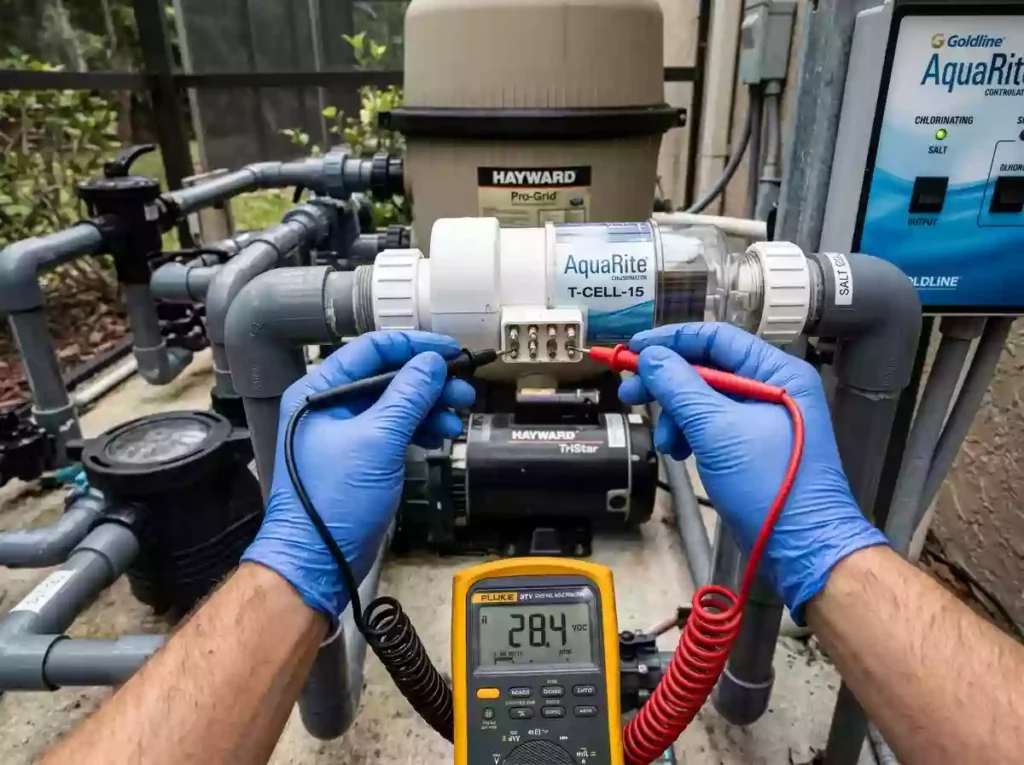
Power the system and set your multimeter to the DC Voltage range. Measure across the cell terminals and compare the reading to the expected calculated voltage or the panel’s display.
Next, switch to Amperage (using a clamp meter is preferred for safety) to verify the current flow. Safety Warning: Use extreme caution when testing live circuits to avoid electrical shock.
The Air Continuity Test:
Once removed from the housing, set your multimeter to the “Continuity/Beeper” mode. Test the metal connections in the open air. If the meter beeps, the internal metallic bridge is intact. If there is no continuity, the internal weld or connection has failed, indicating a structural hardware failure rather than a chemical one.
The Advanced Diagnostic: The Century “Bucket Test” and Chlorine Odor Test
When electrical parameters appear normal but chlorine levels won’t rise, perform the Bucket Test. This simulates real-world conditions in a controlled environment.
Fill a clean plastic bucket with water balanced to the correct pool salinity. Submerge the titanium plates, ensuring the electrical terminals remain dry and above the water line. Power the unit on.
The Professional “Odor Test” (Century Pro Tip):
After a few moments of electrolysis, gently waft the air above the bucket toward your nose—never inhale directly or deeply. If you detect a sharp, distinct chlorine odor, the MMO coating is still catalytically active. If you have proper voltage and amperage but zero smell, the coating is “dead” (passivated), and the cell requires replacement regardless of its physical appearance.
Interpreting Results: Is it Scale, Board Failure, or Coating Depletion?
Accurate salt chlorinator diagnostics require analyzing how voltage and amperage interact:
- Zero Voltage Output: This is a motherboard failure. The power supply or PCB is not delivering energy. The cell itself is likely fine.
- High Voltage + Low Amperage: If the cell is clean, this indicates MMO coating depletion. Titanium is a “valve metal”; without the precious metal coating, it becomes highly resistive. The system tries to “push” (High V) but the current (A) cannot flow. This is an irreversible end-of-life state.
- Normal Parameters + No Chlorine: This indicates the coating is present but has lost its catalytic activity. The electrochemical department refers to this as passivation.
In the world of electrochemistry, coating loss is permanent. Once the noble metals are stripped or deactivated, the cell must be replaced.
Why Century Cells Offer Superior Diagnostic Reliability
Century electrolytic cells are engineered for predictable performance, making them the easiest brand for technicians to diagnose in the field.
We use exclusively ASTM B265 Grade 1 Titanium, ensuring zero baseline resistance issues from impure substrates. Our electrochemical department conducts consistency checks on every batch of MMO coating to ensure uniform thickness and adhesion. This industrial-grade precision means that a Century cell provides stable, “clean” data to your multimeter, eliminating the erratic readings common with low-quality aftermarket alternatives.