
Optimal Salt Water Pool Chemistry: Maximizing Salt Water Chlorinator Cell Lifespan
For commercial aquatic facilities, property operations managers, and pool service distributors, managing optimal salt water pool chemistry has evolved far beyond a baseline matter of swimmer comfort; it is a critical financial strategy to control operational expenditures. As a piece of precision electrochemical hardware, a salt water chlorinator relies entirely on a stabilized aqueous environment to execute highly efficient chlorine generation. When critical chemical metrics deviate from targeted baseline parameters, the internal electrolytic plates bear the immediate physical brunt. Mineral scale rapidly aggregates on electrode surfaces, accelerating anode passivation and drastically shortening the functional lifespan of the salt cell, which subsequently inflates facility overhead through premature component failure. Precise regulation of pool pH, total alkalinity, and calcium hardness is the foundational methodology to mitigate electrode erosion, prolong equipment runtimes, and insulate businesses from unscheduled maintenance overhead and equipment downtime.
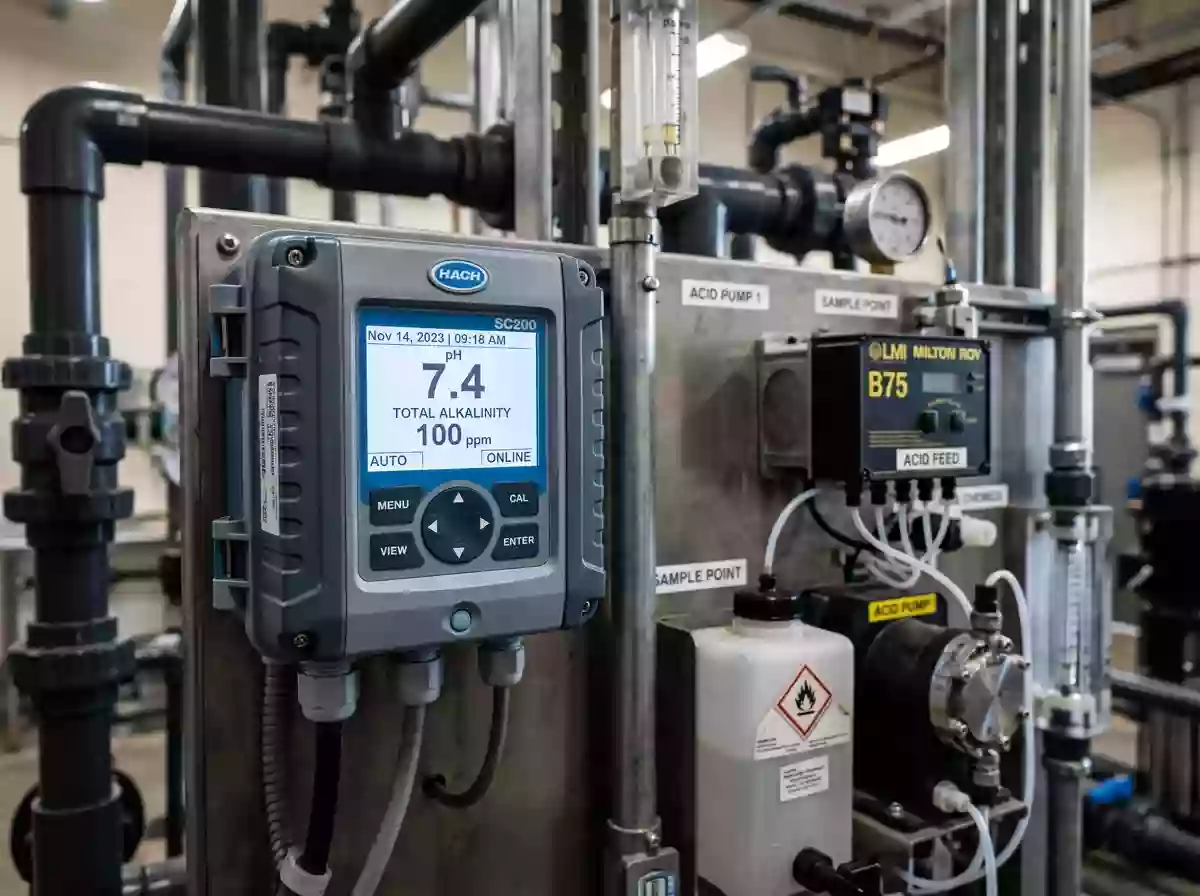
The pH and Total Alkalinity Nexus: Stabilizing the Electrolytic Micro-Environment
During the operational cycles of a salt water chlorinator, the cathodic reduction reaction continuously generates a high concentration of hydroxyl ions. This process creates an inherent thermodynamic drive for the bulk pool water pH to rise, constantly threatening the stability of the pool chemical balance.
Total alkalinity acts as the vital acid-base buffer system against this phenomenon. For commercial installations, this metric must be strictly confined within the narrow window of 80 to 120 ppm. Insufficient alkalinity causes extreme pH volatility, rendering the water chemistry highly erratic, whereas excessive alkalinity promotes rapid calcium carbonate precipitation that directly scales and passivates the catalytic surfaces of the electrodes.
The globally recognized engineering standard mandates maintaining bulk pool water pH between 7.2 and 7.6. This precise range effectively stabilizes the electrolytic micro-environment, suppressing scale accumulation on the internal plate matrix and delaying premature anode aging.
Furthermore, keeping the pH within this threshold optimizes the dissociation curve of chlorine, maximizing the presence of highly active hypochlorous acid ($HOCl$) to guarantee elite disinfection kinetics while significantly compressing the long-term replacement costs for commercial operators.
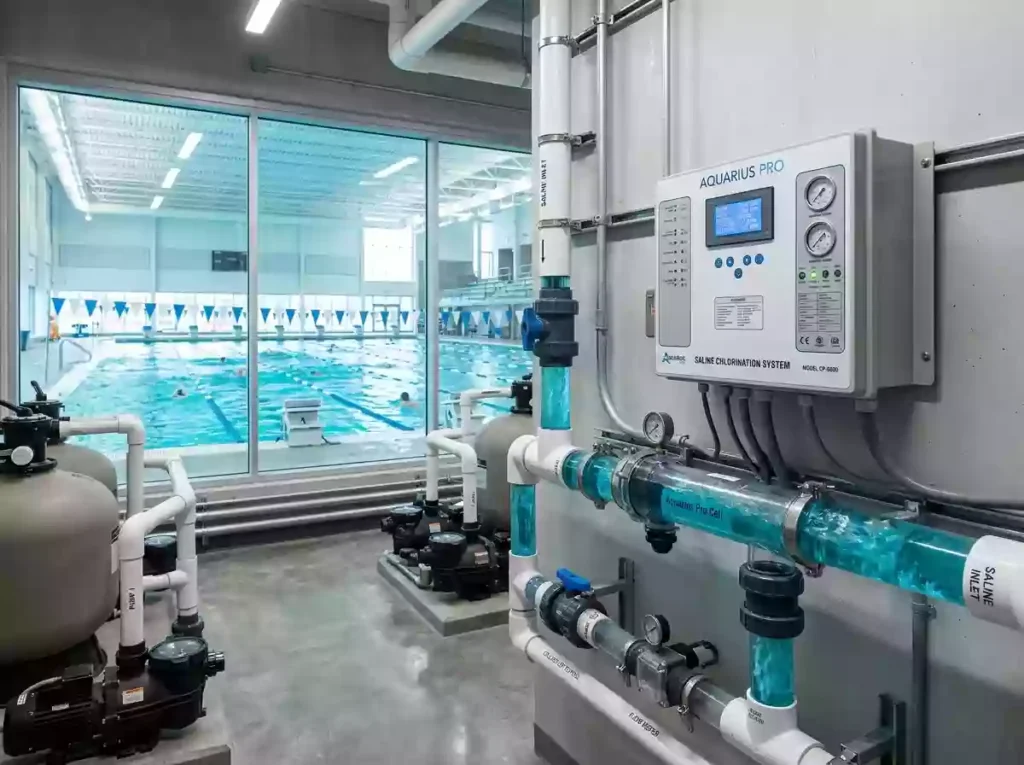
The Stabilizer Equation: Utilizing Cyanuric Acid to Prevent Photo-Degradation
Outdoor swimming pools are permanently subject to intense solar ultraviolet radiation. Without the molecular stabilization provided by cyanuric acid, up to 90% of free available chlorine can be completely degraded and lost within a brief two-hour window. This severe chlorine deficit forces the disinfection machinery into prolonged, high-load operational cycles, multiplying the current density stress on the titanium plates, accelerating cell degradation, and driving up facility overhead.
The optimal concentration window for cyanuric acid pool salt synergy is 30 to 50 ppm. This matrix provides a protective molecular shield around active chlorine species, resisting photolytic breakdown while remaining perfectly adapted to commercial pool water chemistry workloads.
Daily operations must strictly police the upper boundaries of stabilizer accumulation. Once cyanuric acid concentrations cross the 100 ppm threshold, it triggers a catastrophic state known as “chlorine lock,” which severely arrests biocidal efficacy. Correcting this failure state requires extensive water dumping and dilution, incurring massive water utility and municipal discharge expenses. Overseas commercial facility operators must implement routine, standardized monitoring of this parameter to preemptively safeguard their bottom line against compliance losses.

LSI Management: Controlling Calcium Hardness to Protect Titanium Anode Coatings
The Langelier Saturation Index (LSI) serves as the definitive mathematical criteria for determining chemical equilibrium in salt water pools. Moving beyond isolated single-parameter tracking, the $LSI$ algorithm integrates water temperature, pH, total alkalinity, and calcium hardness into a unified index, with 0.0 as perfect equilibrium and -0.3 to +0.3 as the target operational envelope.
The interior of an electrolytic cell chamber inherently manifests an aggressive micro-environment defined by elevated temperatures and localized high pH. When calcium hardness thresholds are breached, calcium carbonate precipitates out of solution, bonding tightly to the precious metal ruthenium-iridium catalytic coating. This localized scale accumulation disrupts uniform current distribution, inducing local thermal spikes that trigger coating delamination. This significantly compromises the lifespan of the titanium anodes, inflating the frequency of salt cell replacement cycles.
[Added Context: Maintaining strict $LSI$ balance effectively suppresses mineral scaling at the source, drastically reducing the frequency of aggressive acid-washing cycles.]
Because chemical descaling via strong acids tasking format irreversibly strips active catalytic layers, minimizing these interventions preserves the noble metal matrix, preserves electrode performance, and sustains peak chlorine evolution efficiency over multi-year runtimes.
Salinity Equilibrium: Balancing Conductivity Against Current Density Requirements
Aqueous salinity directly dictates the electrical conductivity of the pool water matrix. Mainstream commercial and industrial chlorinators require a stable salinity profile strictly managed between 3000 and 3500 ppm to match the engineering specifications for rated current density and ensure stable electrochemical kinetics.
Insufficient salinity severely elevates the water’s electrical resistivity. To generate the demanded mass of free chlorine, the power supply module is forced to scale up its output voltage, driving the transformer into dangerous over-current and thermal saturation states. Simultaneously, low-salinity electrolysis accelerates the harmful oxygen evolution side reaction, causing rapid degradation of the ruthenium-iridium catalytic coating and premature electrode failure.
Conversely, if salinity exceeds targeted operational limits, the water matrix becomes intensely corrosive. This not only accelerates the chemical degradation of peripheral metal structures such as pool ladders, pumps, and pipe fittings but also increases the electrochemical corrosion rate of the titanium substrate, drastically shortening the lifecycles of core components and escalating overall systemic maintenance and replacement expenditures.
The B2B Manufacturing Edge: Sourcing High-Performance Replacement Components
Even under pristine water quality management protocols, the core cell of a salt water chlorinator inevitably reaches its electrochemical operational limits after thousands of hours under heavy current loads, cementing its status as a high-frequency commercial consumable within the maintenance sector.
Century provides comprehensive, industrial-grade pool salt cell replacement engineering, OEM manufacturing, and custom upgrading capabilities. Our replacement electrolytic cells are manufactured to exact dimensional and electrical specifications, ensuring seamless mechanical and electronic integration with mainstream European and American commercial power enclosures and housings.
Utilizing an advanced, delamination-resistant mixed metal oxide (MMO) catalytic formulation, our plates natively support automatic reverse-polarity self-cleaning cycles and effortlessly tolerate routine water quality fluctuations. We establish direct-supply channels with global aquatic facility networks, pool service franchises, and equipment distributors—eliminating intermediary markups, maximizing aftermarket margins, and delivering highly competitive hardware support for international public infrastructure procurement bidding.