
Industrial Effluent Compliance: Wastewater Disinfection Using Electrochlorination Systems
Environmental regulations governing industrial effluent discharge across North America and Europe are becoming increasingly stringent, forcing petrochemical, pharmaceutical, and textile facilities to upgrade their pollution control standards. Industrial wastewater matrices are highly complex and variable. Traditional chemical dosing methods frequently trigger volatile reactions with organic matter in the water, generating severe levels of disinfection byproducts (DBPs). This not only makes stable compliance impossible but also exposes facilities to heavy regulatory fines and operational shutdowns.
In response to these industry pressures, on-site electrochlorination disinfection has rapidly gained traction due to its operational stability and self-sufficient chemical generation. These decentralized electrochlorination systems generate mixed oxidant solutions in situ, executing highly efficient wastewater disinfection and pathogen control. By minimizing byproduct formation at the source, this technology helps facilities effortlessly meet effluent compliance mandates while optimizing overall operational expenditures, establishing itself as the mainstream choice for green industrial wastewater processing.
Regulatory Friction: Deconstructing the Pathogen and DBP Dilemma in Effluent Streams
Industrial wastewater streams typically exhibit high Chemical Oxygen Demand (COD), elevated ammonia nitrogen, and heavy suspended solids. [Added Context: These aggressive organic loads create a massive chemical demand, instantly consuming added chlorine biocides.] Consequently, precise dosing becomes nearly impossible, leading to erratic disinfection performance and a failure to reliably neutralize aquatic pathogens.
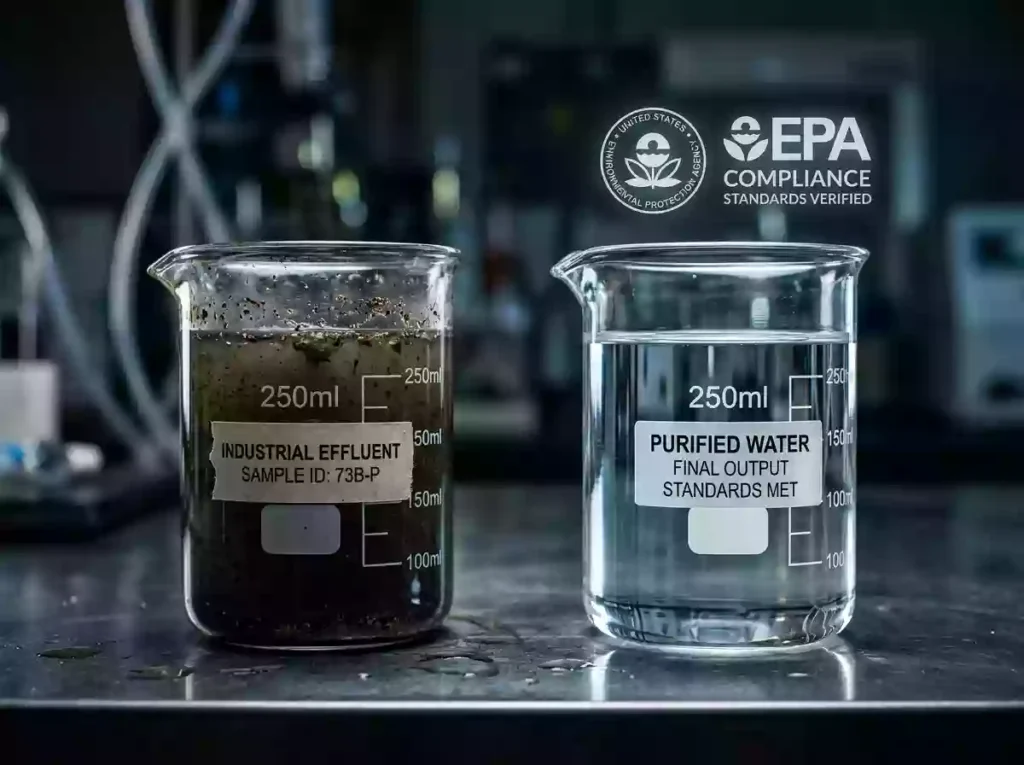
When relying on commercial high-concentration chlorine for industrial wastewater compliance, the chemicals inevitably react with the organic mass, continuously synthesizing carcinogenic DBPs such as Trihalomethanes (THMs) and Haloacetic Acids (HAAs). These specific pollutant markers are strict regulatory red lines in EPA effluent discharge audits. A single breach of these thresholds exposes the enterprise to immediate penalties and mandated facility closures.
Clearly, the imprecise nature of legacy chemical dosing can no longer satisfy modern, stringent discharge standards or the requirement for precise effluent management, rendering it unviable for long-term operational compliance.
Electrochemical Synthesis: How an Electrochlorination System Drives Advanced In-Situ Oxidation
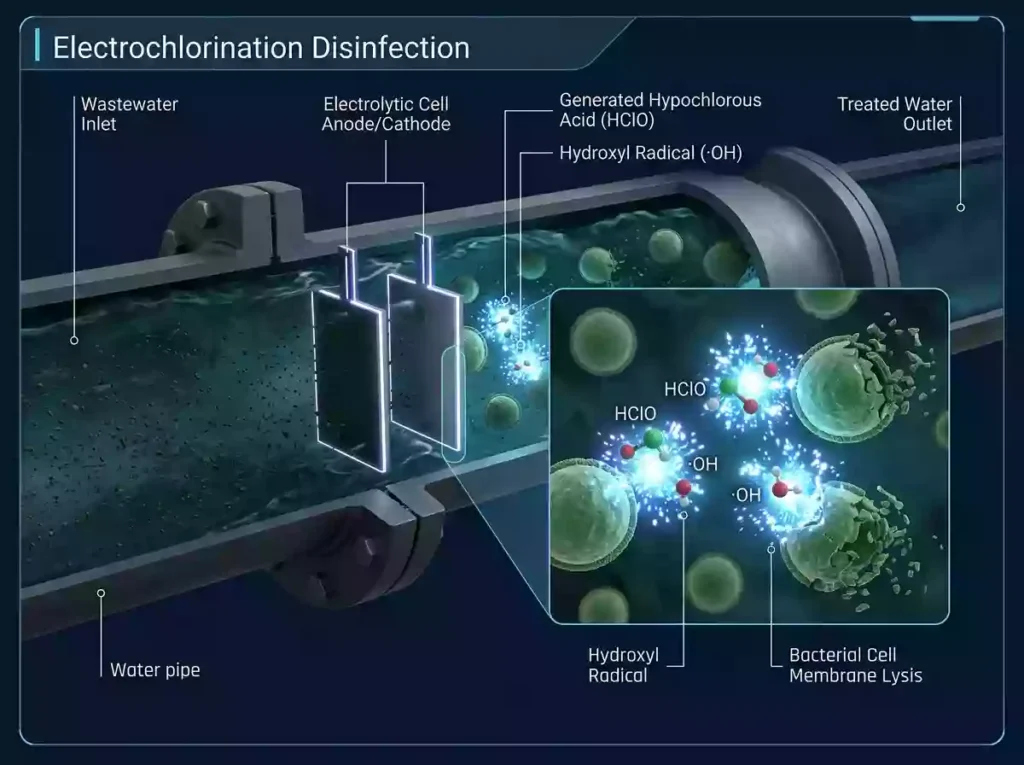
An electrochlorination system relies on a dual-oxidation mechanism to achieve advanced wastewater purification and sterilization. As the effluent enters the electrolytic chamber, the anode directly executes electrochemical oxidation on macro-molecular pollutants, dismantling stubborn organic structures. Simultaneously, the electrolysis of brine generates hypochlorous acid and highly reactive hydroxyl radicals in situ, forming a potent, multi-faceted disinfection matrix.
These active oxidants possess rapid reaction kinetics and extreme oxidative strength, directly rupturing microbial cell walls and severing pathogenic genetic structures for high-efficiency sterilization. Because these agents are generated and utilized instantly on-site, the contact time between free active chlorine and organic matter is drastically compressed. [Added Context: This kinetic advantage fundamentally suppresses the synthesis pathways of THMs and HAAs.] This effectively eliminates the risk of exceeding disinfection byproducts in wastewater limits, ensuring stable compliance with regional industrial environmental discharge codes.
Materials Science in Ruver Environments: Safeguarding Cell Longevity via Century’s MMO Titanium Anode
Industrial effluent environments are notoriously hostile. The water matrix contains heavy metal ions, scaling minerals, and experiences erratic pH fluctuations. When combined with the highly corrosive nature of concentrated chloride ions, standard electrolytic electrodes suffer from rapid surface passivation and catalytic coating delamination, drastically reducing their operational lifespan and preventing stable, long-term operation.
To counter this, Century developed a proprietary mmo titanium anode, utilizing Grade 1 high-purity titanium as the structural substrate. Through a precise, multi-stage thermal decomposition and sintering process, nanoscale ruthenium-iridium noble metal oxide coatings are uniformly deposited, ensuring an incredibly strong bond between the substrate and the catalytic layer.
This specific anode exhibits a remarkably low chlorine evolution potential while effectively suppressing oxygen evolution side reactions. It demonstrates superior electrochemical performance, enduring aggressive acid/base shocks and extreme corrosion, making it perfectly adapted for complex industrial effluent treatment environments. Backed by this robust materials science, the core electrolytic components reliably achieve a maintenance-free lifecycle exceeding five years, thoroughly resolving overseas engineering contractors’ concerns regarding fragile plates and frequent replacement cycles.
Financial Engineering: Financial ROI of Chemical-Free Wastewater Treatment Protocols
In standard industrial effluent treatment scenarios, the continuous procurement of corrosive biocides, combined with hazmat transport, specialized storage maintenance, and hazard insurance premiums, results in unsustainably high long-term operational costs.
By implementing a chemical free wastewater treatment protocol, facilities can generate their disinfection media on-site using only standard industrial salt—or even leverage the intrinsic salinity of the wastewater itself. Daily operational maintenance is reduced to a stable, predictable electricity consumption metric, completely insulating the plant from volatile chemical commodity pricing.
Furthermore, eliminating chemical degradation losses and downstream water conditioning expenses further optimizes overall equipment efficiency. [Added Context: When analyzing the Total Cost of Ownership (TCO), the reduction in OPEX is substantial.] For large-scale wastewater projects processing tens of thousands of tons daily, the initial capital expenditure (CAPEX) for the equipment is typically fully recovered within 18 to 24 months through sheer operational savings, presenting a highly compelling long-term economic advantage.
Global EPC Alliance: Seamless Integration and White-Label Skid Architecture for Infrastructure Contracts
Overseas environmental EPC contractors urgently require fully integrated, rapid-deployment equipment to bypass the tedious inefficiencies of assembling loose components on-site.
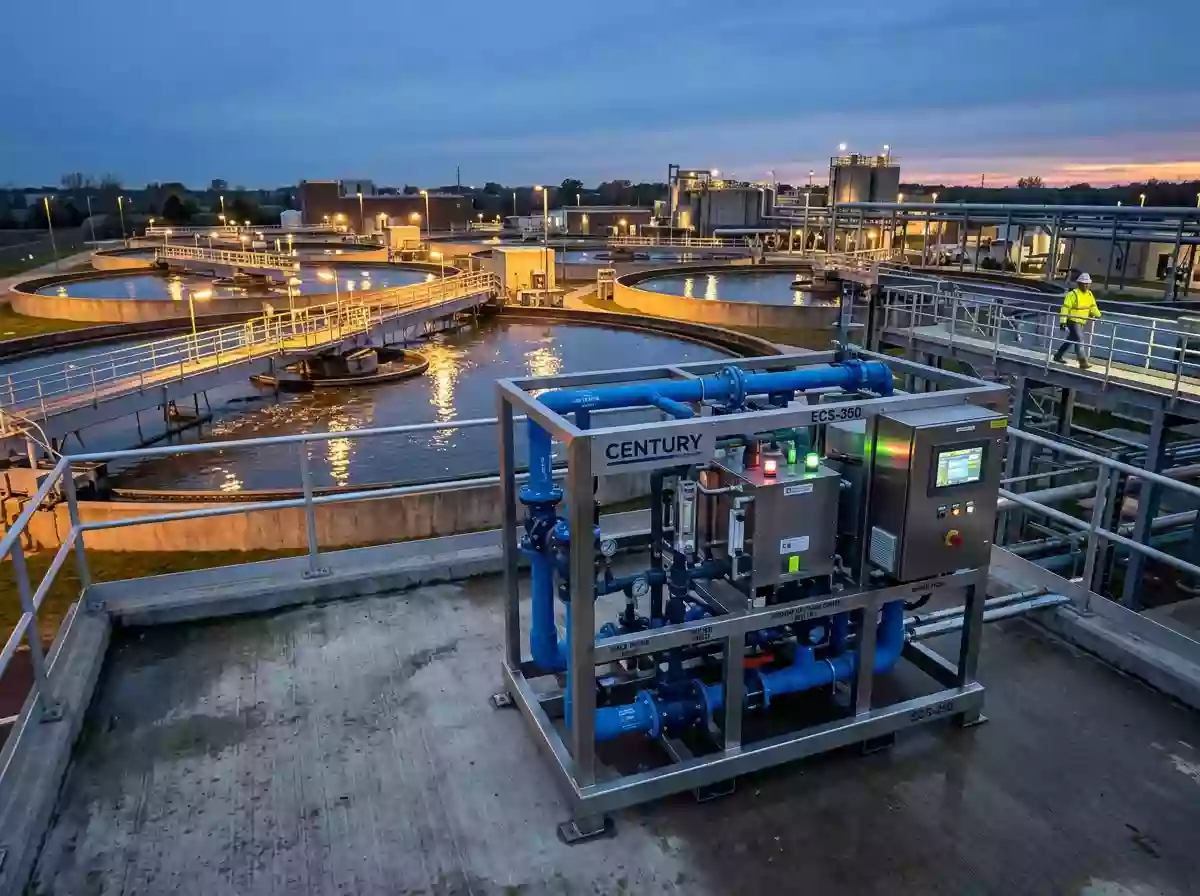
We supply completely pre-assembled and pre-tested skid mounted water treatment systems utilizing our electrochlorination technology, engineered for immediate integration and commissioning on industrial sites. The equipment automation natively supports mainstream communication protocols such as Modbus TCP and BACnet, and the chamber’s anti-corrosion architecture can be customized to exact project specifications. Additionally, Century offers a comprehensive OEM white-label partnership framework. We support full brand swapping and complete aesthetic customization of the hardware, empowering our partners to bid on major regional wastewater infrastructure projects under their own brand identity, leveraging our mature, hard-core technology to secure a definitive competitive advantage in the market.