
On-Site Hypochlorite Generation vs. Bulk Hypochlorite: Mitigating Chemical Transport Risks in Municipal Water Treatment
Modern municipal water treatment disinfection infrastructure currently operates under a dual matrix of intensifying logistics friction and strict regulatory compliance. For decades, facilities relied heavily on the procurement of commercial bulk sodium hypochlorite to maintain continuous biological control. While seemingly straightforward on the surface, this dependency introduces severe hidden vulnerabilities to daily plant logistics.
High-concentration liquid bleach is a highly corrosive hazardous material, subjecting transport routes to rigid legal oversight and high operational liabilities. Furthermore, these bulk chemical solutions suffer from rapid thermal degradation during transport and storage, actively reducing active chlorine strength while creating toxic byproducts like chlorates. This makes maintaining required residual disinfection targets an unpredictable, expensive challenge.
Transitioning to an on-site hypochlorite generation system completely upends this volatile model. By eliminating commercial hazardous chemical shipping entirely, this infrastructure utilizes only food-grade salt and standard potable water to synthesize a precise biocide solution directly in situ. This proactive shift neutralizes chemical transport and chemical storage risks at the source, stabilizes operational budgets, and dramatically elevates the long-term safety profile of municipal water plants.
The Hazmat Freight Crisis: Deconstructing the Operational Vulnerabilities of Bulk Sodium Hypochlorite
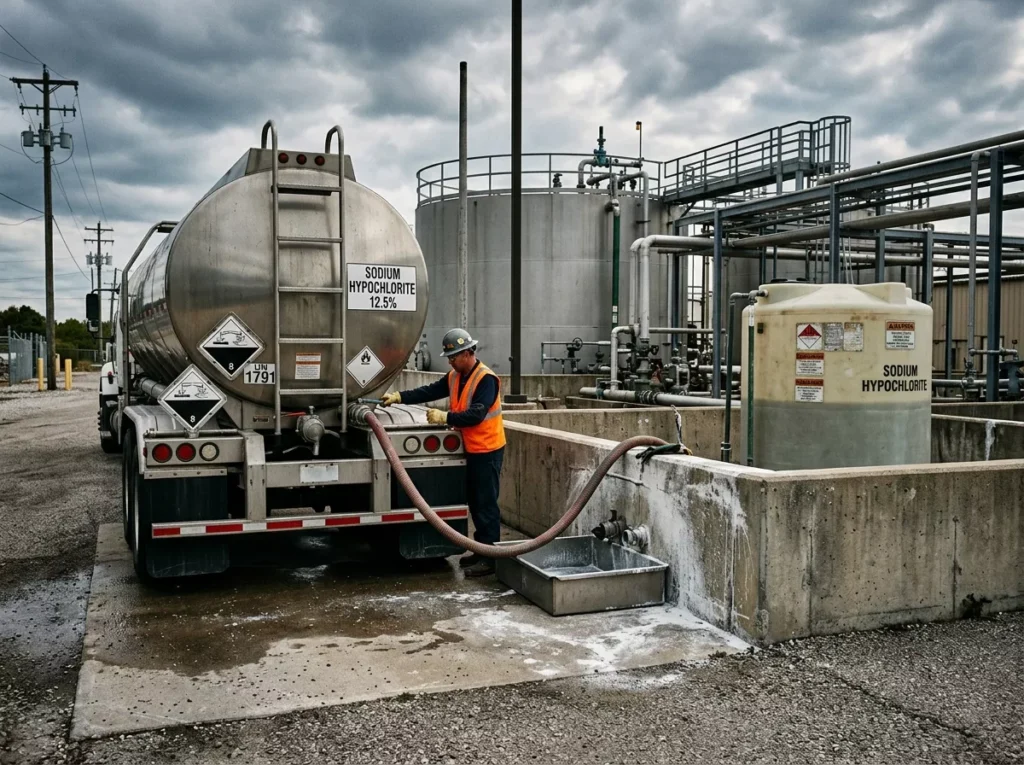
In Western markets, commercial liquid bleach distributed at concentrations between 12.5% and 15% is classified as a high-hazard substance. Consequently, its highway transportation is strictly policed by regulatory bodies such as the Department of Transportation (DOT) and the Environmental Protection Agency (EPA). Logistics fleets must hold specialized hazmat operating certifications, transit routes require formal pre-approval and manifesting, and facilities must carry expensive third-party liability insurance. This web of administrative approvals creates a highly inflexible supply chain, drives freight costs to unsustainable levels, and exposes the public to the permanent threat of tank leaks or catastrophic roadside spills.
Compounding this logistics crisis is the severe issue of sodium hypochlorite degradation. This chemical matrix is highly unstable, breaking down rapidly when exposed to elevated ambient temperatures and UV radiation during summer transit. The loss of free available chlorine means the actual concentration delivered to the plant is frequently far below the nominal invoice specification, presenting a continuous, invisible financial drain.
Furthermore, this degradation path accelerates the synthesis of toxic chlorate ClO3− and bromate byproducts, threatening the facility’s compliance with modern drinking water quality standards. The choice to rely on bulk deliveries appears to eliminate upfront capital expenditure (CAPEX), but it effectively locks the plant into an unpredictable cycle of rising operational expenses (OPEX), freight liabilities, and chemical potency losses.
Decentralized Safety: How an OSHG System Replaces Hazardous Chemistry with Non-Regulated Logistics
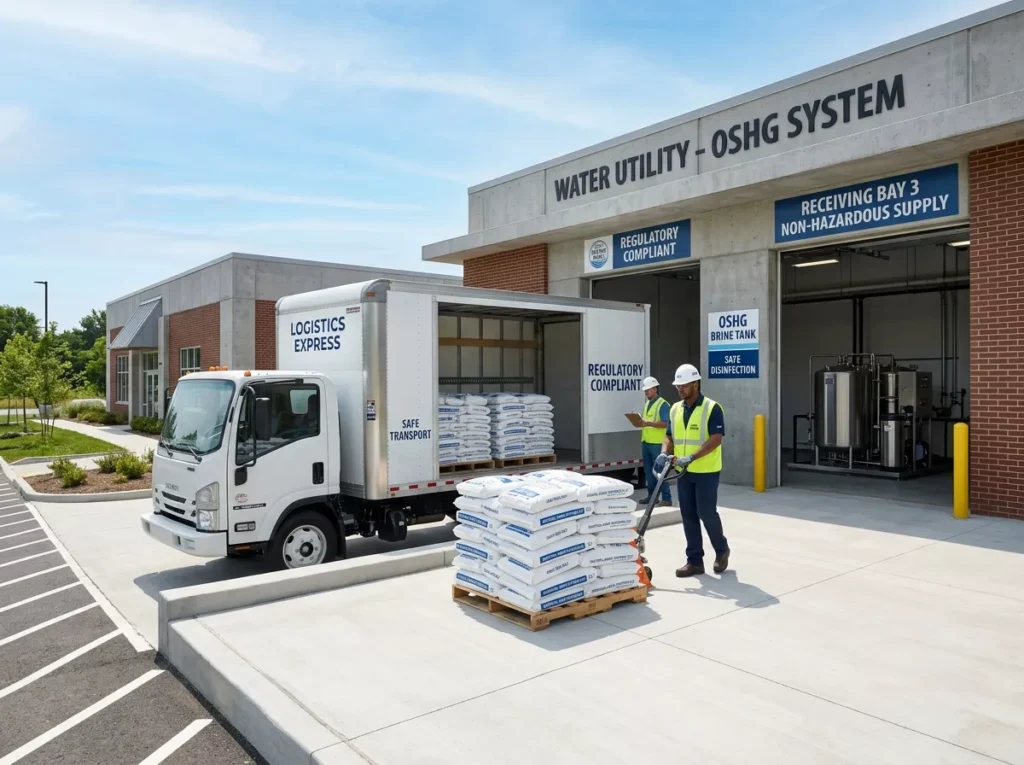
Deploying an oshg system achieves a total safety transformation for a water treatment facility’s primary disinfection feedstock. The plant’s daily procurement schedule shifts entirely to standard, non-iodized industrial water softener salt (NaCl). Because salt is classified as a standard civil and industrial commodity rather than a hazardous material, it can be transported by generic freight carriers. It requires no specialized routing clearances, no hazmat transport certifications, and carries zero high-risk logistics pricing premiums, making material replenishment highly flexible and decentralized.
Operationally, the on-site generation reactor synthesizes a highly dilute sodium hypochlorite solution strictly regulated below a 0.8% (8,000 ppm) concentration threshold. This specific dilution curve drops completely below the high-risk regulatory boundaries established by Western safety frameworks like EPA and OSHA.
Specifically, this grants the plant an automatic exemption from the cumbersome Risk Management Plan (RMP) mandates and OSHA Process Safety Management (PSM) oversight.
Water authorities can completely bypass complex emergency evacuation drill filings, specialized hazardous asset security audits, and repetitive compliance reporting. This slashes safety management labor costs and administrative legal overhead, mitigating everyday operational vulnerabilities across the entire plant perimeter.
Electrochemical Core Stability: Maximizing OSHG Cell Lifecycles via Century’s MMO Titanium Anode Technology
Synthesizing sodium hypochlorite on-site requires continuous, high-current-density electrolysis of saturated brine solutions. This process creates an incredibly demanding electrochemical environment marked by high solution conductivity and heavy operational loads. Standard base metal electrodes operating under these parameters face rapid coating delamination and localized surface passivation, destroying electrolytic cell efficiency and failing the 24/7 reliability standards demanded by municipal water plants.
To ensure long-term runtime survival, Century engineered a proprietary mmo titanium anode specifically optimized for high-salinity stress. Utilizing high-purity industrial grade titanium as the structural foundation, we apply an advanced multi-layered ruthenium-iridium catalytic coating through a proprietary multi-stage thermal decomposition and sintering process. This ensures an unassailable molecular bond between the active catalytic layer and the titanium substrate, yielding supreme resistance against aggressive localized chemical attack. This anode architecture displays exceptional electrochemical stability, effortlessly enduring high-frequency current density shifts and sudden transient electrical surges. This stability optimizes overall current transfer efficiency and significantly drives down the required kilowatt-hour consumption per kilogram of free available chlorine generated. Backed by elite metallurgy and mature coating chemistry, Century cells stably achieve an unassailable maintenance-free operational lifecycle exceeding six years. This addresses the core anxieties of Western engineering teams regarding field maintenance complexity and frequent component replacement, ensuring a highly reliable water disinfection system.
Long-Term Financial ROI: Shifting from Volatile OPEX Commodity Pricing to Predictable Asset Economics
The market price of commercial bulk sodium hypochlorite is fundamentally volatile, tightly coupled to upstream chlor-alkali manufacturing capacities, global crude oil pricing index shifts, and unpredictable transport fuel surcharges. This constant pricing fluctuation prevents water treatment authorities from accurately forecasting their long-term operational expenditures, making quarterly municipal maintenance budget management incredibly difficult to control.
Transitioning to an on-site generation model insulates the facility from market commodity spikes. The ongoing operational cost of the system is determined exclusively by two baseline inputs: commodity industrial salt and local electrical utility tariffs. Because both resources maintain highly flat and predictable pricing structures globally, long-term operational costs can be modeled with absolute precision years in advance. By leveraging an on-site system, facilities completely eliminate hazmat freight markups, expensive secondary chemical containment basin maintenance, and the hidden financial losses caused by liquid bleach degradation. Comprehensive total cost of ownership (TCO) assessments indicate that the upfront fixed CAPEX required for the electrolysis equipment is fully amortized within a 24-to-36-month window via profound OPEX compressions, rendering the system’s long-term lifecycle financial returns clear and highly favorable.
Strategic Partner Integration: White-Label OSHG Platforms for International Water Infrastructure EPCs
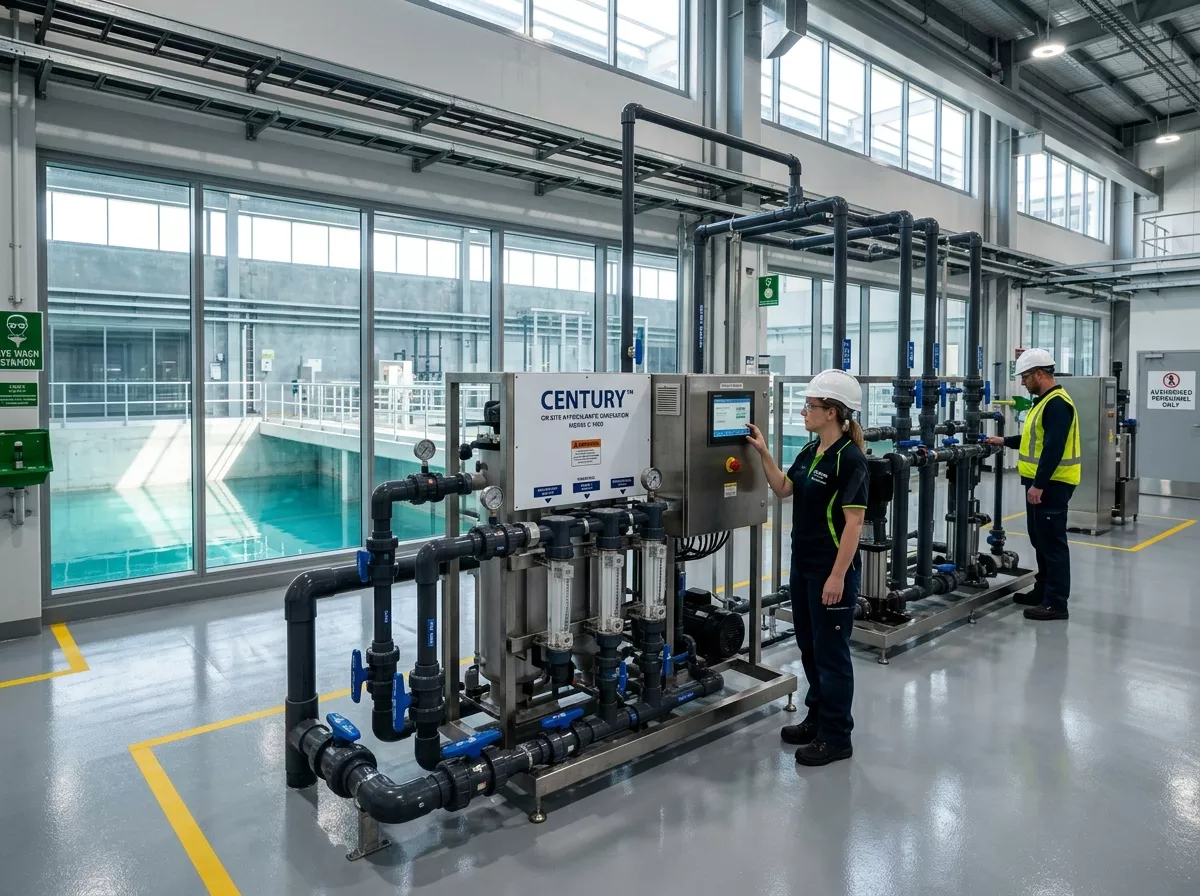
International water-treatment EPC contractors and mechanical system integrators frequently struggle with the inefficiencies of sourcing loose, uncalibrated components from fragmented vendors, which leads to prolonged field-assembly delays and unpredictable commissioning cycles. They require unified, factory-tested, turnkey equipment ready for rapid deployment. Century answers this need with fully integrated, skid-mounted OSHG platforms. Every unit arrives with pre-configured hydraulic pipe manifolds, integrated electrical controls, and automated salt-dissolution tanks engineered directly onto a structural steel frame, requiring only basic water and power hookups at the job site.
Backed by extensive municipal-scale production capacity, Century provides far more than raw component supply; we deliver complete, end-to-end hardware and software customization suites. Our automation enclosures natively support mainstream industrial communication layers—including Modbus TCP and Profibus protocols—ensuring seamless integration into master SCADA networks or plant-wide central control rooms.
Furthermore, we offer a completely open OEM white-label framework, allowing international engineering partners to customize industrial paint schemes, adapt localized graphic user interfaces (GUI), and integrate their own corporate branding elements. This empowers contractors to bid on major public water infrastructure tenders with a premium, technologically insulated brand identity, building structural market advantages as we jointly expand across the global water infrastructure sector.