
What is a Salt Cell Generator? The Complete Guide for Pool and Water Treatment
What exactly is a salt cell generator? In simple terms, it is an electrochemical device that, when supplied with direct current (DC), electrolyzes a saltwater solution (brine) to produce sodium hypochlorite. This powerful oxidant effectively eradicates organic matter and pathogens, ensuring the water meets strict health and safety standards. In this comprehensive guide, we will dive into the working principles, anatomical structure, electrode configurations, efficiency factors, and broad applications of salt cell generators.
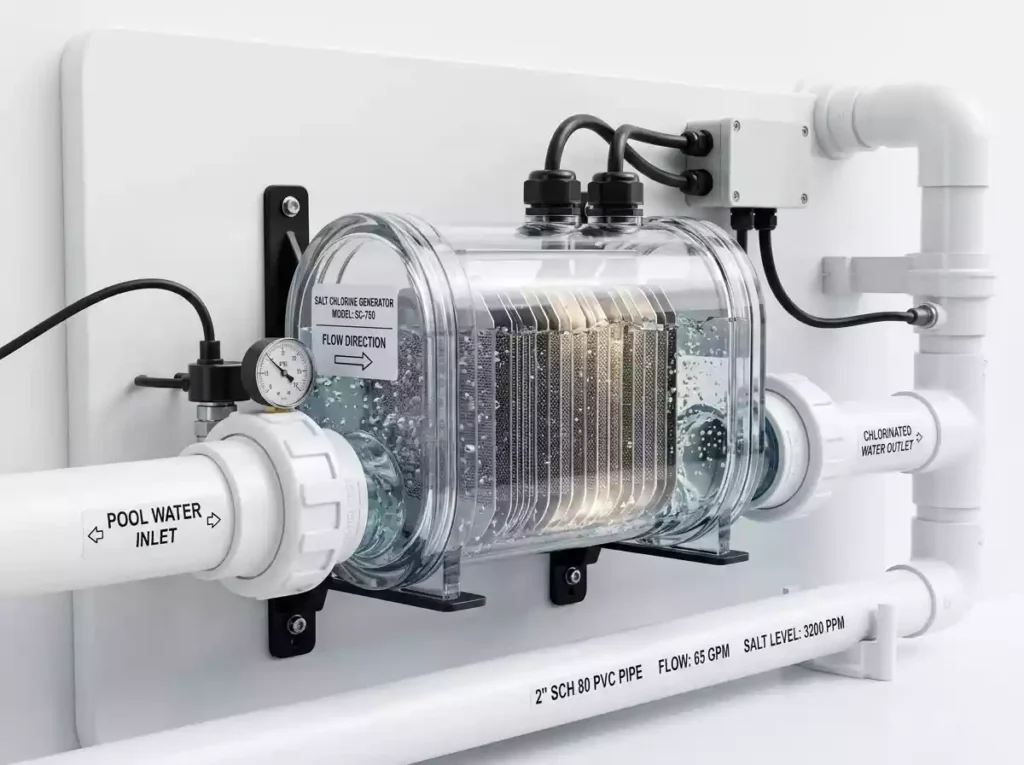
How Does a Salt Cell Work in Water Disinfection?
The core mechanism of a salt cell is straightforward. (For a deep dive into the electrochemistry, check out our related blog: Water Electrolysis Process: The Complete Guide for Industrial Water Treatment).
Briefly, when DC power is applied to the brine solution within the cell, a chemical reaction occurs. At the positive electrode (anode), chlorine gas is generated, which immediately dissolves in water to form hypochlorous acid and hypochlorite ions—the primary agents for water disinfection. At the negative electrode (cathode), hydrogen gas (H2) is produced as a byproduct. While harmless in small open pools, in enclosed or industrial OSHG (On-Site Hypochlorite Generation) systems, proper ventilation is crucial to safely expel this hydrogen gas and prevent combustion risks.
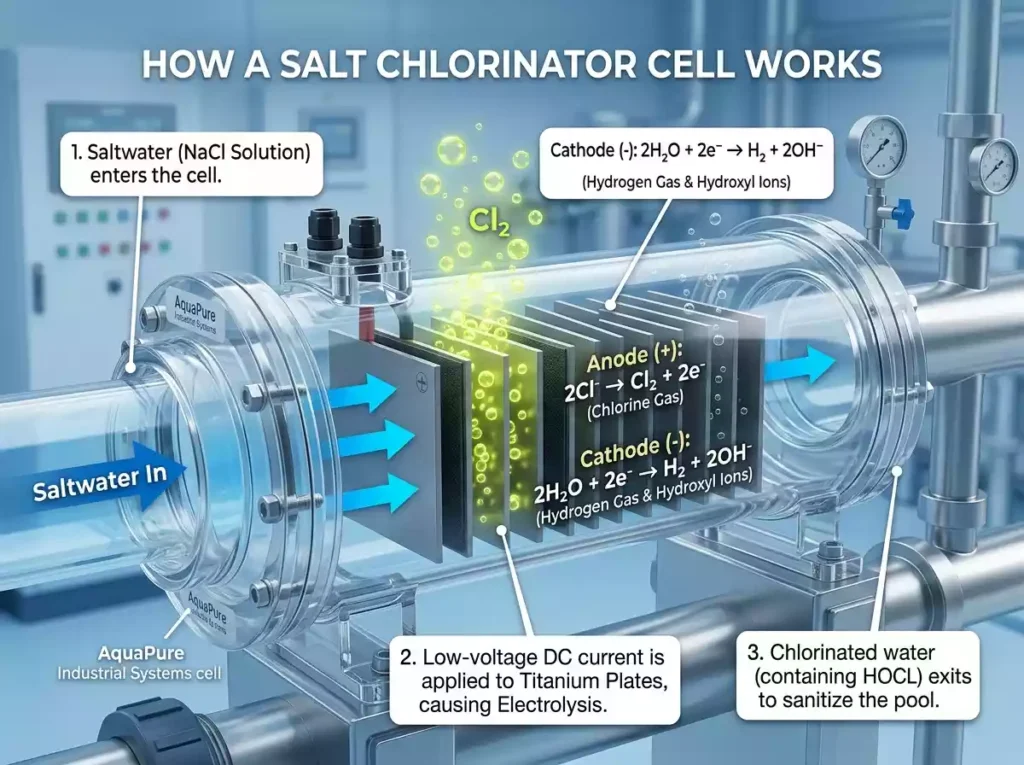
Anatomy of a Salt Chlorinator Cell: Housings, Anodes, and Cathodes
A standard salt chlorinator cell anatomy consists of three critical components:
- The Cell Housing (Reaction Chamber): This is the vessel where electrolysis takes place. Given the highly corrosive nature of chlorine, housings are typically manufactured from durable, chemical-resistant materials like clear PVC, Polycarbonate (PC), or Acrylic, allowing for visual inspection.
- The Anode: Traditional anodes degrade quickly during electrolysis. Century utilizes Dimensionally Stable Anodes (DSA) made from a valve metal titanium substrate coated with Mixed Metal Oxides (MMO). This titanium anode for salt cell applications boasts a high current density capacity and an exceptionally long lifespan.
- The Cathode: The cathode is generally made of pure titanium. However, in self-cleaning salt cells designed for reverse polarity, both the anode and cathode are coated with MMO.
Internal Design: Bipolar vs. Monopolar Salt Cell Configurations
Salt cells contain multiple electrode plates, and the way these plates are electrically connected significantly impacts performance. This brings us to the debate of bipolar vs monopolar salt cell designs:
- Monopolar Salt Cells (Parallel Connection): In this setup, every anode and cathode plate is directly connected to the power supply. Each plate has the same polarity on both sides. It operates on low voltage and high current. If one plate fails, the rest continue to function. This robust design is heavily favored in industrial applications.
- Bipolar Salt Cells (Series Connection): Here, only the two outermost plates are connected to the power source (one positive, one negative). The internal plates are not directly wired; they become polarized by induction, acting as an anode on one side and a cathode on the other. It operates on higher voltage and lower current. While highly efficient for compact spaces like residential pools, the failure of a single plate drops the efficiency of the entire cell.
Key Factors Affecting Efficiency: Electrode Gap and Reverse Polarity
The Impact of Inter-Electrode Gap and Cell Voltage
The distance between the plates (electrode gap) is critical. Because the reaction occurs at the plate surface and the current travels through the saltwater, a wider gap increases the ohmic resistance of the water. According to Ohm’s Law, maintaining the required current across a wider gap demands higher cell voltage. This results in wasted power (heat) and drops overall efficiency. At Century, our engineers precision-calibrate the electrode gap between 2mm and 5mm based on the specific application.
The Role of Salt Cell Reverse Polarity
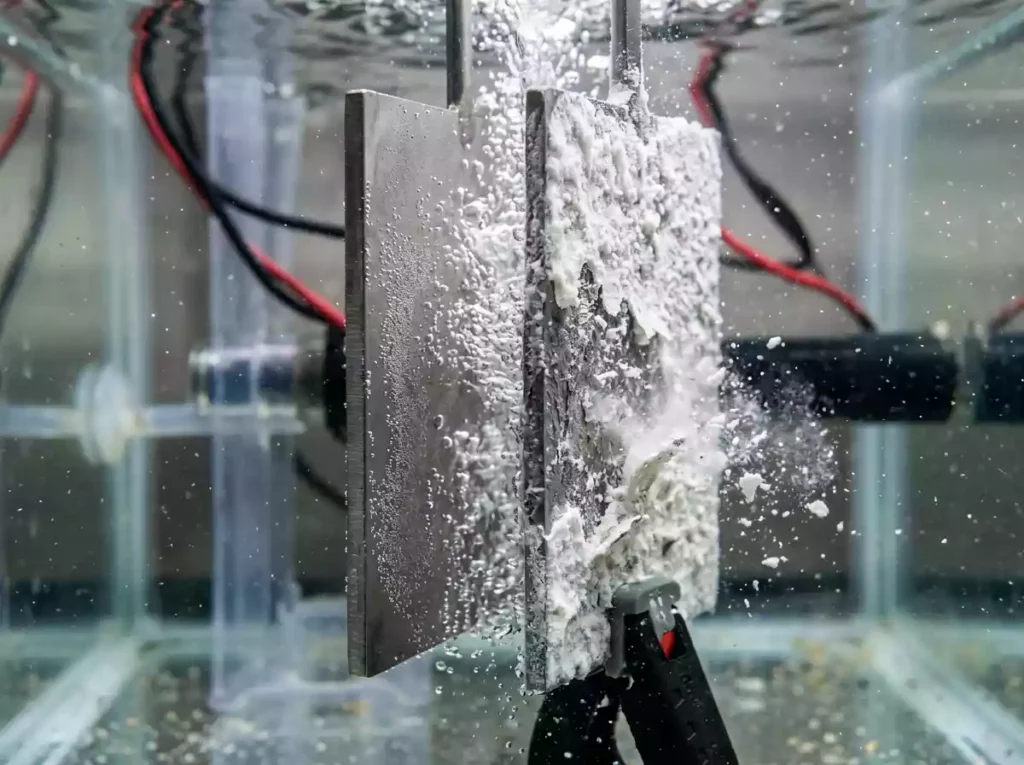
During operation, the cathode (negative) naturally attracts calcium and magnesium ions from the water, leading to severe scaling. If left unchecked, this scale acts as an insulator, causing:
- Plunging electrolysis efficiency and low chlorine output.
- Spikes in resistance and dangerous overheating.
- Premature depletion of the MMO coating.
- System error codes and a shortened cell life.
By utilizing salt cell reverse polarity,Century’s intelligent power supplies feature automatic reverse polarity, eliminating the need for manual acid washing. Field data shows that this automated self-cleaning technology extends the MMO coating lifespan by up to 20% compared to traditional monopolar models without reverse polarity, significantly lowering your long-term maintenance costs.
Power Supply and Installation Considerations
- Plumbing Connections: The cell housing connects directly to standard PVC pipework. Depending on the flow rate, Century offers port sizes ranging from 1/2-inch to 2-inch, with custom fittings available for OEM clients.
- Electrical Terminals: The interface between the cell and the DC power supply consists of positive and negative terminals. We utilize quick-connect plugs for low-amperage residential units and heavy-duty bolted lugs for high-amperage commercial systems.
- Power Supply Selection: Choosing the right power supply depends on plate quantity, surface area, connection type (monopolar/bipolar), and the maximum current density of the MMO coating. Century’s engineering team calculates these metrics using Faraday’s and Ohm’s Laws to ensure perfect system matching.
Buyer’s Guide: What to Look for in a Replacement Salt Cell
Knowing when to replace your salt cell is critical. If your system displays low chlorine errors, the water turns cloudy despite long pump run times, or the cell plates show severe degradation, it is time for an upgrade. As a premier manufacturer, Century provides high-performance aftermarket replacement salt cells. When sourcing a replacement, you only need to provide your existing plumbing size, terminal plug type, and power supply model. We deliver highly compatible, plug-and-play replacement salt cells that offer superior value. Furthermore, we can customize the MMO coating thickness to meet your specific salt cell lifespan requirements. Browse our product pages to view our full range of models.
Scaling Up: From Salt Cells to Industrial OSHG Systems
While Century is a leading provider of salt cells and complete salt chlorine generators for pools, our capabilities extend far beyond. As a One-Stop Electrochlorination Equipment Manufacturer, we design and produce large-scale OSHG water treatment systems for municipal and heavy industrial applications. Contact our technical sales team today to discuss your project needs. Request a free custom OEM quote.