
What is an OSHG System? The Ultimate Guide to On-Site Hypochlorite Generation
For decades, industrial water treatment relied heavily on hazardous chemical transportation and storage. Today, facility managers are rapidly transitioning to a safer, more sustainable solution: On-Site Hypochlorite Generation, commonly known as OSHG.
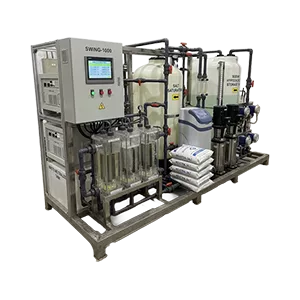
At its core, an OSHG system is a turnkey chemical plant scaled down to fit inside your facility. Instead of purchasing degrading liquid bleach, this system utilizes a highly precise 3% brine (saltwater) solution to generate sodium hypochlorite exactly when and where you need it, dosing it directly into your main water line. A standard industrial setup integrates a dedicated DC power supply, a precision-engineered electrolyzer, PLC automation, and an intuitive HMI (Human-Machine Interface).
How Does an OSHG System Work? (The Principles of Electrochlorination)
When you invest in a fully integrated electrochlorination system, operational complexity vanishes. To produce a continuous supply of highly active sodium hypochlorite, the system requires only three basic inputs: water, salt, and electricity. (For a deep dive into the chemical equations, refer to our complete guide on the Water Electrolysis Process).
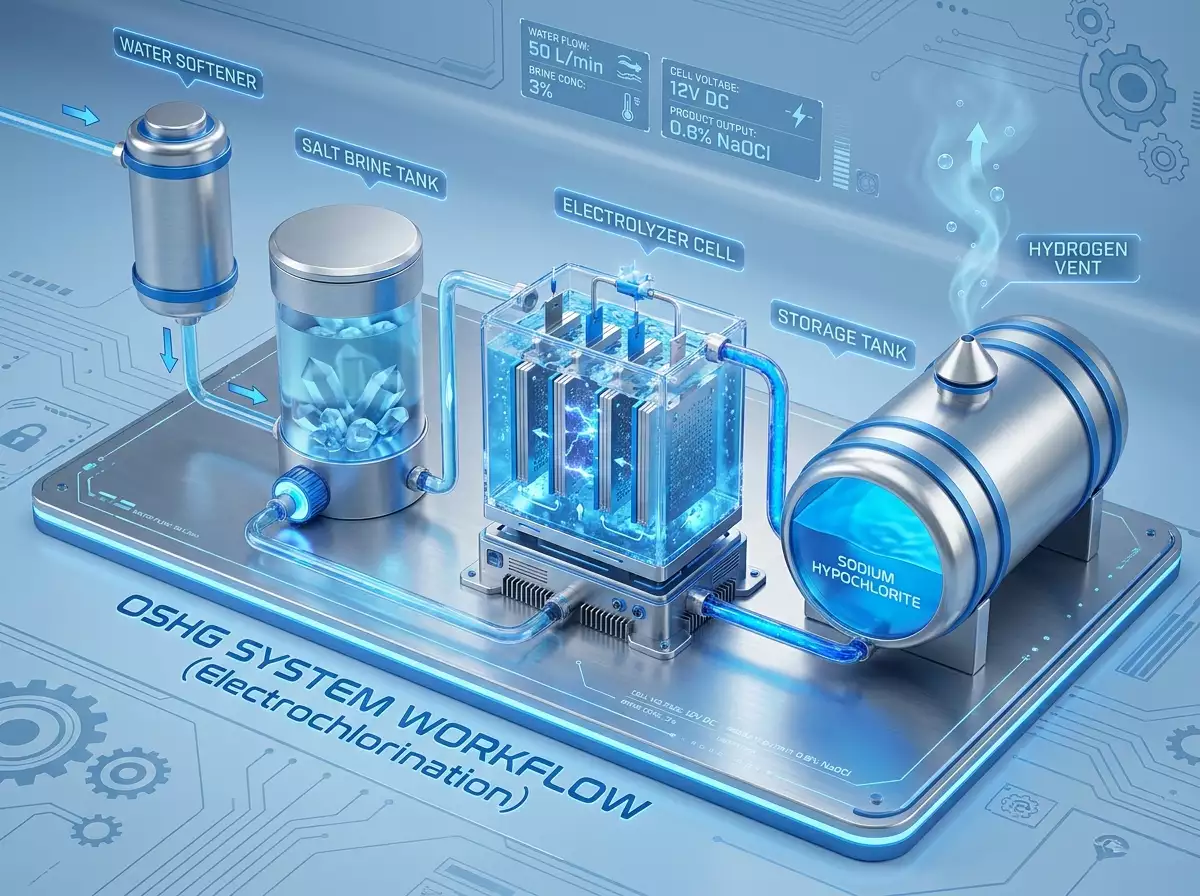
The operational workflow of an OSHG system is engineered for continuous, automated production:
- Softening: Raw water passes through a commercial water softener to remove calcium and magnesium, protecting the internal components from scaling.
- Brine Production: The softened water flows into a salt tank, dissolving the salt to create a saturated brine solution.
- Proportional Dilution: This saturated brine is precisely diluted with softened water to achieve an optimal 3% concentration.
- Electrolysis: The diluted brine enters the electrolyzer cell. As direct current passes through the electrodes, the electrochemical reaction converts the brine into a highly effective sodium hypochlorite solution.
- Storage & Venting: The generated solution is piped into a storage tank for dosing. Because hydrogen gas is a natural byproduct of this high-yield reaction, Century systems feature active degassing mechanisms to safely vent the hydrogen outdoors, eliminating explosion risks.
OSHG vs. Bulk Bleach and Chlorine Gas: Why Switch?
When designing a large-scale water disinfection strategy, engineers typically evaluate three main options. Understanding the debate between chlorine gas vs liquid chlorine (bulk bleach) and modern electrolysis is critical for your facility’s safety and budget.
- Chlorine Gas: Historically cheap, but exceptionally hazardous. It requires specialized pressurized transport, rigorous EPA/OSHA compliance, hazmat suits for operators, and poses catastrophic risks in the event of a leak.
- Bulk Bleach (Commercial Sodium Hypochlorite): Safer than gas, but financially inefficient. Commercial bleach degrades rapidly (losing up to 50% of its active strength in weeks) and requires massive storage tanks. You are essentially paying exorbitant freight costs to ship water.
- OSHG: The modern standard. You only transport and store standard, inert salt (NaCl). It produces a stable 0.8% solution on demand, entirely automating the process and removing human operators from chemical handling risks.
| Feature | Chlorine Gas | Bulk Bleach | OSHG System |
| Logistics Cost | High (Hazmat freight) | High (Shipping heavy water) | Extremely Low (Salt only) |
| Storage & Stability | Toxic hazard, highly regulated | Rapid degradation, loses potency | Stable, raw salt has no expiry |
| Compliance | Extremely strict | Strict | Minimal |
| Operator Safety | High risk, PPE required | Moderate risk | Automated, zero contact |
OSHG vs. Salt Cells: Understanding the Scale and Design
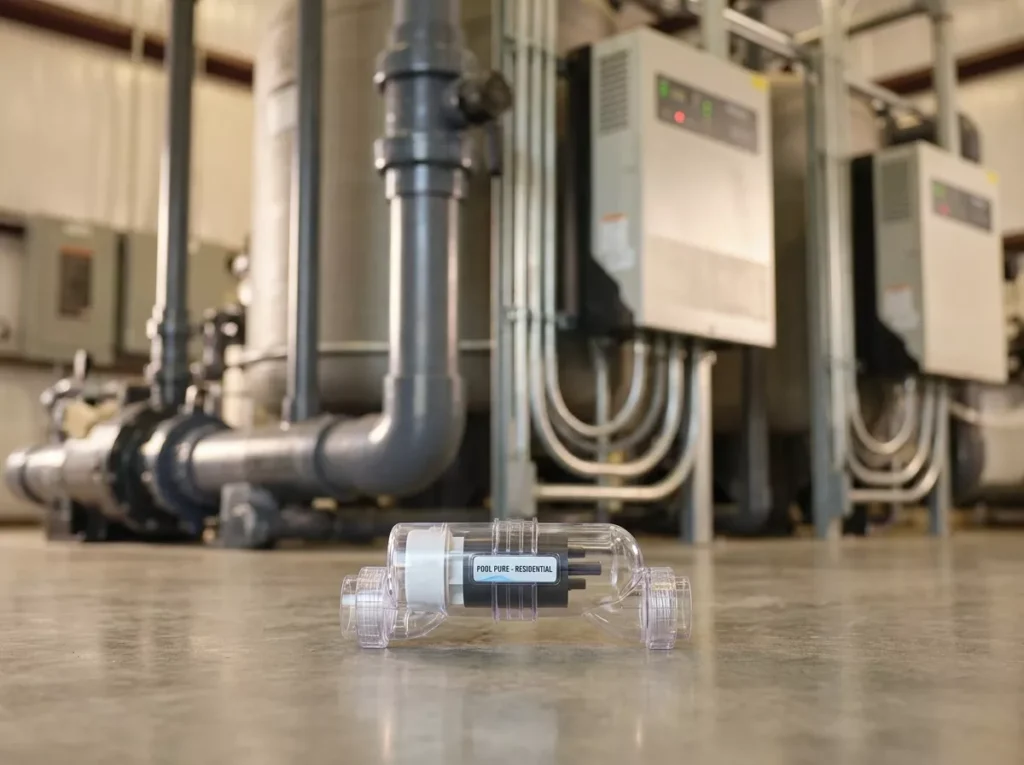
While both utilize electrochemistry, comparing a commercial salt water chlorinator (a salt cell) to an industrial OSHG plant is like comparing a residential boiler to a municipal power station.
- Salinity & Concentration: A pool salt cell electrolyzes the entire body of water at a low salinity of roughly 3,000 ppm. An OSHG unit is a standalone generator that electrolyzes a concentrated 3% brine (30,000 ppm) internally, creating a strong 8,000 ppm hypochlorite solution that is then injected into the main water line via dosing pumps.
- Operating Pressure: Salt cells are installed directly in-line and must withstand the full pressure of the filtration piping. In contrast, OSHG electrolyzers operate at atmospheric or very low pressure; the resulting liquid flows freely into a vented storage tank.
- Application Scale: Salt cells are perfect for aquatic centers and pools. OSHG systems are engineered for municipal water plants and heavy industrial complexes.
Key Engineering Parameters for Industrial Sodium Hypochlorite Generators
Because an OSHG unit is a fully automated, capital-intensive asset, specifying the right parameters with your manufacturer is vital to ensure ROI. When consulting with Century, we focus on:
- Precise Salt Concentration: OSHG systems demand high-purity salt. The influent brine is strictly regulated at approximately 3% for peak current efficiency. If your application requires a customized concentration, our engineers can modify the PLC logic accordingly.
- Chlorine Output Capacity: Industrial output requirements vary wildly—from 1 kg per day to several metric tons daily for multi-million-gallon water facilities. Accurately scoping your daily demand ensures we match the exact electrolyzer stack and power supply required, preventing under-sizing or wasteful capital expenditure.
- Inlet/Outlet Configurations: Based on the calculated output and your facility’s existing plumbing footprint, we customize the industrial-grade UPVC/CPVC piping connections for seamless integration.
Advanced Electrolyzer Design: Monopolar, Bipolar, and Polarity Reversal
To ensure maximum operational stability, many brine electrochlorinator models utilize robust monopolar configurations. Because these systems use softened water and maintain stable concentrations, the electrode gap can be engineered extremely tight, drastically improving electrical efficiency.
Furthermore, Century’s automated control systems periodically initiate polarity reversal to shed any micro-scale buildup. Since OSHG electrolyzers operate under low fluid pressure, the internal cell housings are often constructed using precision-machined and solvent-welded clear acrylics or industrial polymers. This engineering choice maintains exceptional structural integrity while significantly reducing overall manufacturing costs.
The Importance of Automation in Modern Electrochlorination
You cannot manage what you do not measure. In a Century OSHG system, automation isn’t a luxury; it is the core of the product.
Driven by an industrial-grade PLC, our systems continuously monitor influent water temperature and brine concentration in real-time. The rectifier provides a rock-solid constant current, while the system automatically executes a polarity reversal every four hours to protect the MMO titanium coatings. Hydrogen mitigation is actively managed via automated purge fans to prevent gas accumulation. All of this complex electrochemistry is simplified and presented to your operators via a user-friendly, responsive HMI touch screen.
Major Applications for OSHG Systems
The scalability and safety profile of on-site generation make it the disinfection method of choice across critical infrastructure sectors. Century’s heavy-duty systems are deployed in:
- Municipal Drinking Water: Replacing dangerous chlorine gas to ensure safe, compliant, and continuous potable water delivery for entire cities.
- Wastewater Treatment Plants: Providing heavy-duty oxidation and disinfection to meet strict environmental discharge regulations without the liability of bulk chemicals.
- Power Plant Cooling Towers: Dosing hypochlorite to aggressively combat biofilm buildup, algae growth, and Legionella in massive heat exchange networks, thereby maintaining thermal efficiency.
- Large Commercial Aquatics & Theme Parks: Delivering consistent, high-volume sanitation for millions of gallons of water, ensuring guest safety even under extreme bather loads.