
Why pH Creeps Up in Saltwater Systems: Electrochemical Mechanisms and Commercial Engineering Solutions
For aquatic facilities transitioning to on-site chlorine generation, regulating water quality parameters remains a primary operational focus. While electrolytic chlorination reliably yields high-purity sodium hypochlorite, operators universally encounter a persistent upward trend in water pH. Unlike traditional gas chlorine, which introduces an aggressive acidic load, salt water chlorination environments continuously drive the body of water toward an alkaline state. If left unmanaged, this shift drastically reduces the sanitizing activity of free chlorine— forcing highly active hypochlorous acid (HOCl) to dissociate into less reactive hypochlorite ions (OCl–)—and triggers massive calcium precipitation and scaling, damaging the entire water treatment infrastructure. This technical analysis deconstructs the electrochemical principles and physical-chemical drivers behind why pH creeps up in saltwater systems, delivering long-term engineering solutions for saltwater pool pH balance in commercial facilities.
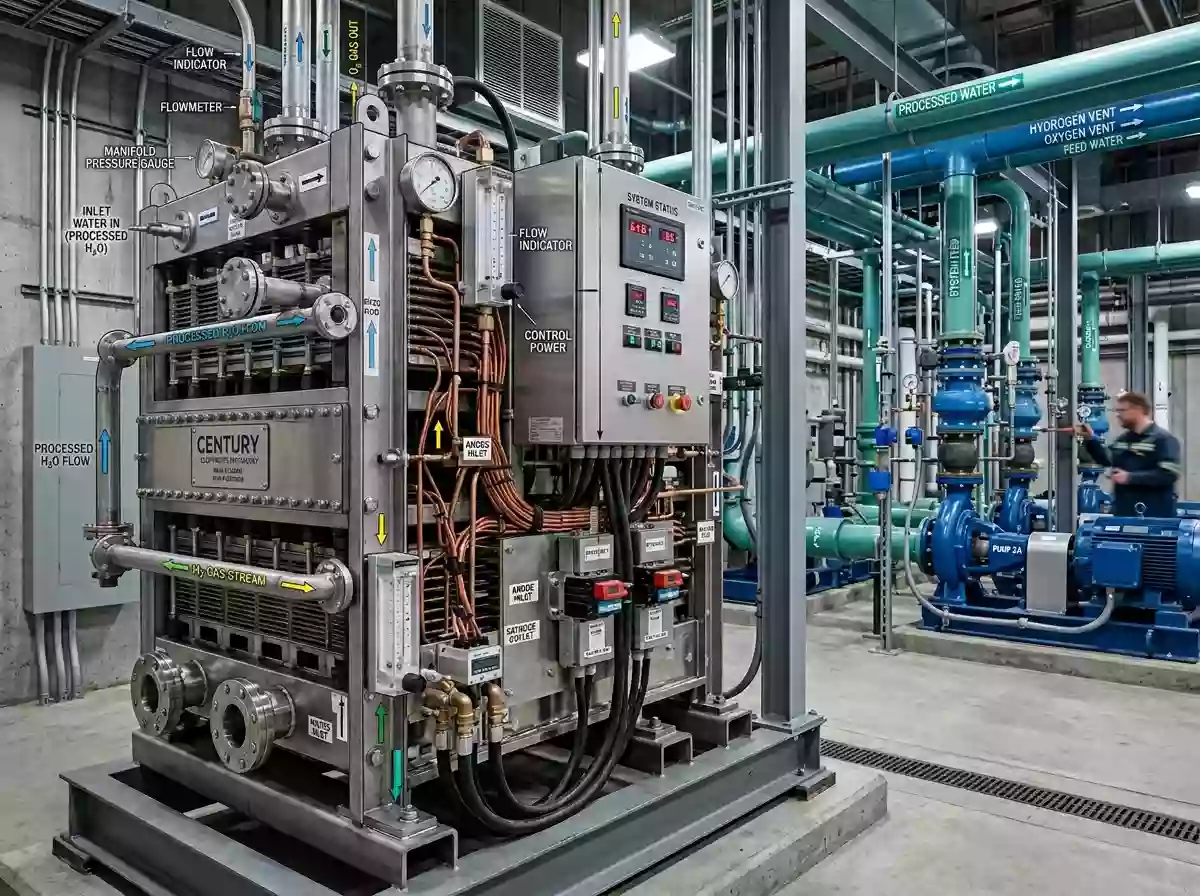
The Electrolytic Byproduct: How Sodium Hydroxide Drives Salty Pool Alkaline Shifts
To identify the root cause of why a saltwater pool pH keeps rising, one must analyze the operational chemistry inside a membraneless electrolytic cell. As dilute brine flows across energized titanium electrodes, a reduction reaction occurs at the cathode interface, breaking down water molecules to produce hydrogen gas and releasing high concentrations of hydroxyl ions:
2H2O+2e−→H2↑+2OH−
These hydroxyl ions rapidly bond with sodium ions floating in the water to form highly alkaline sodium hydroxide (NaOH) directly at the electrode interface, serving as the primary molecular driver for the overall upward shift in sodium hydroxide pool pH. Even though the subsequent hydrolysis of chlorine into hypochlorous acid offers a minor neutralizing, counter-balancing effect downstream, it cannot offset the continuous accumulation of this strong alkaline byproduct. This creates a persistent, highly alkaline micro-environment around the electrodes that continuously mixes into the main water circulation loop. Over extended operating cycles, this alkaline shift disrupts the chemical equilibrium, degrades sanitizing efficiency, and accelerates the emergence of compounded water quality anomalies.
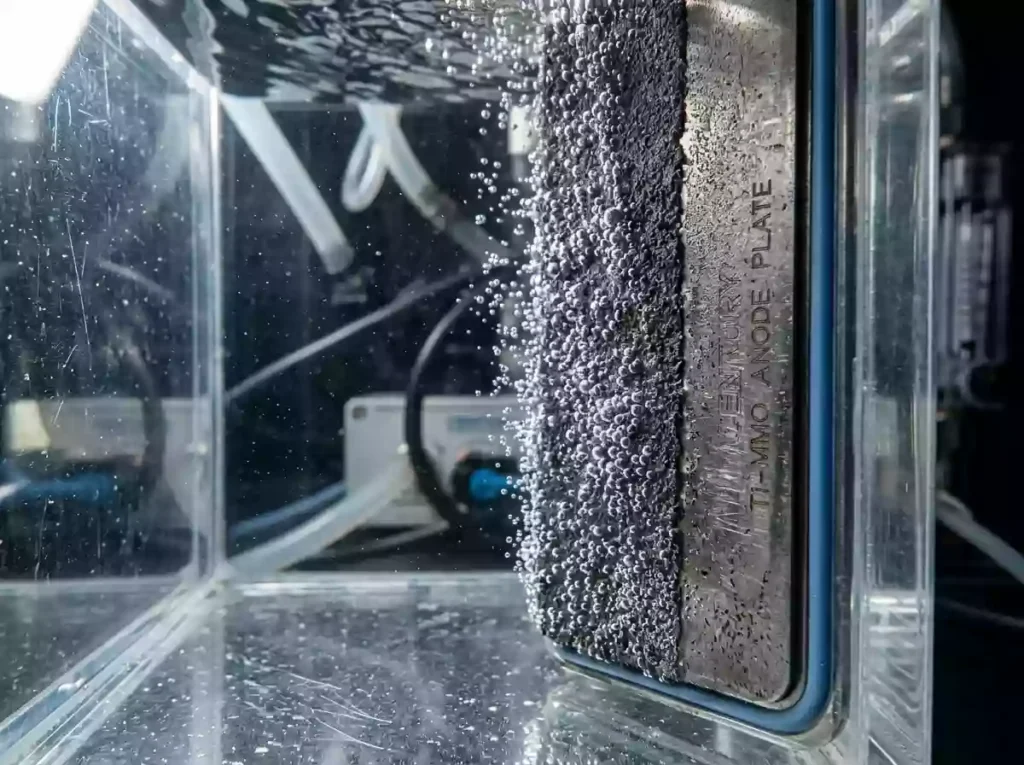
Hydrodynamic Aeration: Carbon Dioxide Off-Gassing and Atmospheric Equilibrium
Beyond electrochemical reactions, hydrodynamic aeration significantly accelerates the upward pH drift. The electrolytic process continuously generates massive volumes of microscopic hydrogen bubbles. As the treated water exits the electrolytic chamber and is injected back into the pool basin at high velocities via return nozzles, these dense micro-bubbles create an aggressive, ongoing aeration effect throughout the pool tank.
Water naturally carries dissolved carbon dioxide (CO2), which establishes a delicate equilibrium with carbonic acid (H2CO3) to maintain a stable baseline pH. The severe mechanical turbulence accelerated by the return stream forces the carbon dioxide off gassing pool process into the atmosphere, breaking the existing aquatic equilibrium. According to the chemical principles of mass action, the water mass spontaneously consumes hydrogen ions (H+) to compensate for the lost atmospheric carbon dioxide. Consequently, the water naturally turns alkaline and the pH rises continuously without any external addition of chemical bases. Establishing proactive degassing and velocity protocols is an indispensable element of securing a stable saltwater pool pH balance.
The Scaling Impact: High pH Consequence on Commercial Electrolyzer Longevity
Allowing the saltwater system pH to linger above the ideal 7.4 to 7.6 operational range causes severe structural damage to core equipment components. When pH breaches the 7.8 threshold, the langelier saturation index pool metric shifts to a positive value, indicating an aggressive tendency toward scale precipitation. Dissolved calcium ions cross-link with carbonate ions, depositing insoluble calcium carbonate crystals.
Operating under elevated temperatures and high current densities, the titanium plates become highly susceptible to attracting this mineral scale, forming a dense, insulated crust over the active areas. This layer causes a dramatic spike in internal electrolytic resistance, forcing the power rectifier to escalate voltage to stabilize output, which induces severe localized overheating. This voltage surge initiates a destructive current crowding effect. This chronic thermal and electrical stress directly causes titanium anode scaling, leading to the delamination, peeling, and failure of the precious ruthenium-iridium mixed metal oxide (MMO) coating. This premature failure destroys the commercial cell, spikes capital replacement costs, and destabilizes the entire water treatment process.
Total Alkalinity Dynamics: Mitigating the LSI Deficit and Acid Dosing Logistics
Total alkalinity, primarily composed of bicarbonate ions (HCO3-), acts as the natural buffering system of water and is critical for stabilizing the pH of a saltwater facility. When total alkalinity exceeds 120 ppm, the water exhibits excessive resistance to pH changes, locking it into an elevated alkaline state and dramatically increasing the required chemical volume for acid correction. Conversely, low alkalinity causes erratic, severe pH bouncing, making water balance highly unstable.
Commercial applications demand a standardized muriatic acid dosing pool protocol to continuously neutralize the electrolytic sodium hydroxide byproduct and suppress the upward pH creep. Bulk, single-dose chemical dumping must be strictly avoided to prevent a rapid crash in total alkalinity, which triggers highly corrosive water conditions that damage pool shells, pipework, and heat exchangers. Incorporating high-precision peristaltic pumps for continuous, automated micro-dosing stabilizes total alkalinity safely between 80 to 100 ppm. This method gently corrects the Langelier Saturation Index, ensuring precise pH control while maintaining a long-term, balanced water chemical matrix to manage operating expenses (OPEX).
Automated Countermeasures: Integrating Closed-Loop Systems with Century Architecture
In high-load commercial scenarios, manual water testing intervals and manual chemical dosing are highly inefficient, failing to keep pace with the swift pH increases caused by 24/7 cell operations and resulting in severe water chemistry imbalances. Century commercial chlorination hardware counteracts this vulnerability with a fully integrated, closed-loop control system.
By combining an advanced automated pool chemical controller with high-precision online pH sensors and a central PLC processing unit, the system seamlessly commands the acid injection module. The equipment collects real-time water quality metrics, instantly delivering precise, metered chemical dosing upon detecting minor pH deviations. This keeps the water locked into an optimal pH range of 7.4 to 7.5, suppressing scale formation conditions before they start, protecting electrolytic workflows, improving sanitization rates, and maximizing electrode lifespans. Integrating a heavy-duty commercial pool electrochlorinator system from Century achieves true unattended automation, drastically reducing long-term operational costs and facility maintenance overheads.