
Monopolar vs. Bipolar Electrochlorination Cell Design: The B2B Engineering Guide
When engineering a sodium hypochlorite generator, the connection topology of the titanium anode plates fundamentally dictates system performance. Industrial electrolyzers rely on either monopolar or bipolar configurations. In a monopolar design, plates of the same polarity are wired in parallel, operating under low-voltage, high-current conditions. This offers structural simplicity and ease of maintenance but demands massive busbars and a larger physical footprint. Conversely, a bipolar chlorinator cell connects units in series, applying power only to the terminal plates. The intermediate plates function as both anode and cathode on opposite faces. This high-voltage, low-current approach yields a highly compact footprint and uniform current distribution. This guide breaks down the mechanistic differences and application scenarios of both electrochlorination cell designs to help B2B buyers and system integrators make data-driven sourcing decisions.
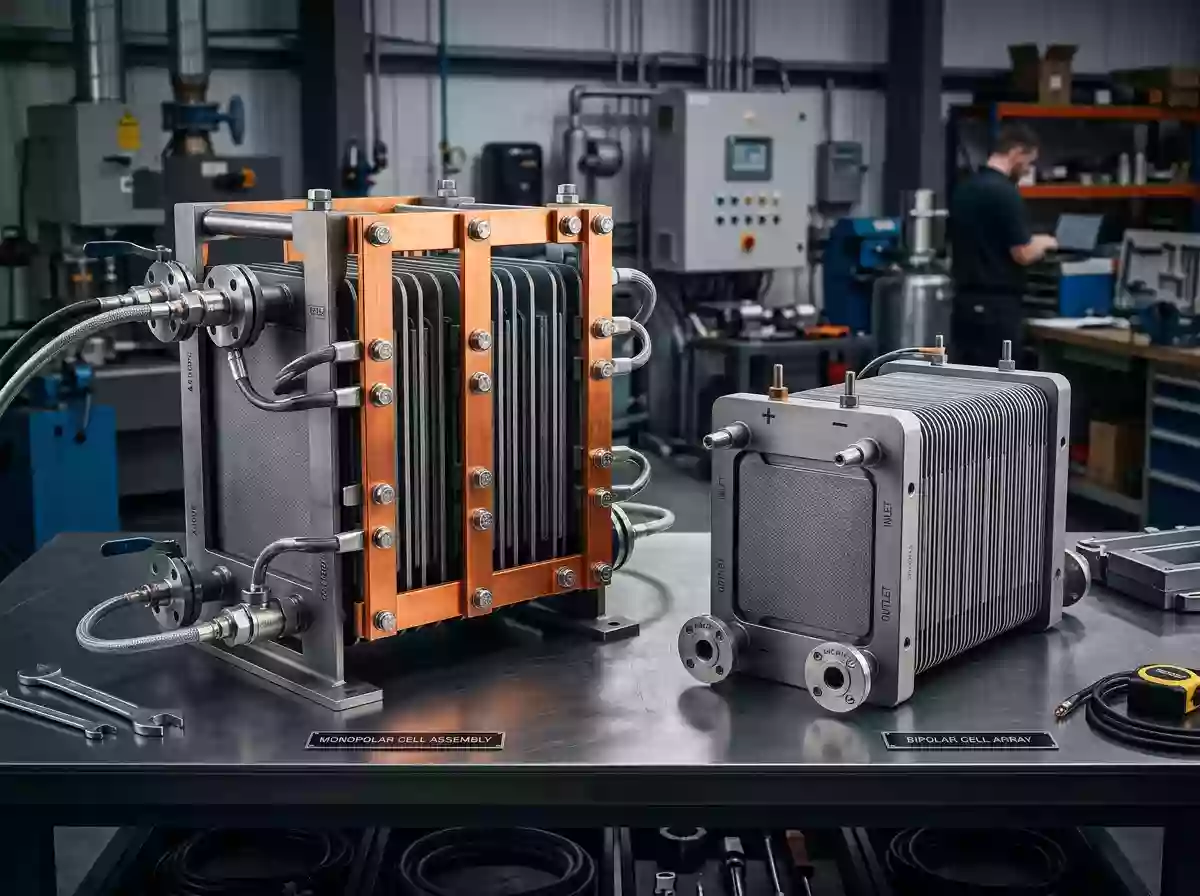
The Core Circuitry: Defining Monopolar vs. Bipolar Electrolyzer Systems
From a foundational circuit perspective, a monopolar system operates on an electrical parallel connection. All titanium anode plates are wired to the positive terminal, and all cathodes to the negative. Both faces of a single plate share the identical polarity, resulting in uniform voltage across cells while the total amperage is divided among them.
The bipolar electrolyzer operates on an electrical series connection. Power is supplied exclusively to the terminal plates, leaving the intermediate plates physically disconnected from the external power source. Instead, these intermediate plates are polarized by the electric field traveling through the electrolyte. Face A of an intermediate plate acts as an anode (where chloride ions lose electrons to evolve chlorine gas), while Face B acts as a cathode (where hydrogen ions gain electrons). This simultaneous oxidation and reduction on a single substrate—forming a series-conductive core—is the fundamental microscopic distinction between the two designs.
Inside the Monopolar Electrode Assembly: Low Voltage, High Current Engineering
A monopolar electrode assembly inherently operates under low-voltage, massive-current parameters. A single electrolytic cell typically runs at merely 3 to 5 volts, yet the total system current can easily scale into the thousands of amperes. This electrical profile places extreme demands on the conductive infrastructure. It necessitates oversized copper busbars and heavy-duty titanium composite conductors to carry the load. If the conductive cross-section is undersized, the system will suffer from severe Ohmic heating losses, wasting significant electrical energy.
This remains a critical design pain point in field engineering. During the mass production of monopolar components, Century implements rigorous current load calculations to engineer precise busbar connections, drastically minimizing contact resistance between the titanium plates and the conductors. This manufacturing precision prevents localized thermal runaway during high-amperage transmission, eliminating the risk of high-temperature deformation or terminal burnout. The result is a robust monopolar structure capable of sustaining continuous, heavy-duty current loads for years.
Demystifying the Bipolar Chlorinator Cell: Voltage Scaling and Shunt Current Challenges
Configured in series, the bipolar chlorinator cell operates under high-voltage, low-current conditions. The total system voltage is the sum of the individual cell voltages—frequently scaling to 24V or 48V banks—while the system amperage remains equal to that of a single unit. This architecture eliminates the need for massive copper busbars, drastically simplifying external wiring and driving down the procurement and installation costs of conductive hardware.
However, it introduces a notoriously difficult industry challenge: parasitic shunt currents. Because all plates share a continuous electrolyte flow path, a fraction of the electrical current bypasses the reactive plates, channeling directly through the fluid pathway as wasted energy. Over time, these stray currents distort the electric field at the edges of the electrolyzer, triggering accelerated anodic dissolution of the MMO (Mixed Metal Oxide) coating. This leads to premature delamination of the coating at the edges, severely shortening the lifespan of the electrode.
As an experienced titanium anode manufacturer, Century tackles this by engineering CFD-optimized hydraulic baffles. By restructuring the internal fluid channels, we regulate both the water flow trajectory and the electric field distribution. This physical barrier effectively blocks parasitic pathways, mitigating shunt currents and ensuring the long-term stability of the bipolar cell array.

Efficiency Metrics: Industrial Electrolysis Power Consumption & CAPEX Comparison
When evaluating industrial electrolysis power consumption and overall ROI, the two architectures diverge significantly. The bipolar structure is incredibly dense. By minimizing the gap between plates, it lowers solution resistance, making it highly energy-efficient in high-salinity, high-conductivity environments like seawater electrolysis. Furthermore, its low-current requirement significantly reduces the CAPEX required for heavy-duty rectifiers. Conversely, the monopolar circuit architecture boasts superior fault tolerance. It adapts exceptionally well to low-conductivity water and high-velocity hydraulic scouring. While its power supply footprint and initial rectifier costs are higher, its operational versatility is unmatched. Equipment procurement should align with site-specific salinity, flow dynamics, energy standards, and project budgets to determine the optimal cell architecture.
B2B Sourcing Strategy: Matching Cell Architecture to Water Treatment Scale
For large-scale municipal water treatment electrochlorination projects, the bipolar configuration is the undisputed standard. Its high space-utilization ratio and low-current requirements allow municipalities to drastically slash rectifier procurement costs, aligning perfectly with the low-OPEX mandates of massive infrastructure projects.
In contrast, commercial pool salt cells and systems requiring high-frequency reverse polarity for self-cleaning are better served by the monopolar design. This structure is impervious to the electrical shockwaves generated during frequent polarity reversals. Because it lacks the induced charge lag inherent to intermediate plates, a monopolar cell maintains rock-solid stability and superior longevity under aggressive descaling cycles. At Century, we bypass the race-to-the-bottom commodity market. We leverage live site parameters—including fluid velocity, reverse polarity frequency, and brine concentration—to custom-engineer the exact electrochlorination cell design you need, delivering precision-matched hardware for global B2B integrators.