
Balancing Output and Lifespan: Optimizing Current Density in Commercial Electrochlorination Cells
In the engineering and scaling of industrial water disinfection infrastructure, selecting the optimal operating parameters for an electrolytic system is a complex techno-economic challenge. Among these variables, current density electrochlorination acts as the primary vector determining both the initial capital expenditure (CAPEX) and the long-term operational costs (OPEX) of the system. For engineering firms and equipment distributors purchasing core components, understanding the physical and electrochemical implications of current distribution is mandatory to prevent premature asset failure.
Historically, some system designers mistakenly accelerated current feeds to minimize the physical footprint of the equipment, only to encounter catastrophic material degradation in the field. To mitigate these risks, Century works as a specialized technical partner to selective leading global OEMs, providing customized, precision-engineered titanium components that balance aggressive chemical throughput with predictable material longevity.
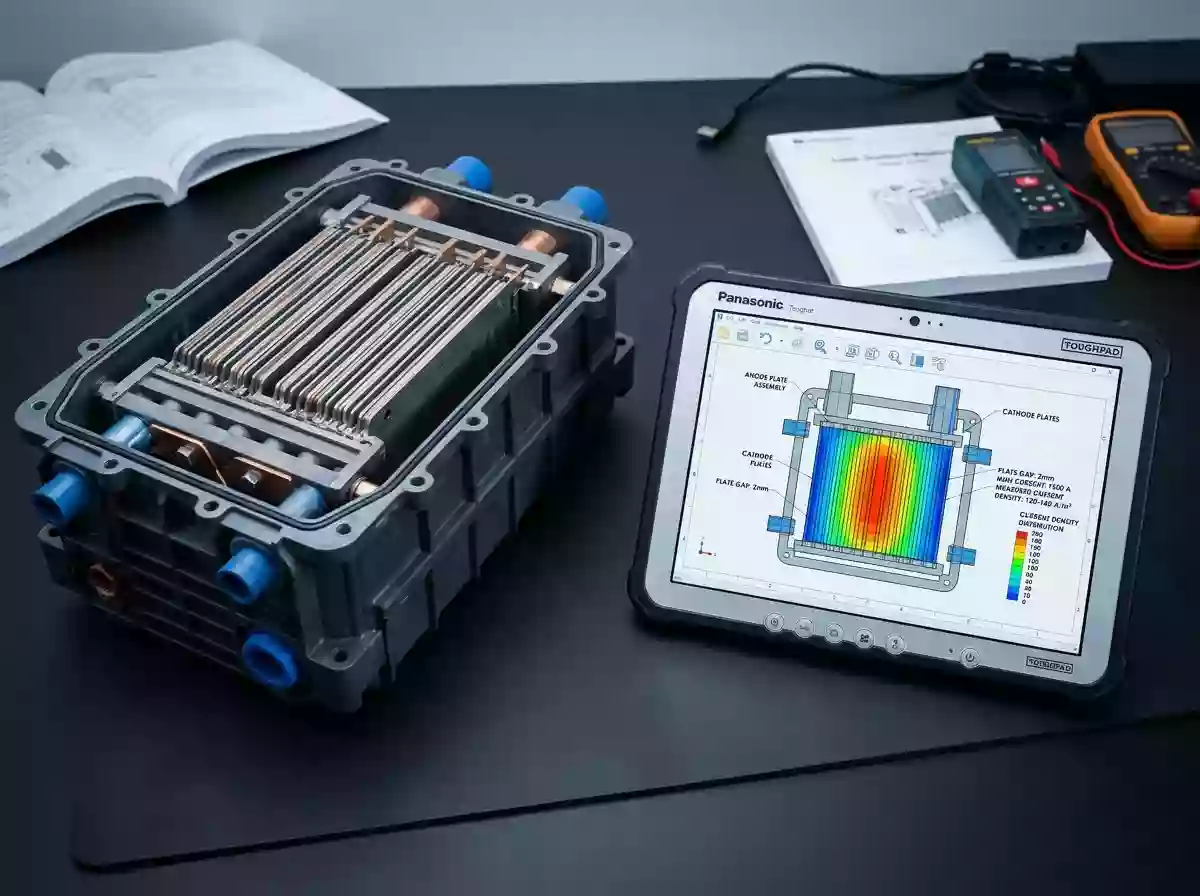
The Core Vector: Defining Current Density in Commercial Electrochlorination Cells
Electrochemical current density, expressed linearly as amperes per square meter of active electrode area (A/m²), defines the concentration of electrical energy forced through the catalytic interface. In any standard commercial electrochlorination cell, this metric governs the kinetics of the chlorine evolution reaction (CER). According to Faraday’s laws of electrolysis, the mass of free chlorine produced is directly proportional to the total electrical current passed through the system. Consequently, current density establishes the baseline volume capacity of the generator.
When designing a chlorine generation loop, current density acts as the foundational metric that determines the total required active surface area of the plates. Running a cell at an elevated current threshold allows a smaller volume of titanium mesh or plates to generate the identical poundage of sodium hypochlorite as a much larger cell running at a lower amperage load. However, compressing this energy profile introduces harsh operational penalties. For high-throughput applications, a competent titanium electrode manufacturer must verify that the base metal micro-geometry and fluid dynamics can handle the localized charge transfer without generating extreme thermal hotspots or uneven current crowding.
The Efficiency Matrix: Production Scaling vs. Electrochlorination Power Consumption
While maximizing the current load reduces the required mass of titanium—thereby lowering the initial procurement cost of the electrolytic cell—it disrupts the system’s electrical efficiency curve. As the current density escalates beyond optimal thresholds, the total cell operating voltage climbs non-linearly. This voltage expansion is driven by a combination of activation overpotential at the catalytic interface, mass transport limitations in low-salinity brines, and ohmic resistance within the electrolyte solution and the metal substrate itself.
This upward voltage shift has a direct impact on electrochlorination power consumption, which is quantified as the kilowatt-hours of electrical energy consumed per kilogram of equivalent free chlorine produced (kWh/kg Cl₂). When a system is driven at an excessive current rate, a larger percentage of the incoming electrical energy is wasted as parasitic heat generation rather than driving the conversion of chloride ions into active chlorine.
For large-scale municipal water treatment facilities operating continuously, a minor spike in cell voltage can accumulate into thousands of dollars in excess utility costs annually. Century assists selective leading global waterworks OEMs by optimizing the macro-geometry of plate configurations, ensuring that localized fluid flow reduces bubble coverage on the electrode surface, thereby stabilizing operating voltage and lowering baseline energy overheads.
Accelerated Wear: High Current Load and MMO Anode Degradation Mechanics
Beyond energy losses, excessive current distribution triggers severe structural damage at the micro-level. The catalytic Mixed Metal Oxide (MMO) coating—typically an engineered solid solution of ruthenium and iridium oxides—possesses a finite charge-transfer capacity. Operating above these engineered limits accelerates the kinetics of mmo anode degradation through two primary electrochemical pathways: parasitic oxygen evolution and localized proton accumulation.
At elevated current rates, the local potential of the anode shifts into the region where the oxygen evolution reaction (OER) begins to compete aggressively with chlorine evolution. The generation of oxygen molecules within the microscopic pores of the MMO coating creates immense mechanical internal pressure, leading to micro-fracturing of the catalytic crystal lattice. Concurrently, the water-splitting reaction associated with oxygen evolution generates an intense concentration of hydrogen ions (H+) directly at the anode interface. This localized drop in pH creates a highly acidic micro-environment that accelerates the chemical dissolution of the precious metal matrix. Once the iridium-ruthenium oxide layer is stripped or loosened, the titanium substrate undergoes rapid, irreversible passivation, terminating the operating life of the cell.
Application Tailoring: Custom Current Loads for Commercial Pools and Municipal Waterworks
Because the boundaries of electrochemical wear change based on water chemistry, current density must be engineered around the specific application profile. Commercial swimming pool chlorinators and municipal drinking water plants present completely divergent operational demands, requiring distinctly unique hardware responses.
Commercial pool systems operate in highly variable environments with low total dissolved solids (TDS), fluctuating water temperatures, and elevated levels of calcium and magnesium ions. These conditions make the cells highly susceptible to carbonate scaling. To clear this mineral buildup without aggressive acid washing, these systems utilize frequent polarity reversal cycles. For a reverse polarity salt cell, operating at an aggressive current density is highly risky; the combined stress of hydrogen embrittlement during the cathodic phase and high hydraulic shear will quickly cause premature coating delamination. Consequently, commercial pool configurations generally require a highly conservative current density limit (typically under 400-600 A/m²) combined with a high-adhesion, specialized MMO formulation to withstand constant polarization switching.
In contrast, municipal waterworks treat stable, highly conditioned brine streams under constant, unvaried polarity. These installations prioritize maximum asset reliability and an uninterrupted service life exceeding five to seven years. For these applications, engineers can deploy optimized mid-to-high current densities (ranging from 1000 to 1500 A/m²), provided the system integrates premium-grade substrate preparation and precise noble metal mass loading. Century engineers custom component configurations tailored exactly to these operational demands. By adjusting the micro-porosity of our coatings and verifying surface roughness metrics, we provide selective international brands with components that consistently deliver high volume output without compromising structural integrity.