
Converting Commercial Chlorine Pools to Salt Systems: A Technical and Financial Guide to Retrofitting Saltwater Chlorinators
Operating a commercial swimming pool under a traditional liquid chlorine or calcium hypochlorite dosing regime introduces substantial overheads. These include mandatory hazardous material storage compliance, volatile chemical procurement costs, complex logistics, and accelerated corrosion of piping and infrastructure.
Today, executing a commercial salt water pool conversion to leverage onsite electrochemical chlorine generation has emerged as the premier strategy for commercial facilities looking to optimize operational expenditure (OpEx) and extend asset lifespans. By synthesizing sodium hypochlorite directly on-site, facilities eliminate dependence on bulk chemical suppliers and achieve precise control over water quality.
This comprehensive technical guide outlines the exact roadmap for a commercial pool saltwater chlorinator retrofit, focusing on saltwater chlorinator ROI analysis, hydraulic integration, and chemical stabilization protocols.
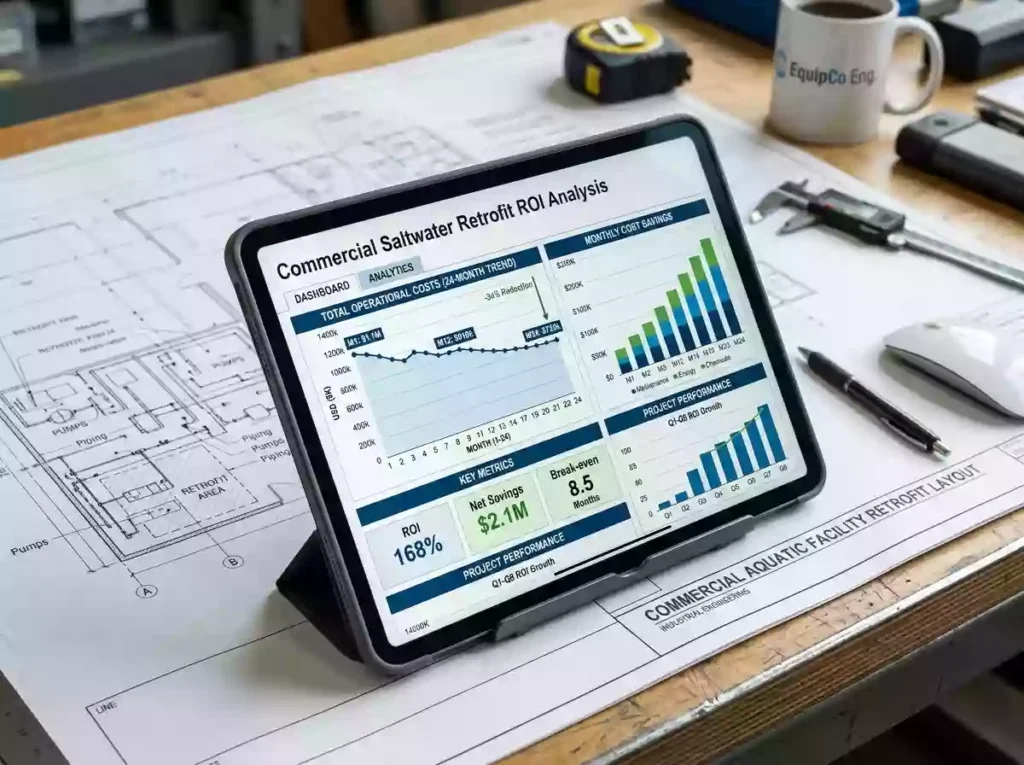
Financial Engineering: Assessing the Cost to Convert Pool to Salt Water and Long-Term ROI
When analyzing the cost to convert pool to salt water, commercial operators must look beyond the initial capital expenditure (CapEx) and focus on the lifetime operational savings. The upfront commercial saltwater chlorinator cost represents a notable investment ceiling. It encompasses heavy-duty industrial electrolytic cells, intelligent variable-frequency rectifiers, customized bypass piping networks, and integrated automated control skids. This initial outlay is significantly higher than that of primitive chemical feed pumps.
However, the long-term operational savings are profound. By utilizing low-cost, food-grade granulated sodium chloride ($NaCl$) to generate free available chlorine on-site, facilities insulate themselves from the volatile pricing and supply chain bottlenecks of packaged liquid chlorine and cal-hypo tablets.
[Technical Detail Enhanced – Added Cost Metric]: Industry data indicates that shifting to onsite generation cuts annual chemical consumption expenditures by 60% to 70%.
Furthermore, eliminating bulk hazardous chemical storage drastically reduces regulatory compliance costs, lowers liability insurance premiums, and cuts specialized labor hours previously dedicated to manual dosing and frequent chemical balancing. For high-bather-load commercial facilities—such as resort pools, water parks, and municipal aquatic centers—the continuous reduction in OpEx typically yields a full saltwater chlorinator ROI within 18 to 24 months, transforming a mandatory sanitation requirement into a stable, cost-saving asset.
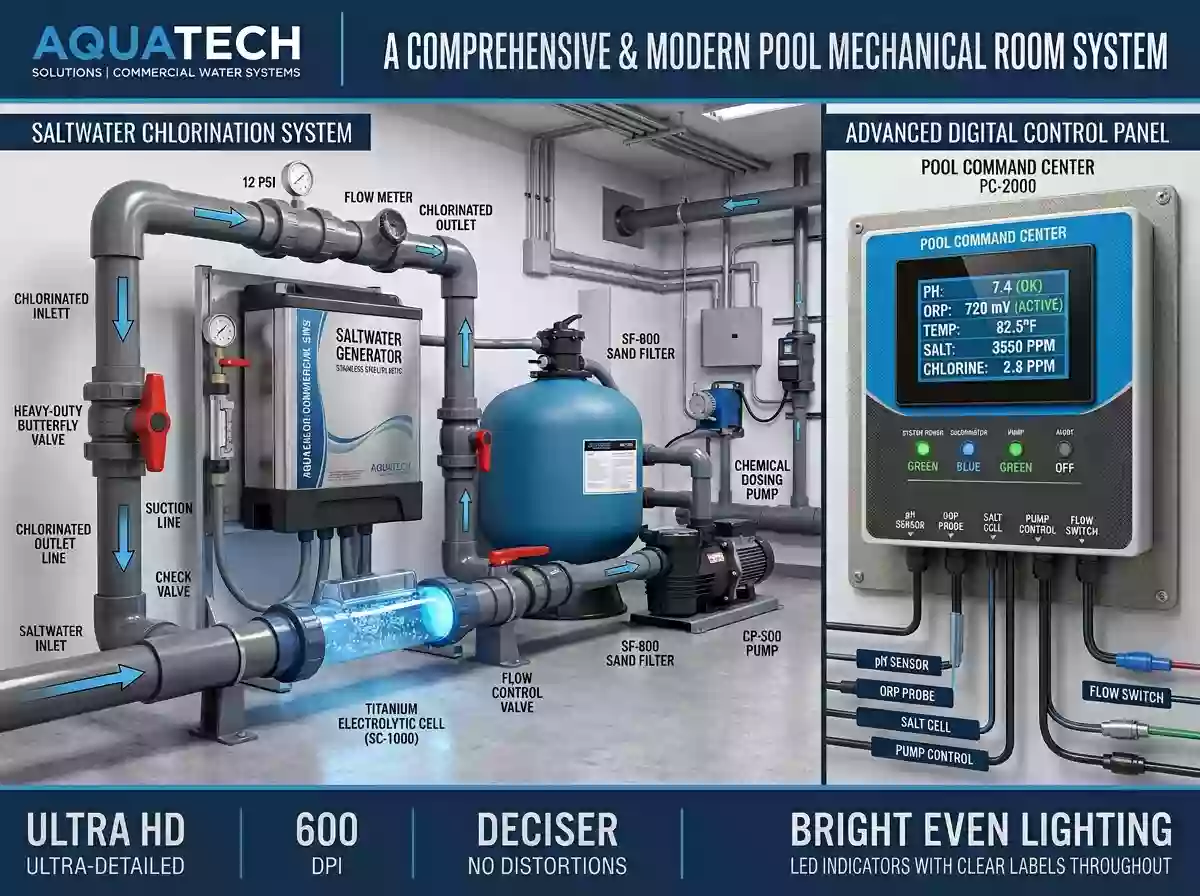
Hydraulic Integration: Designing a Heavy-Duty Pool Salt Chlorine Generator Retrofit
Integrating an industrial-grade commercial saltwater chlorinator into an existing mechanical room demands strict adherence to fluid dynamics and hydraulic standards. It is critical never to plumb a high-output electrolytic cell directly into the main filtration loop. The standard engineering blueprint dictates fabricating a three-valve bypass loop downstream of the filtration and commercial pool heating systems. This configuration ensures uninterrupted main pool circulation while allowing routine maintenance, acid-washing, or electrode inspections without shutting down the facility’s primary water loop.
Precise calculation of hydraulic head loss across the bypass is mandatory. Engineers should install a calibrated flow control valve alongside an inline digital flow meter to carefully regulate the volumetric flow rate through the electrolytic chamber.
Maintaining an optimal water velocity—typically between 1.5 and 2.5 meters per second (m/s)—is essential to eliminate localized turbulence and vortex-induced cavitation.
Proper flow distribution ensures uniform water contact across the titanium electrode plates, effectively dissipating reaction heat and preventing localized thermal spikes. This optimal velocity also guarantees that newly generated sodium hypochlorite is rapidly and homogeneously distributed back into the pool basin, preventing localized hyper-chlorination and ensuring consistent sanitizer levels across the entire aquatic matrix.
Asset Protection: Material Compatibility and Galvanic Isolation in Saltwater Upgrades
A common reservation among commercial facility managers regarding a saltwater pool conversion is the potential for accelerated galvanic corrosion of downstream metallic fixtures. However, this concern stems from a misunderstanding of salinity scales. While ocean water exhibits a highly corrosive salinity of approximately 35,000 ppm, a properly maintained commercial saltwater pool operates at a mild salinity of 3,200 to 3,500 ppm, which is significantly less aggressive. Corrosion risks can be entirely mitigated through precise metallurgical engineering and proactive grounding protocols during the commercial pool retrofitting phase.
During the retrofit, a comprehensive audit of all wetted metallic components is required. Existing low-grade components must be upgraded: swimming pool ladders, anchors, and underwater light niches should be replaced with Marine-Grade 316 Stainless Steel, while primary heat exchangers must utilize high-grade titanium construction.
Additionally, installing an inline zinc sacrificial anode within the circulation loop is a critical defense mechanism. This anode actively attracts stray currents and neutralizes the electrochemical triggers of galvanic corrosion.
The core chemical reaction taking place at the anode during on-site chlorine generation follows this fundamental electrochemical process:
2Cl−→Cl2+2e−
Cl2+H2O→HOCl+HCl
Combining material upgrades with robust galvanic isolation comprehensively protects the piping network, internal components, and pool deck aesthetics, substantially extending the operational lifespan of the facility’s hardware assets.
Chemical Transition SOP: Water Matrix Rebalancing Prior to Cell Activation
Once the physical installation of the commercial saltwater chlorinator kit is complete, the system must not be energized immediately. A strict water matrix stabilization Standard Operating Procedure (SOP) must be followed. Prior to introducing any salt, all existing primary chemical feed systems must be deactivated. The water chemistry must then be rebalanced to precise parameters: Total Alkalinity (TA) must be adjusted to 80–100 ppm, and Cyanuric Acid (CYA) stabilizer levels must be established between 30–50 ppm to protect newly generated free chlorine from rapid UV degradation, thereby stabilizing long-term chemical baseline costs.
After confirming these chemical parameters, the initial salt dosing can begin. Facilities must utilize high-purity pool-grade granulated salt (minimum 99.5% purity), broadcasting it evenly across the shallow end of the pool basin. Salt must never be dumped directly into the skimmers or allowed to pile up near the intake of the electrolytic cell.
Throughout this dissolution phase, the main electrolytic rectifier must remain powered off. The primary circulation pumps must run continuously for 24 hours to ensure absolute dissolution and a homogeneous water salinity profile across a target range of 3,200 to 3,500 ppm. Verifying uniform concentration via a calibrated digital salinity meter prior to cell activation prevents high-salinity slugs from entering the electrolytic chamber, protecting the specialized catalytic coatings on the electrodes from over-current damage.
Engineering Advantage: Deploying Century Architecture for Uncompromised Retrofit Reliability
Commercial facility retrofits often present challenging constraints, including confined mechanical room footprints and erratic hydraulic flow conditions. The Century line of heavy-duty commercial saltwater chlorine generators is engineered specifically to thrive in these demanding retrofitting environments. Utilizing premium Grade 1 Titanium base substrates paired with a proprietary, high-density Mixed Metal Oxide (MMO) noble metal catalytic coating, Century electrodes deliver exceptional resistance to high-amperage electrical stress and particulate erosion, ensuring sustained, high-efficiency chlorine output over extended lifecycles.
The matching intelligent switch-mode power supply features proprietary adaptive impedance scanning technology. This advanced control system continuously monitors the dynamic electrical resistance within the electrolytic chamber—tracking shifts in water temperature, flow fluctuations, and mineral scaling—and automatically auto-tunes the output voltage and current. This real-time adjustment compensates for the mechanical variances common in older, retrofitted circulation loops. The high adaptation tolerance and robust design of the Century system ensure seamless mechanical integration, delivering a fully automated, low-maintenance, and ultra-reliable pool sanitizer automation upgrade.