
Calculating Salt Requirements for Commercial vs. Residential Pools: A Technical Sizing Guide for Electrochlorination Systems
Transitioning to an electrochlorination system eliminates the hazards associated with traditional chemical storage, stabilizing water quality while strictly controlling operational expenditures. However, the core of running this equipment efficiently lies in precise salinity management. Whether operating a small backyard pool or a large-scale commercial aquatic center, establishing and maintaining a standard salinity baseline is mandatory. An imbalanced salt ratio not only disrupts water chemistry but also rapidly accelerates the degradation of titanium electrodes. This technical guide outlines professional volumetric formulas, distinguishes the hydrodynamic and operational load differences between residential and commercial environments, and provides empirical standards for calculating salt requirements across both scenarios, offering actionable references for accurate electrochlorination system sizing and dosing logistics.
The Baseline Metric: Understanding Salt Parts Per Million (PPM) for Pools
For both residential and commercial applications, the baseline salinity standard remains universal. Mainstream electrochlorinators operate optimally within a salinity range of 3,000 to 4,000 PPM. This concentration closely mirrors the salinity of human tears, ensuring bather comfort while providing the electrolytic cell with sufficient, stable water conductivity.
Deviating from this standard range triggers various mechanical and electrochemical failures. When salinity drops below 2,800 PPM, the water lacks adequate conductivity. To compensate, the power supply module will actively increase voltage to force the electrolysis reaction. This causes a rapid temperature spike across the plates, accelerating the depletion and flaking of the ruthenium-iridium (Ru-Ir) catalytic coating on the titanium substrate, which drastically shortens the cell’s lifespan.
Conversely, if salinity exceeds 4,500 PPM, the electrochemical corrosivity of the water increases significantly. This aggressive environment will continuously attack metallic pool fixtures, including stainless steel ladders, pump impellers, heat exchanger coils, and underwater lighting fixtures, leading to severe galvanic corrosion. Strictly adhering to the optimal salt parts per million (ppm) for pools is the fundamental prerequisite for ensuring stable system operation and extending asset longevity.
Formulaic Approach: Calculating Pool Salt Requirements by Volume
Calculating pool salt requirements is accurately determined by water volume, utilizing clear industry-standard conversion metrics. In US standard units, raising the salinity of 10,000 gallons of water by 1,000 PPM requires approximately 83 pounds of dedicated pool-grade salt. Under the metric system, raising the same concentration in one cubic meter (1m3) of water requires roughly 1 kilogram of salt.
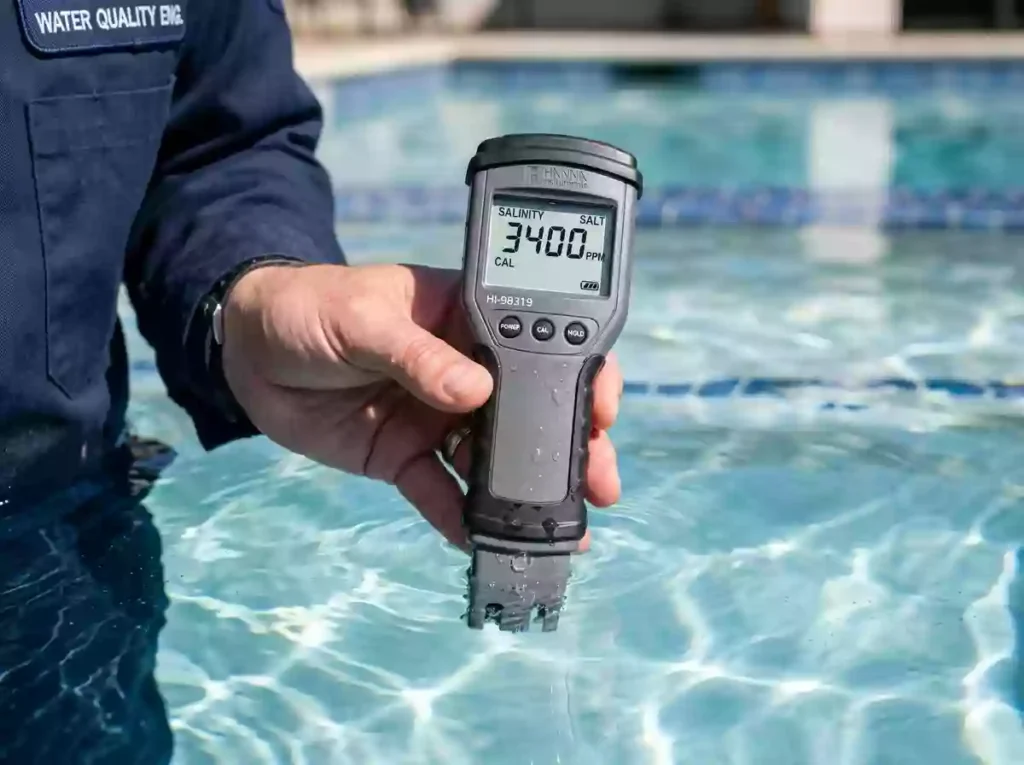
For brand-new pools starting at zero salinity, operators can directly apply this volumetric formula to calculate the total initial salt dosage required to hit the target PPM. For existing pools requiring a top-off, operators must first measure the current salinity using calibrated digital instruments, calculate the concentration deficit, and then determine the exact supplemental dosage.
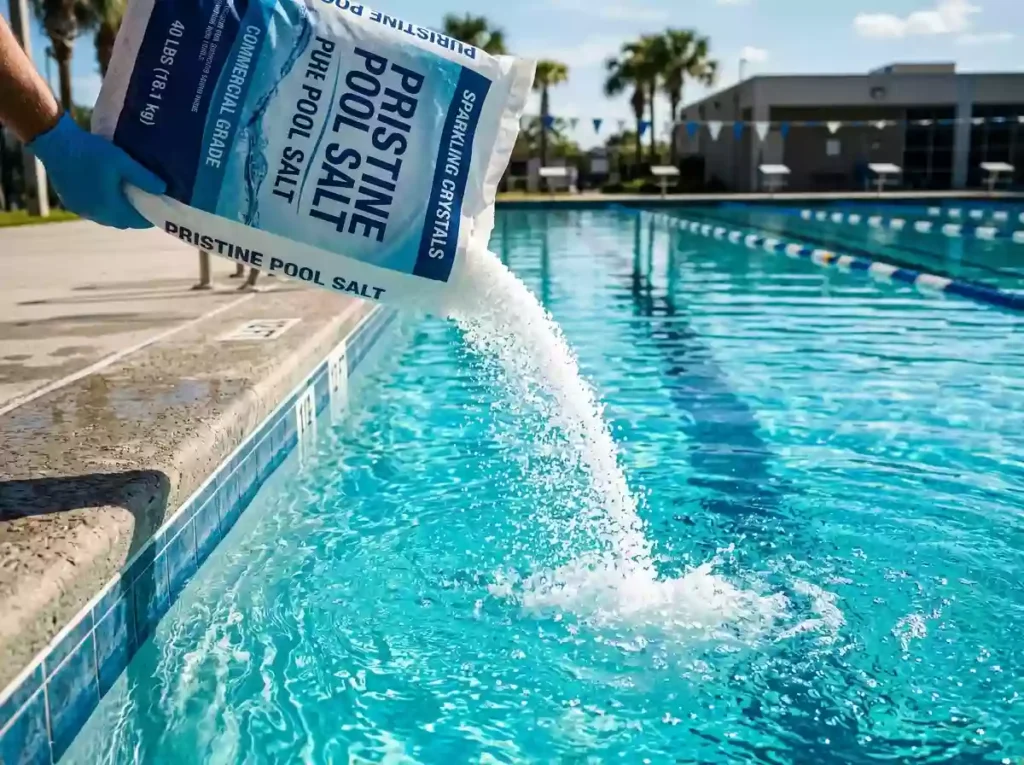
During application, bulk salt must never be dumped directly into the skimmer. It should be broadcast evenly across the deep end of the pool to dissolve naturally. This prevents highly concentrated saline pockets from passing directly through the electrolytic cell. Utilizing this precise mathematical approach prevents critical under-dosing or over-dosing errors during routine salt water chlorination maintenance.
Scale and Bather Load: Residential vs Commercial Salt Cell Dynamics
Residential pools experience low bather traffic and minimal organic contamination. Consequently, they only need to run for a few hours daily to maintain standard free chlorine residuals. This provides the electrolytic equipment with ample downtime to dissipate heat, resulting in a gradual rate of salt consumption and electrode wear, significantly extending the overall service life.
In stark contrast, commercial venues such as hotels and public aquatic centers face dense bather loads. The massive influx of organic contaminants—such as bodily secretions and cosmetics—combined with relentless UV degradation, causes chlorine demand to skyrocket. To compensate, the equipment must operate continuously at full capacity under heavy duty cycles.
Evaluating a residential vs commercial salt cell reveals that residential cell structures and coating durability simply cannot withstand these harsh conditions; they will rapidly suffer from electrode passivation and complete failure. Authentic commercial cells feature a significantly larger active reaction surface area and thickened, multi-layered noble metal coatings. Paired with industrial-grade power rectifiers capable of sustainably handling high-amperage outputs, they fulfill the rigorous demands of continuous, high-intensity operations.
Operational Variables: How Much Salt for Commercial Pool Maintenance?
Electrochlorination is a cyclical reaction; salt is not fundamentally “consumed” during chlorine generation. Once the biocidal process is complete, the chlorine elements revert back into chloride ions within the water. When a commercial pool experiences a drop in salinity, it is entirely due to physical water loss.
During daily operations, salt is continuously flushed out through sand filter backwashing, bather splash-out, and heavy rainwater dilution. Large-scale commercial pools with high-frequency maintenance schedules discharge massive volumes of water, making this mechanical salt depletion highly noticeable.
In industry practice, determining how much salt for commercial pool maintenance is required usually translates to replenishing 5% to 15% of the total salt inventory monthly to maintain the baseline. Facility managers must establish a fixed weekly salinity testing protocol. This structured approach allows for accurate forecasting of monthly and annual consumable operating expenses (OPEX) while stabilizing water conductivity, thereby preventing equipment overload failures during peak seasonal operations.
Optimizing Commercial Pool Salt Chlorinator Sizing for Peak Efficiency
Accurately managing salt dosing is merely the foundation; engineering the correct output capacity for the electrochlorination system is the ultimate key for commercial projects. If a system is undersized, it will fail to meet peak organic load demands even if the salinity is perfect. Forcing the equipment to run at maximum load indefinitely will drastically accelerate electrode deterioration.
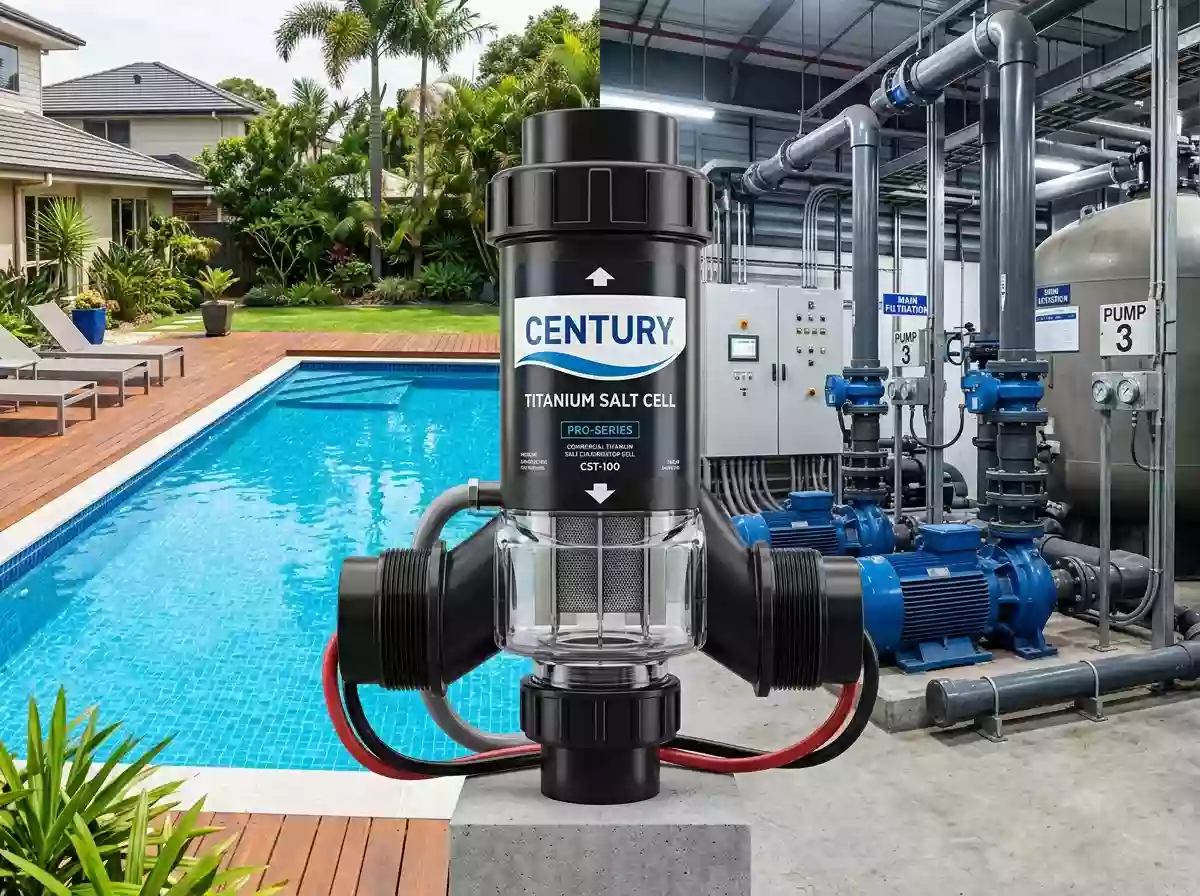
Century provides a comprehensive series of high-capacity commercial pool salt chlorinator modules, with outputs ranging from 50g/h to a massive 500g/h, seamlessly integrated with intelligent water quality monitoring controllers. By merging precise salt dosing protocols with an industrial commercial pool electrochlorinator array, facilities can effortlessly meet strict disinfection standards and ensure water quality compliance. This engineering synergy effectively extends the lifespan of the salt cell, reduces maintenance downtime, and comprehensively lowers the Total Cost of Ownership (TCO) across the project’s lifecycle.