
High Calcium Hardness Management: Preventing Rapid Scaling in Commercial Water Treatment Systems
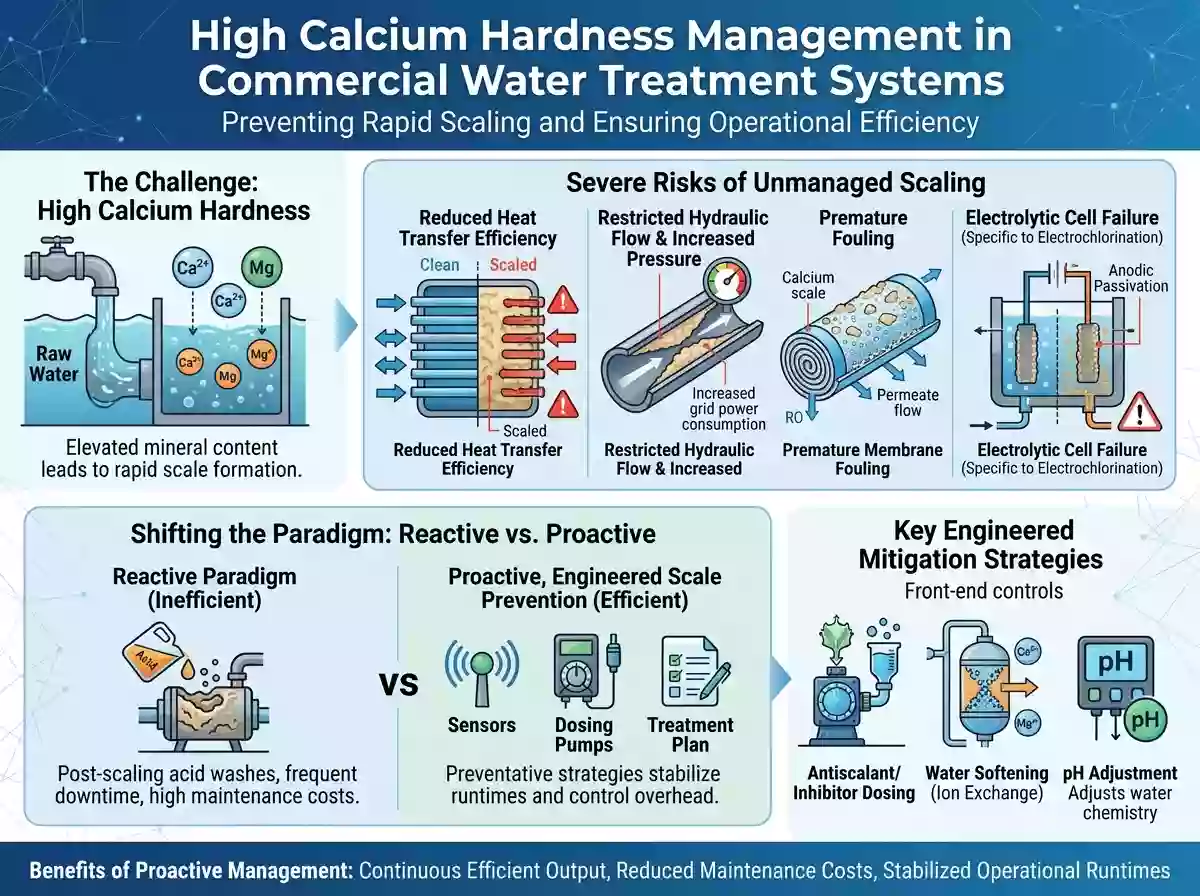
In industrial and large-scale municipal water treatment environments, processing raw water with elevated high calcium hardness introduces severe risks of mineral precipitation. Without systematic engineering controls, calcareous scale rapidly adheres to critical equipment surfaces. This crystallization acts as a thermal insulator that drastically reduces heat transfer efficiency, while simultaneously restricting hydraulic flow, increasing grid power consumption, and causing premature fouling of filtration membranes.
For facilities relying on electrolytic disinfection processes, excessive mineral loads present an acute threat. High-calcium environments directly induce electrochlorination cell scaling, ultimately leading to irreversible anodic passivation and component failure. Discarding the reactive paradigm of post-scaling acid washes in favor of proactive, engineered scale prevention in water treatment is mandatory. Implementing front-end mitigation strategies stabilizes operational runtimes, controls maintenance overhead, and ensures the continuous, efficient output of commercial water treatment systems.
The Thermodynamics of Scale: How High Calcium Hardness Precipitates in Water Treatment Infrastructure
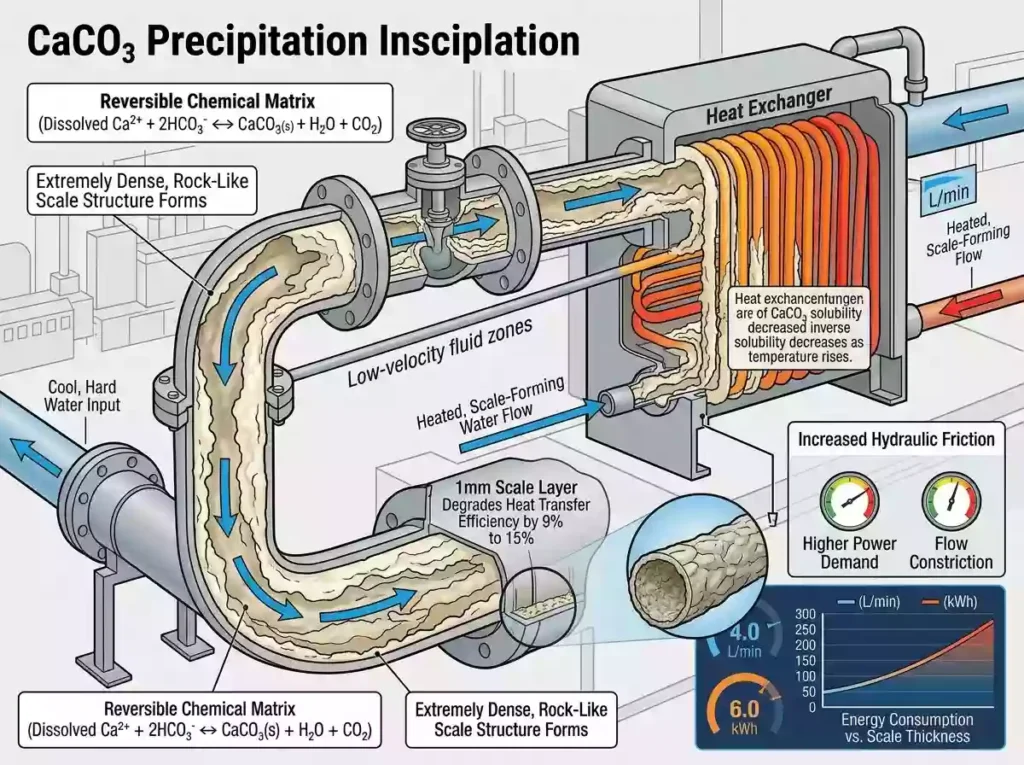
Calcium carbonate (CaCO3) exhibits a unique inverse solubility characteristic. Unlike most solutes, its solubility decreases as water temperature rises, making the high-temperature zones of water treatment infrastructure highly susceptible to rapid calcification.
When a system operates under high calcium hardness conditions, dissolved calcium ions continuously react with bicarbonate and dissolved carbon dioxide in a reversible chemical matrix, precipitating as solid calcium carbonate. [Added Content: These mineral deposits naturally aggregate in low-velocity fluid zones, such as piping elbows, internal valve housings, and the microfluidic boundary layers of heat exchangers, forming an extremely dense, rock-like scale structure.]
The operational impact is immediately measurable in terms of energy loss. Scale is an exceptionally poor thermal conductor. A mere 1-millimeter layer of scale can degrade localized heat transfer efficiency by 9% to 15%. To maintain target operational parameters, the system is forced to draw higher amperage, leading to spiked energy costs. Concurrently, the scale layer reduces the internal diameter of piping, increasing hydraulic friction and further degrading the overall efficiency of the water treatment plant.
The Electrochemical Catalyst: Why Electrolytic Cells Accelerate Rapid Scaling Bottlenecks
During the operation of on-site hypochlorite generators, the cathode continuously facilitates a hydrogen evolution reaction. This electrochemical process constantly generates hydroxyl ions (OH-), forcing the pH of the micro-aquatic environment immediately adjacent to the electrode plate to spike aggressively above 11, creating a highly localized alkaline extreme.
This localized alkalinity completely fractures the chemical equilibrium of the bulk water. It acts as a massive catalyst, forcing calcium and carbonate ions to aggressively bond and precipitate out of solution. This environment is the primary driver of severe electrochlorination cell scaling, allowing dense mineral formations to rapidly encrust the electrode surfaces.
Once formed, this impermeable scale acts as a dielectric barrier, isolating the electrolyte from the active catalytic coating. [Added Content: This isolation forces the electrical current to seek paths of least resistance, causing severe current density maldistribution.] The resulting localized overheating physically damages the precious metal catalytic layer, causing it to blister and detach, effectively destroying the cell’s lifespan. Because the electrolytic process inherently breeds mineral precipitation, deploying a robust framework for preventing rapid scaling is not optional—it is a baseline requirement for sustainable asset management.
Comprehensive LSI and RSI Modeling: Predictive Engineering vs. Reactive Chemical Dosing
Relying exclusively on a single calcium hardness metric to manage water quality is an outdated and deeply flawed methodology. Modern industrial standards dictate the use of comprehensive algorithmic models, primarily the Langelier Saturation Index (LSI) and the Ryznar Stability Index (RSI).
These indices aggregate five critical parameters: water temperature, pH, total alkalinity, calcium hardness, and total dissolved solids (TDS). By processing these variables, engineers can determine the exact scaling or corrosive tendency of the fluid. In practical commercial operations, maintaining an LSI value strictly between -0.3 and +0.3 ensures the water remains in an optimal, stable state—neither aggressive enough to corrode infrastructure nor saturated enough to precipitate scale.
Transitioning from reactive chemical dosing to predictive engineering via water quality mathematical modeling allows operators to architect scale prevention in water treatment directly into the system’s DNA. [Added Content: This front-end planning dictates precise flow rates and pre-treatment requirements before a single drop of water is processed.] This paradigm drastically reduces long-term chemical expenditures and eliminates the downtime associated with manual acid-washing, forming the core design philosophy for high-efficiency commercial water projects.
Commercial Scale Prevention Strategies: Implementing Automated Mitigation in Large-Scale Systems
Large-scale commercial water treatment systems must prioritize front-end pretreatment architectures. Deploying Strong Acid Cation (SAC) exchange resins or commercial nanofiltration (NF) membrane skids proactively intercepts and removes excess calcium ions from the bulk water, drastically lowering the baseline scaling potential before the water reaches critical thermal or electrolytic components.
To complement mechanical filtration, automated chemical intervention is utilized. Precision dosing pumps inject environmentally compliant antiscalants, such as specialized polyphosphates or polyacrylic acids. These chemicals operate on a threshold effect; they physically distort the crystal lattice structure of precipitating calcium carbonate, preventing the micro-crystals from adhering to pipe walls and electrodes, allowing them to be flushed out harmlessly with the effluent.
Furthermore, integrating a reverse polarity chlorinator provides a physical defense mechanism. By periodically reversing the electrical polarity of the electrodes, the system creates a transient, localized acidic environment that dissolves nascent scale formations without requiring manual teardowns. This hybrid approach of chemical distortion and automated physical cleaning drastically reduces manual maintenance cycles and protects sensitive internal components.
The B2B Manufacturing Edge: How Century’s Advanced Anodes Tolerate Moderate Scaling Environments
In many off-grid or high-hardness municipal projects, strict budget constraints prevent the deployment of comprehensive front-end softening infrastructure. Under these demanding parameters, the core electrolytic hardware must possess exceptional environmental adaptability and innate chemical resilience.
Century engineers address this via highly densified, multi-layered Ruthenium-Iridium (Ru-Ir) Mixed Metal Oxide (MMO) coating protocols. Utilizing proprietary high-temperature thermal sintering, the resulting titanium anode coating exhibits a remarkably smooth, defect-free surface morphology. This microscopic smoothness fundamentally weakens the mechanical adhesion strength of precipitating minerals. Furthermore, the robust coating matrix is engineered to withstand the intense current impacts associated with localized oxygen evolution side-reactions. Even when deployed in aquatic environments with moderate to high scaling risks, these advanced plates consistently sustain high electrolytic efficiency. For international EPC contractors and distributors, Century’s hardware resilience translates directly to minimized post-installation warranty claims, reduced field maintenance liabilities, and the achievement of an optimized Total Cost of Ownership (TCO) across global B2B deployments.