
On-Site Sodium Hypochlorite Generation (OSHG) for Municipalities: Engineering Transition, Safety Risk Mitigation, and Lifecycle Economics
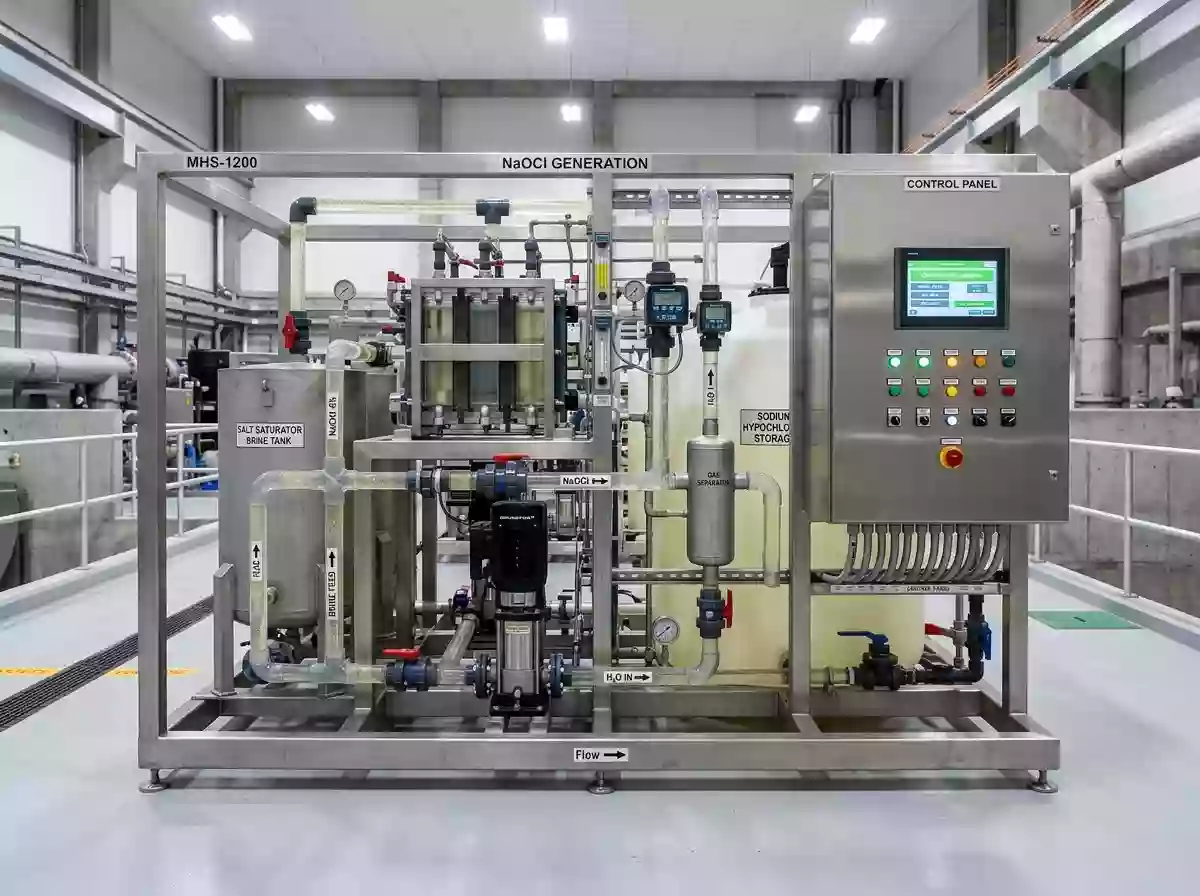
Municipal water departments and consulting engineering firms urgently require disinfection solutions that balance uncompromising safety, operational stability, and long-term financial economy. Bulk liquid chlorine gas cylinders and high-concentration commercial sodium hypochlorite—traditionally the backbones of large-scale water treatment—are rapidly being phased out. This industry-wide shift is driven by escalating hazardous transportation risks, supply chain volatility, and tightening environmental mandates. By transitioning to on-site sodium hypochlorite generation (OSHG) technology, waterworks can synthesize a low-strength disinfectant solution on-demand using only commodity-grade solar salt, water, and electricity, completely eliminating the liabilities of toxic chemical logistics. This technical evaluation deconstructs the structural engineering parameters, regulatory compliance frameworks, and lifecycle cost dynamics of municipal OSHG deployments to provide an empirical asset selection guide for modern water treatment facilities executing an oshg system water treatment upgrade.
Regulatory Drivers and Risk Mitigation: Moving Beyond Hazardous Chlorine Gas
The systematic decommissioning of conventional pressurized liquid chlorine gas infrastructures across American and European municipal waterworks is primarily catalyzed by increasingly stringent regulatory enforcement. Compliance frameworks, such as the US EPA’s Risk Management Plan (RMP) and OSHA’s Process Safety Management (PSM) regulations, continue to tighten their oversight on hazardous substances. Bulk liquid chlorine gas is classified as an acutely toxic inhalation hazard; its storage, containment, and transit require complex risk mitigation protocols and emergency response planning. A single containment breach presents catastrophic lethal risks to surrounding residential zones and local ecosystems, exposing the utility to severe legal liabilities and immense operational strain.
Conversely, an on-site sodium hypochlorite generation system mitigates these liabilities at the molecular level by synthesizing the biocide on-demand at a stable, active free chlorine concentration of approximately 0.8%—well below the 1.0% hazardous chemical threshold. Under international chemical safety standards, a sodium hypochlorite solution under 1% is classified as a non-hazardous, non-combustible substance. This status effectively exempts the waterworks from cumbersome environmental permitting, specialized hazardous material storage infrastructure, and exorbitant liability insurance premiums. Implementing an OSHG array fundamentally eliminates chemical safety risks at the source, dramatically streamlining daily utility management and local regulatory approvals.
Core Electrochemistry and Electrolyzer Engineering in OSHG System Water Treatment
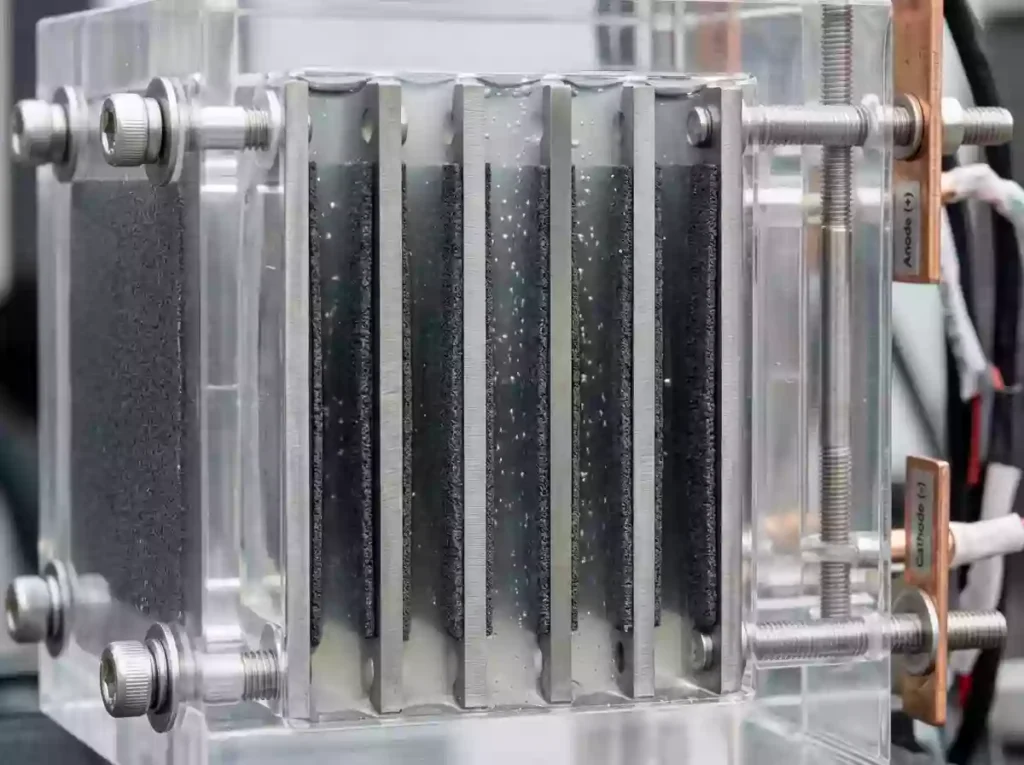
On-site chlorination systems utilize a membraneless electrolytic cell architecture to execute the electrochemical synthesis of the disinfecting agent. Within the cell, a precise sodium chloride brine solution undergoes electrolysis to produce sodium hypochlorite and hydrogen gas as a primary byproduct, expressed through the standard electrochemical equation:
NaCl+H2O→NaClO+H2↑
Because large-scale municipal operations monitor Specific Power Consumption (SPC, expressed as $\text{kWh/kg}$ of free available chlorine) with extreme scrutiny, optimizing cell efficiency is critical for successful municipal electrochlorination system scaling.
Century’s municipal-grade electrolyzers are engineered using premium Grade 1 pure titanium plates as the structural substrate, coated with a proprietary, multi-layered Ruthenium-Iridium Mixed Metal Oxide (MMO) catalytic formulation that delivers exceptional electrocatalytic activity and superior corrosion resistance. The inter-electrode plate gap is precisely calibrated at 3 to 4 mm. This specialized geometry is optimized to balance fluid dynamics with electrical efficiency, minimizing the electrolyte’s internal ohmic resistance while maintaining a high salt-to-chlorine conversion rate and current efficiency. This robust configuration tolerates wide seasonal fluctuations in feed water temperatures, actively retards anode passivation, and maintains low kilowatt-hour consumption metrics, successfully fulfilling the stringent continuous duty cycles demanded by heavy-duty municipal water disinfection facilities.
Financial Logistics: Bulk Liquid Chlorine vs. OSHG Lifecycle Analytics
Commercial-grade 12.5% bulk liquid sodium hypochlorite is inherently thermodynamically unstable. Environmental factors, specifically elevated summer temperatures and UV exposure, drastically accelerate its natural degradation pathway, decomposing the active biocide into inactive chlorates and oxygen gas. Within weeks of warehouse storage, the available free chlorine content can plummet significantly, resulting in severe chemical product waste and making accurate dosing pump calibration nearly impossible for water treatment operators. Furthermore, the specialized transport, handling, and hazardous materials storage compliance protocols required for commercial bleach incur substantial, unyielding operating expenditures (OPEX).
An OSHG configuration disrupts this costly paradigm via a just-in-time production strategy. The freshly generated 0.8% sodium hypochlorite solution is highly stable, exhibiting virtually zero natural degradation over standard operational holding cycles. The system requires only affordable, non-hazardous industrial-grade solar salt and standard electrical power as raw consumables, ensuring highly predictable and controlled input costs. When evaluating a comprehensive Total Cost of Ownership (TCO) model comparing initial capital expenditure (CAPEX) against ongoing salt and power OPEX, large-scale utilities deploying an OSHG system typically achieve full capital investment amortization within 24 to 36 months. This rapid return on investment is sustained by the absolute elimination of bulk chemical procurement premiums, hazardous freight surcharges, and dedicated safety compliance labor, proving highly advantageous in any bulk liquid chlorine vs oshg engineering assessment.
Water Quality Compliance: Mitigating Disinfection Byproducts (DBPs) and Chlorate Formations
Potable water distribution codes worldwide enforce uncompromising restrictions on disinfection byproducts (DBPs) to protect public health. Regulatory standards—including the World Health Organization (WHO) guidelines, European Drinking Water Directives, and NSF/ANSI Standard 61—strictly regulate maximum allowable contaminant levels (MCL) for harmful species such as trihalomethanes, bromates, and chlorate ClO3− ions.
During active brine electrolysis, localized thermal spikes across the anode surfaces or localized pH shifts within the boundary layer can catalyze unwanted secondary parasitic reactions that synthesize chlorate compounds, directly threatening water quality compliance. Century mitigates this vulnerability by pairing highly regulated inlet water volumetric flow controls with an intelligent, integrated constant-temperature cooling loop. This system stabilizes internal electrolyzer operating temperatures strictly below 30∘C By optimizing the reaction environment directly at the electrocatalytic interface and suppressing thermal secondary pathways, Century minimizes harmful byproduct synthesis, ensuring that the generated solution seamlessly satisfies the strictest public safety guidelines as an elite sodium hypochlorite generator for drinking water networks.
Automation Architecture and Redundancy Integration in Modern Waterworks
Modern municipal water infrastructure demands complete, fail-safe automation to maintain operational continuity. Century’s OSHG platforms are engineered with a centralized, industrial-grade Programmable Logic Controller (PLC) master unit that natively supports universal communication protocols, including Modbus RTU and Profinet. This architecture allows flawless, plug-and-play integration into the water plant’s overarching SCADA control center, facilitating real-time remote monitoring, granular data logging, and fully automated, closed-loop chemical dosing based on real-time flow and residual chlorine telemetry. This high level of integration supports reliable, unmanned facility operations.
Because municipal water disinfection is a critical utility that tolerates zero operational downtime, industrial-grade electrochlorination networks utilize a fully redundant duty/standby layout (100% mechanical redundancy) or a multi-train parallel configuration. During scheduled routine maintenance or automated acid-washing cleaning cycles on the primary electrolyzer train, the secondary standby unit automatically and seamlessly assumes the treatment load. This architecture guarantees uninterrupted chemical synthesis and constant chemical delivery to the injection points, fully satisfying the rigid high-availability and reliability standards mandated by modern civil engineering infrastructure.