
Optimizing Commercial Aquatics: The Role of Microprocessor Controllers in Modern Salt Chlorine Generators
Legacy salt chlorination systems traditionally operated on a crude open-loop model, delivering a static, uncompensated power output that failed to respond to real-time environmental dynamics. When factors such as brine salinity, fluid temperature, and localized flow velocities fluctuated, these analog units frequently suffered from severe imbalances in active chlorine output. As modern operational standards for commercial aquatics and municipal water treatment plants grow increasingly stringent, the integration of advanced microprocessor controllers has shifted from a premium option to an industrial necessity. Serving as the centralized intelligence of the entire electrochlorination system, the microprocessor elevates basic electrolytic conversion into a fully automated, closed-loop smart topology. This digital shift not only drives down energy consumption through precision current tuning but also stabilizes active residual sanitization metrics, acting as the technological core for the modernization of disinfection infrastructure.
Beyond Analog Timers: Evolution of the Salt Chlorine Generator Controller
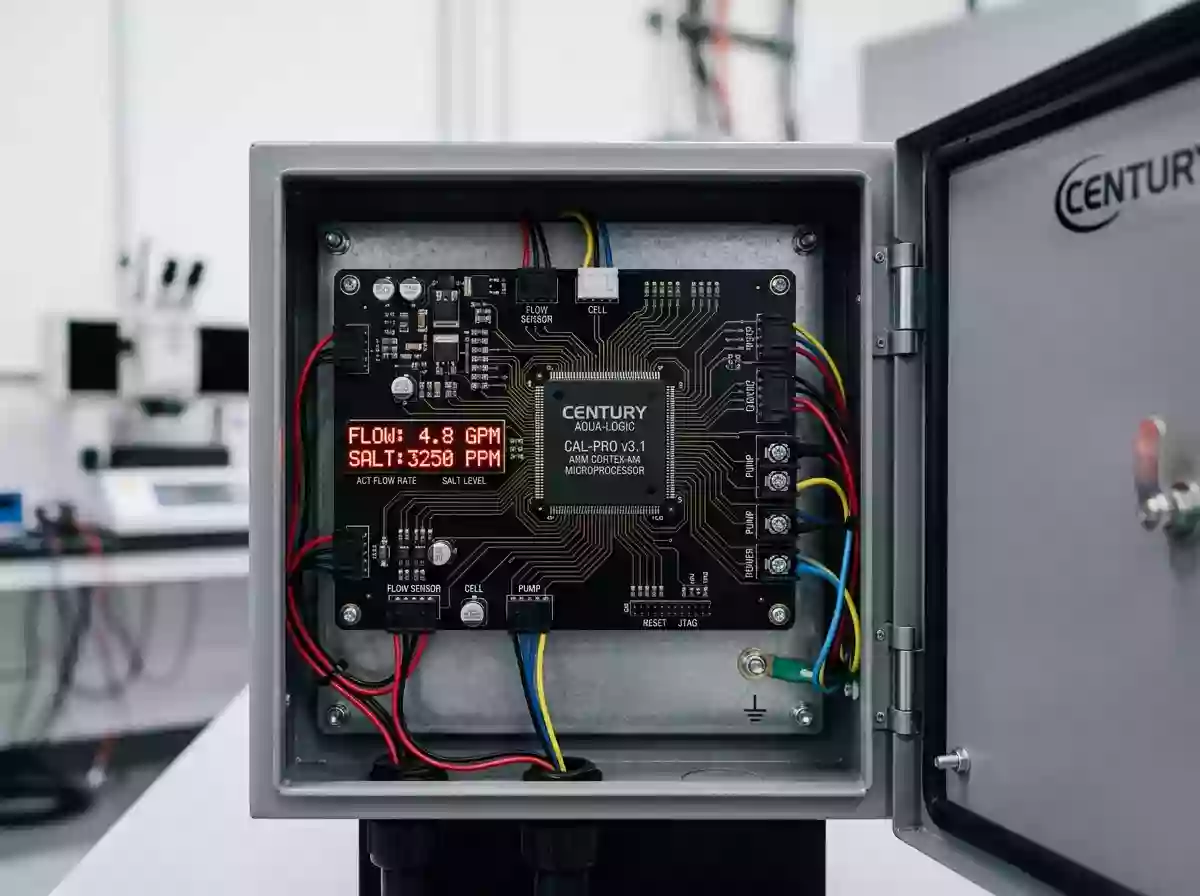
Early-generation electrochlorination hardware relied strictly on mechanical relay contactors and analog countdown timers to manage system cycles. This rigid operational framework meant the equipment could not dynamically modulate its output curve in response to shifting baseline conditions like water temperature or chloride ion concentrations, making precise chlorine dosing nearly impossible to sustain.
Modern architectures overcome these challenges by embedding a high-speed salt chlorine generator controller driven by dedicated microprocessors. Utilizing high-frequency Pulse-Width Modulation (PWM) regulation topologies, these microprocessors sample and adjust the rectification circuits at microsecond intervals. This rapid gating control secures an ultra-stable constant-current or constant-voltage delivery, perfectly matching the electrochemical mandates of the active cell.
Furthermore, this digitized control framework exhibits superior utility grid adaptability. It actively suppresses line voltage fluctuations and transient surge voltage vectors, filtering out anomalous electrical noise before it reaches the cell, which dramatically decreases component failure rates and ensures rugged, all-weather performance across the entire commercial salt chlorinator platform.
Real-Time Dynamic Feedback: Preventing Premature Titanium Anode Degradation
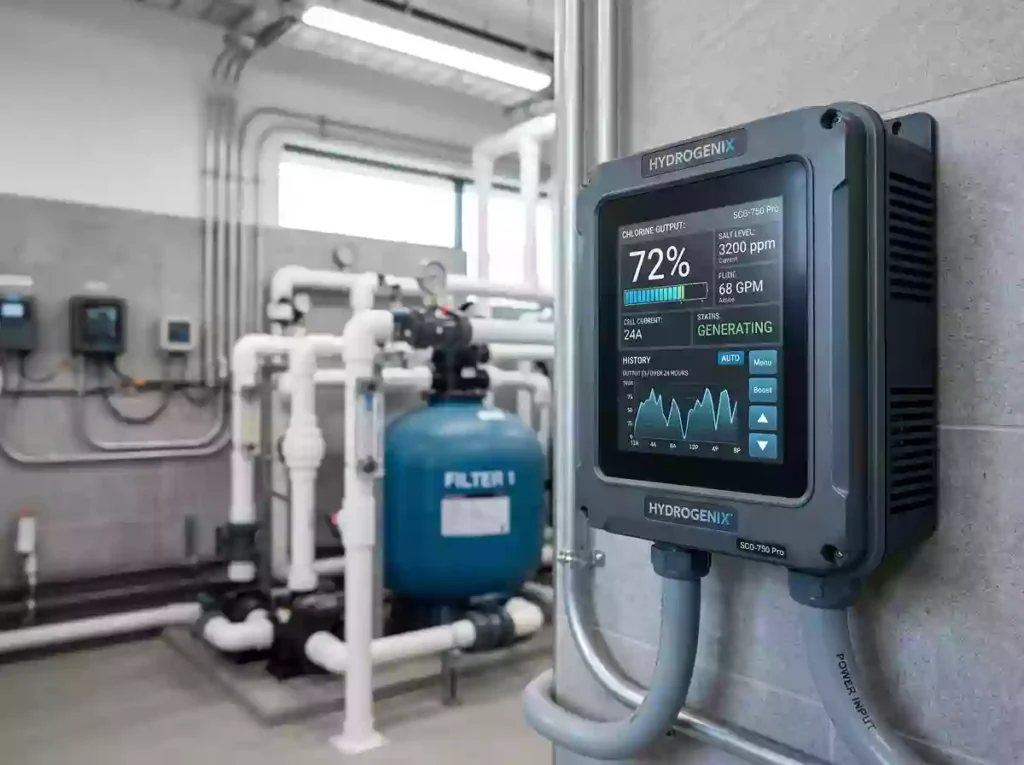
When ambient water temperature drops or salt concentrations spike, the localized electrical resistance across the electrolyte solution shifts instantly. Legacy regulation hardware responds too sluggishly to these shifts, frequently resulting in localized current crowding anomalies that severely accelerate electrode erosion.
Modern microprocessors mitigate this through high-resolution ADC (Analog-to-Digital Converter) sampling channels, continuously capturing running cell voltage and running amperages. By instantly calculating the real-time interfacial impedance of the active plates, the control firmware executes sub-millisecond current-limiting protocols to lock operations within a certified safe envelope. Simultaneously, the integrated circuitry runs a highly sophisticated reverse polarity chlorinator control algorithm, intelligently scheduling the electrode commutation intervals based on cumulative running data. This targeted polarity reversal actively breaks down and sheds calcium carbonate and magnesium hydroxide scaling precipitates from the catalytic surfaces. By smoothing out the electrical transients during the commutation phase and dampening sharp inductive current spikes, the controller shields the mixed metal oxide matrix, extending the absolute operational lifecycle of the mmo titanium anode by more than 30%.
Industrial Integration: Embedding Commercial Salt Chlorinators into SCADA and IoT Networks
Modern municipal water plants and high-throughput commercial aquatics facilities have completely abandoned isolated, standalone machinery footprints. Disconnected hardware elements inherently create operational data silos, resulting in blind spots in asset monitoring and delayed maintenance interventions.
Microprocessor-empowered salt chlorine units feature native integration with standardized industrial communication hardware, including RS-485 serial buses running Modbus RTU protocols. This allows the system to aggregate critical operational telemetry—such as real-time chlorine synthesis rates, precise cell voltages, line amperages, and proactive diagnostic fault alerts—and stream it directly into the facility’s master scada water treatment management panel for unified visualization.
This smart telemetry layout enables frictionless linking with online free residual chlorine probes. When downstream analytical sensors detect a deficit in sanitizer concentration, the data is instantly relayed back to the central processor, which automatically scales up the electrolytic cell’s driving current. The entire loop executes as a fully automated water disinfection sequence, slashing field maintenance overhead and eliminating human charting errors.
Fault Diagnostics and Smart Safety Loops: Minimizing Infrastructure Downtime
Unscheduled emergency shutdowns drastically penalize the operational ROI of municipal and commercial water treatment projects. Advanced electronic control systems leverage microprocessor-resident firmware safety routines to actively intercept cascading hardware damage before a critical failure occurs.
By cross-referencing digital flow switches and tracking real-time electrolyte conductivity metrics, the controller can identify line blockages, air pockets, or complete fluid loss within milliseconds. The processor immediately isolates the primary power delivery loop, preventing dry-run overheating scenarios that could permanently warp or destroy the titanium electrode assemblies within seconds.
Additionally, the MCU maintains constant thermal tracking of both the electrolyte stream and the power semiconductor junction temperatures. If an over-temperature threshold is approached, the system triggers an intelligent thermal derating algorithm to safely scale back operational power rather than throwing a hard fault code and shutting down entirely. This maintains continuous disinfection capability while safeguarding internal electronics, minimizing critical facility downtime and curbing unexpected repair expenditures.
White-Label Customization: Smart Pool Controller Custom Branding and OEM Edge
Sourcing fragmented, third-party component controllers leads to poor systemic calibration and introduces severe reliability risks during multi-year continuous operations. For modern engineering firms and equipment integrators, deploying a matured, cohesive digital control core is paramount. Century fulfills this market demand by moving past simple hardware distribution to deliver comprehensive, mutually optimized electrochemical systems. In addition to our premium titanium anodes and engineered cell housings, we supply deeply calibrated microprocessor firmware stacks engineered for the specific fluid profiles of our clients. Century opens full white-label manufacturing and private-label firmware tuning services for international B2B partners seeking to establish an elite smart pool controller custom branding portfolio. From localized graphic user interfaces (GUI) to custom commutation timing profiles, our systems ensure absolute hardware-software harmony, empowering global brands to deploy a highly differentiated, technologically insulated product line that secures a dominant market position.