
Retrofitting Water Infrastructure: Upgrading Legacy Transformers to High-Efficiency Switching Power Supplies
A vast segment of aging water treatment infrastructure and commercial aquatics facilities across the West continues to rely on legacy heavy-iron line transformers and silicon-controlled rectifier (SCR) systems. These obsolete power architectures present massive mechanical deadweight, low operational power factors, and excessive thermal dissipation. Beyond leaking immense blocks of expensive line power, these traditional magnetic power units impose severe ventilation and field maintenance burdens on utility operators. As global mandates intensify for carbon reduction and operational cost-efficiency, clinging to these legacy units is no longer viable. Upgrading aging power supplies to an advanced high-frequency switching power supply yields an immediate reduction in utility expenditures, optimizes the electrochemical environment of the cell, and comprehensively stabilizes the long-term uptime of the chlorination matrix.
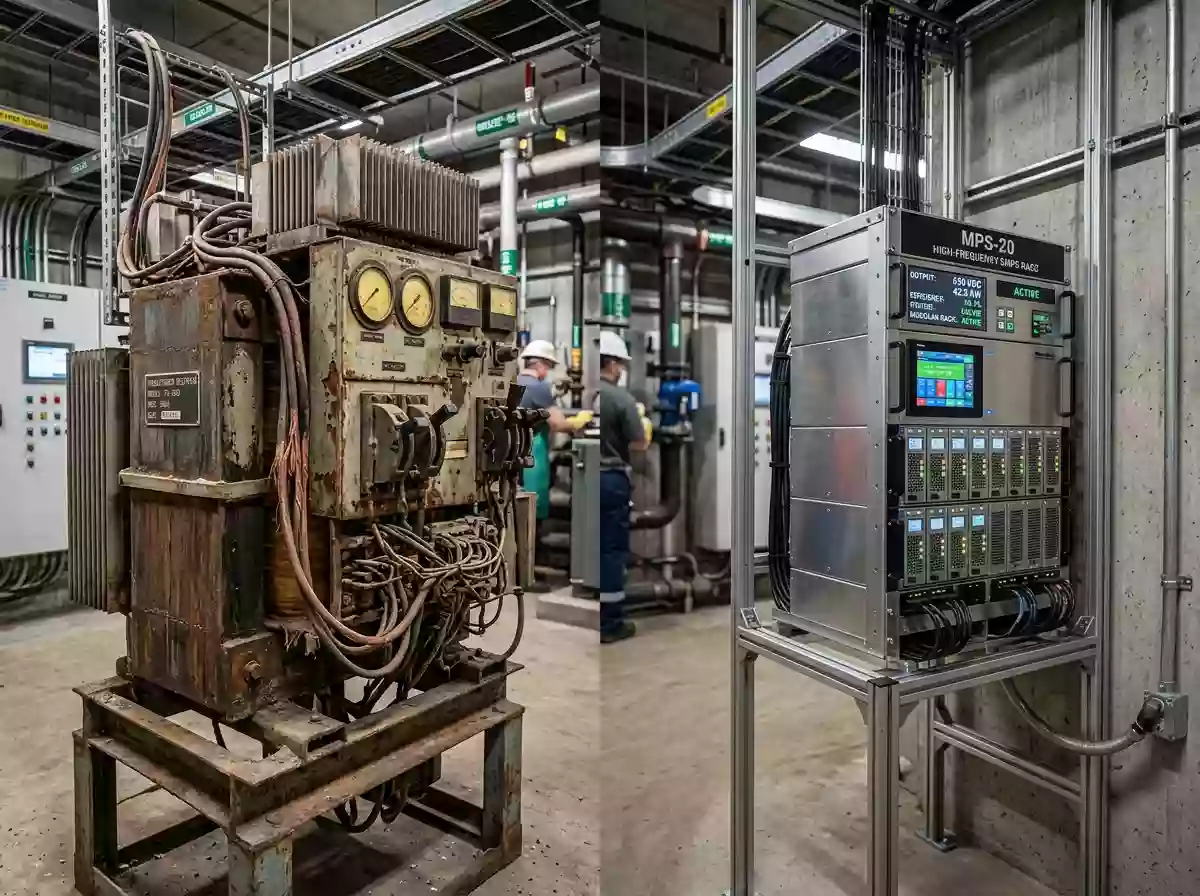
The Efficiency Drain: Pitfalls of Legacy Thyristor and Transformer Rectifiers in Water Treatment
Traditional mains-frequency iron-core transformers and thyristor rectifiers suffer from deep structural inefficiencies. During electrical conversion, these legacy units are heavily penalized by magnetic core losses, $I^2R$ resistive copper losses, and the significant forward voltage drops inherent to older semiconductor devices. Consequently, their net energy conversion efficiency languishes between 65% and 75%, meaning nearly one-third of the total grid power consumed is dissipated into the facility as parasitic waste heat, driving massive long-term financial leaks.
Furthermore, these traditional industrial electrolysis power supply cabinets are notoriously cumbersome, often weighing several tons. This immense physical footprint aggressively crowds water utility panel rooms and mandates the installation of dedicated heavy-duty HVAC or forced-air cooling systems, inflating localized capital and facility maintenance expenditures.
From an operational control perspective, old-school thyristor-based systems exhibit sluggish control loop responses, with adjustment latencies stretching into tens of milliseconds or full seconds. Lacking microsecond-level dynamic regulation, these legacy rectifiers fail to track the instantaneous fluctuations in brine salinity, fluid dynamics, and temperature within the electrolyzer, triggering erratic DC output profiles and uncompensated variations in chemical output.
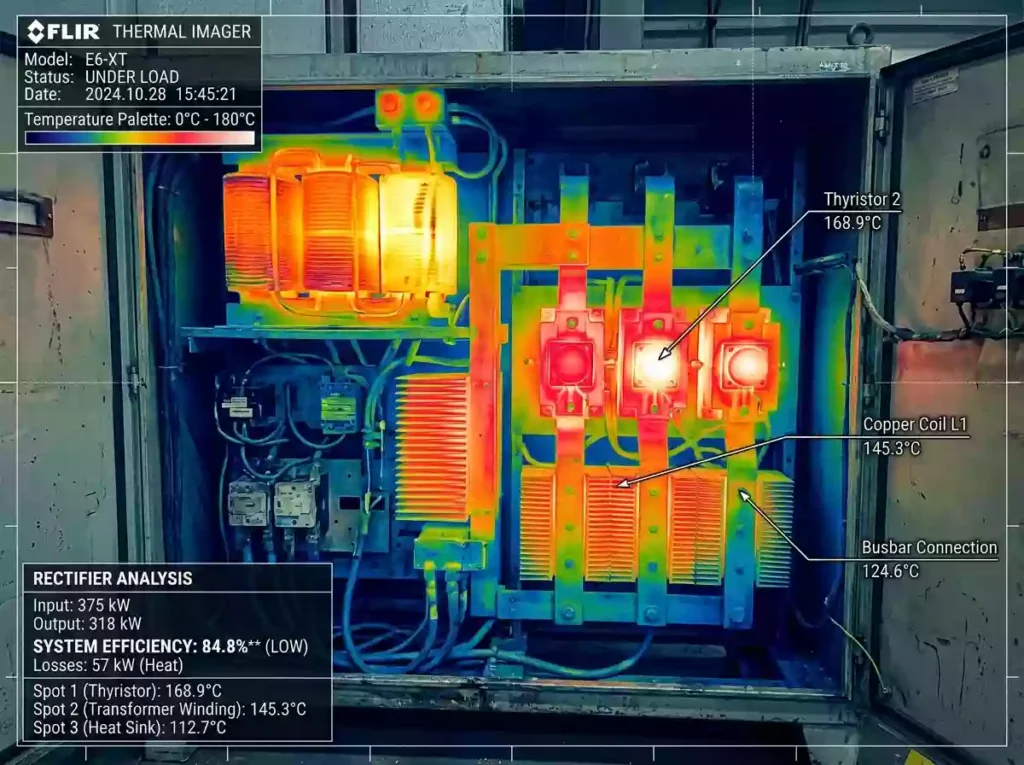
Technical Breakdown: SCR Rectifier vs SMPS Topologies for Industrial Electrolysis
The operational principles governing an SCR rectifier and a high-frequency switching mode power supply (SMPS) are fundamentally distinct. An SCR system relies directly on the standard 50/60 Hz utility grid frequency, utilizing phase-controlled thyristors to slice the incoming AC sine wave to adjust output voltage and current. In contrast, an SMPS utilizes advanced, high-speed power semiconductors—specifically Pulse-Width Modulation (PWM) driven IGBTs—to elevate the primary working frequency into the tens of kilohertz kHz range, entirely breaking free from mains frequency constraints.
In terms of baseline performance metrics, the technical superiority of an SMPS is absolute. It pushes conversion efficiencies up to the 90% to 95% threshold, while maintaining a near-unity power factor approaching 0.99. By eliminating heavy iron laminations and thick copper windings, the structural architecture is highly consolidated.
Simultaneously, a modern switching power supply features native digital integration capabilities. It interfaces natively via industrial communication protocols such as Modbus or Profibus into the plant’s centralized SCADA control room. This allows remote operations teams to execute precision data acquisition and automated tuning of electrolysis current, cell voltage, and real-time fault diagnostics, completely aligning with the demands of automated industrial asset management.
Preserving the Catalyst: How Switching Power Supply Precision Mitigates Titanium Anode Wear
The magnitude of the DC ripple factor is a primary determinant of the structural consumption rate of precious metal coatings. Legacy SCR rectifiers deliver a rough DC output heavily contaminated with low-frequency harmonic noise, typically exceeding a 10% ripple coefficient. This continuous electrical volatility acts as a destructive cyclic shock to the electrolytic cell, destabilizing the interfacial double-layer capacitance of the plates.
Operating under these abusive electrical conditions heavily stimulates parasitic side reactions, most notably the Oxygen Evolution Reaction (OER). The resulting aggressive, oxygen-rich micro-environment accelerates the chemical passivation and localized mechanical stripping of the expensive mixed metal oxide (MMO) catalytic layer from the mmo titanium anode. Once the protective coating peels or delaminates, the raw titanium base suffers rapid degradation, forcing premature electrode failure long before its engineered lifespan. Transitioning to an advanced high-frequency electrochlorination rectifier suppresses the output DC ripple factor down to a highly stable 2% to 3% window. The resulting smooth, linear waveform maintains a highly uniform electrochemical reaction boundary, suppressing destructive side reactions and sheltering the noble metal coating from corrosive stress. This electrical optimization effectively extends the operational lifecycle of the MMO titanium anodes by more than 30%, drastically cutting down emergency replacement costs and field maintenance liabilities.
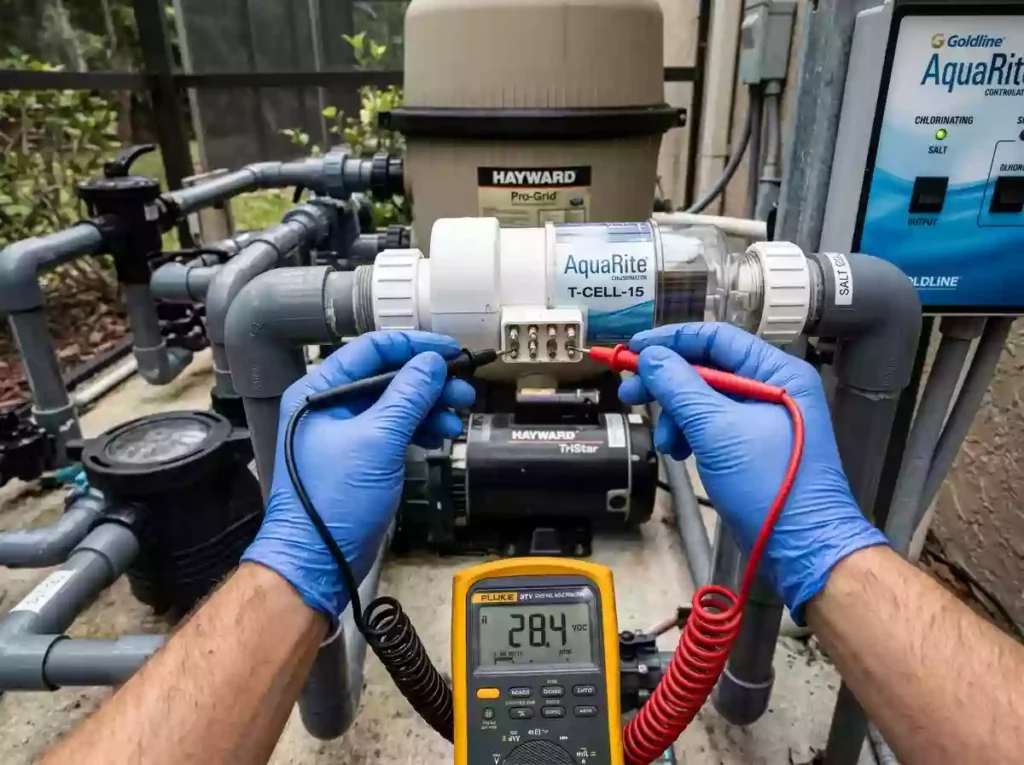
The Retrofit Blueprint: Step-by-Step Integration of an Advanced Electrochlorination Rectifier
Executing a successful electrical modernization project extends far beyond physically swapping out a cabinet; it demands precise pre-engineering calculations. Engineers must evaluate the legacy electrolyzer’s exact plate boundaries, historical cell voltages, and real-time water quality dynamics to establish the re-rated optimal current density. This guarantees that the new electrical output envelope perfectly aligns with the mechanical and electrochemical constraints of the existing electrodes.
When integrating a compact high-frequency electrochlorination rectifier, the primary distribution busbars must be re-engineered to optimize the high-amperage path and eliminate structural loop impedance. Furthermore, to withstand the humid, corrosive, and salt-laden environments typical of chlorine generation bays, the new equipment enclosure must be specified with high IP-rated corrosion protection and isolated, dedicated cooling channels to prevent ambient corrosive gases from migrating into sensitive internal electronics.
The final stage centers on the seamless migration of the control layer. Legacy analog dial meters are entirely phased out, replaced by programmable logic controllers (PLCs) that form a fully automated digital closed-loop circuit. By linking power output directly to real-time sodium hypochlorite generation sensors, the system automatically fine-tunes its amperage to match fluid demands, securing completely stable, unattended facility operation.
Strategic Sourcing: Empowering Infrastructure with Integrated Electrochemical Solutions
When rehabilitating legacy municipal water facilities or large-scale commercial aquatics plants, procurement managers must avoid decentralized sourcing. Purchasing anodes from one vendor and randomly pairing them with an uncalibrated rectifier from another vendor creates a severe engineering disconnect. Lacking cross-disciplinary electrical and electrochemical tuning, the resulting mismatched system suffers from elevated component failure rates and highly compromised operational reliability. Century actively rejects this unlinked, single-component sales model. We focus exclusively on delivering completely integrated system upgrade solutions, where the power electronics and the titanium anodes undergo deep, mutual co-optimization before deployment. For system integrators and engineering firms, Century offers specialized technical alignment and complete white-label retrofit packages. This comprehensive methodology substantially lowers initial capital conversion costs, extends the absolute runtime of the core hardware assets, and empowers our global partners to deploy a highly differentiated, hyper-efficient technological portfolio that commands a distinct competitive edge in their local markets.