
The Foundation of MMO Adhesion: Why Acid Etching is Critical in Titanium Substrate Preparation
The native oxide film, machining lubricants, and surface impurities present on raw titanium substrates directly inhibit the molecular bonding of Mixed Metal Oxide (MMO) coatings. Acid etching eliminates this passive oxide layer and surface contamination while simultaneously engineering a microscopic, rugged topography. This micro-texture exponentially increases the mechanical anchoring force of the MMO slurry, locking the catalytic coating tightly into the titanium matrix. By completely eliminating coating cracking and delamination under intense electrolysis, this structural stabilization reinforces long-term electrode performance and significantly extends the overall asset service life.
Beyond the Surface: The Overlooked Risks of Substandard Substrate Preparation
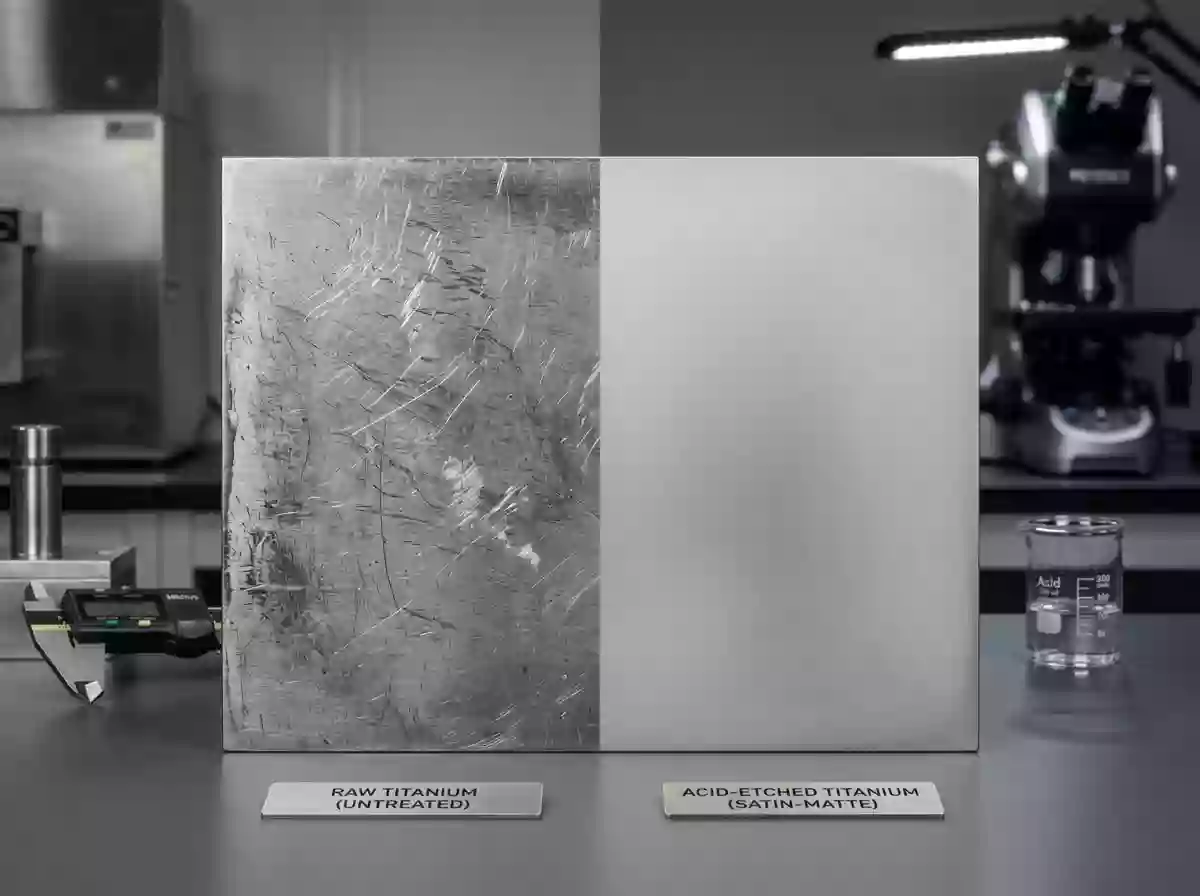
Following mechanical stamping and machining processes, raw titanium surfaces remain heavily contaminated with drawing lubricants, metallic micro-shards, and a spontaneously formed, highly dense, non-conductive titanium dioxide (TiO₂) passivation layer. These surface impurities and passive films act as a natural barrier to subsequent coating layers.
If precious metal coatings are applied directly onto untreated titanium without thorough substrate preparation, a distinct physical isolation zone forms at the interface, preventing microscopic bonding. Within an active electrochlorination cell, continuous hydraulic shear forces and the electrochemical stress induced by current reversals rapidly cause the coating to blister, macro-crack, or completely delaminate. Consequently, electrochemical conversion efficiency drops catastrophically, forcing premature cell failure. This turns the hardware into a short-lived, low-tier component that significantly drives up downstream maintenance and operational replacement overheads.
Microscopic Anchoring: How Acid Etching Prevents Anode Coating Delamination
Utilizing hot oxalic acid baths for titanium etching serves a purpose far greater than superficial degreasing and impurity removal; its true core value lies in micro-topographical restructuring. The etching process precisely attacks the titanium grain boundaries, eroding a uniform distribution of micron-level honeycomb pits to establish a stable microscopic roughness profile.
This specialized micro-texture expands the effective surface area between the titanium base and the MMO formulation. Once the catalytic slurry undergoes high-temperature thermal stabilization, it fills these honeycomb cavities completely, forming a permanent mechanical lock. This micro-interlocking matrix effectively counters the intense interfacial shear stress generated during reverse-polarity cycles and resists continuous hydraulic erosion from high-velocity water streams. By anchoring the coating layer from a structural standpoint, it suppresses anode coating delamination at its root, stabilizes the electrode’s structural integrity, preserves steady electrolysis efficiency over long duty cycles, and substantially prolongs the operational lifespan of the titanium anode.
Process Rigor: Controlling Temperature and Concentration in Titanium Anode Manufacturing
Small-scale operations routinely rely on manual guesswork to manage the etching phase, a practice completely devoid of standardized metric control. This introduces two extreme failure points: over-etching, which wastes raw titanium mass and degrades the structural integrity of the plate; or under-etching, which fails to develop an adequate micro-roughness profile, stripping the coating of its mechanical anchoring foundation and inviting downstream delamination.
Within a professional titanium anode manufacturing framework, Century eliminates empirical guesswork entirely. We implement fully automated, closed-loop control systems to strictly govern acid bath concentrations, thermal curves, and substrate immersion times. This precise chemistry-driven automation stabilizes the surface roughness parameter within a tight target window of $R_a$ 2.5–4.0 μm. These uniform etching conditions eliminate batch-to-batch structural variance across every single titanium plate, establishing an unshakeable process baseline for uniform MMO loading, long-term corrosion resistance, and predictable electrolysis output.
Strategic Selection: Why Sophisticated Global OEMs Audit Substrate Protocols
Mature European and North American brands evaluating industrial water treatment components look far past superficial sample data or showroom prototypes. Instead, procurement teams conduct strict on-site facility audits targeting hidden core workflows—specifically, the titanium substrate etching protocols, the automated acid filtration and waste management infrastructure, and the closed-loop chemical bath dosing systems. These audits verify whether the manufacturer possesses a genuinely stable, scalable production environment.
Backed by a dedicated electrochemical department, Century has mastered this substrate pre-treatment phase. We reject low-cost, corner-cutting methods that compromise engineering integrity. Our entire wet-chemical line operates in full alignment with international quality standards, including ISO-9001 frameworks, ensuring verifiable process traceability for every batch. By delivering transparent, auditable process compliance, Century builds highly secure supply chains for elite global swimming pool and municipal waterworks OEMs. This technical transparency guarantees product consistency from the very base layer, enabling our partners to drastically lower warranty callback liabilities and field failure risks while anchoring long-term strategic cooperation.