
Engineering Longevity: How MMO Coating Thickness Determines Titanium Anode Lifespan
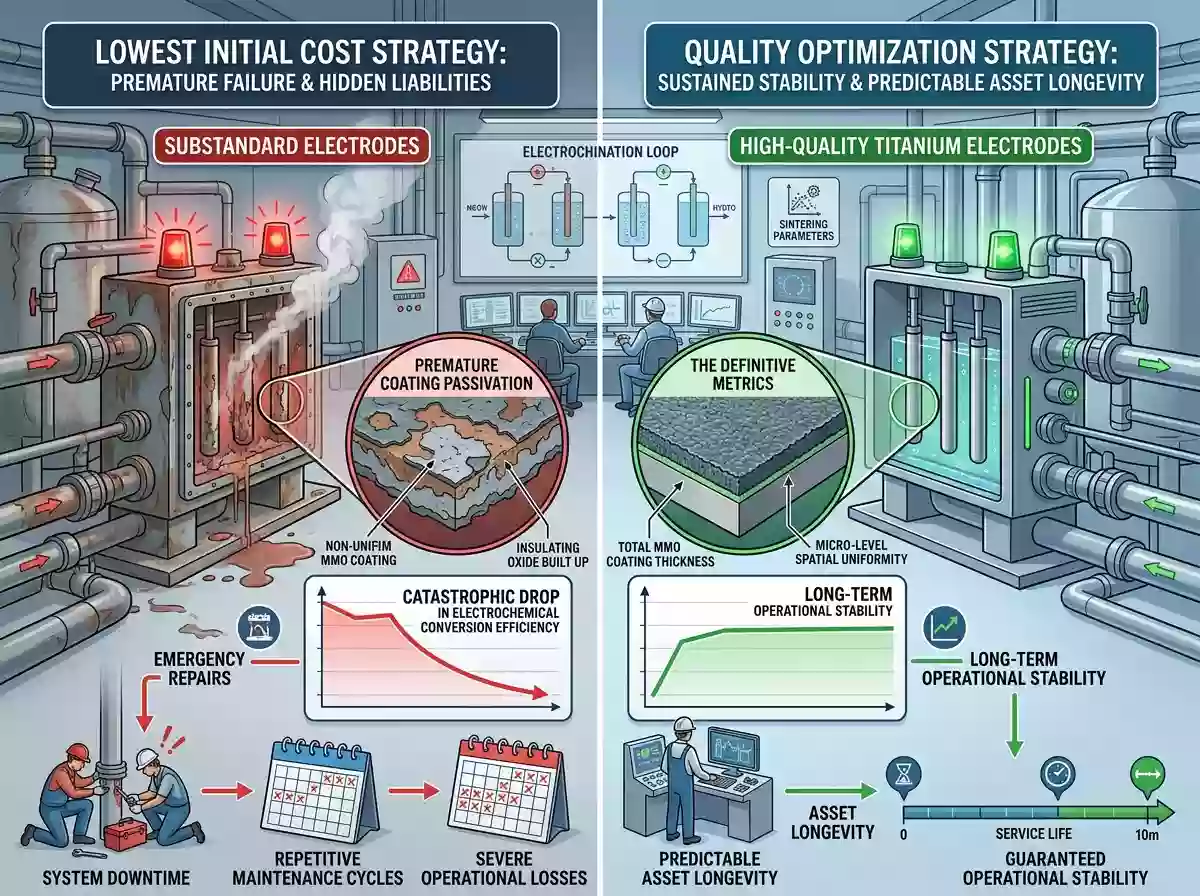
Procurement strategies driven solely by the lowest initial acquisition cost frequently backfire in the industrial water treatment sector, introducing substantial hidden liabilities. Substandard electrodes often suffer from premature coating passivation, which triggers an immediate and catastrophic drop in electrochemical conversion efficiency. For plant operators and equipment distributors, this material failure translates directly into unexpected system downtime, repetitive maintenance cycles, and severe operational losses.
In reality, the total mmo coating thickness and its micro-level spatial uniformity are the definitive metrics governing the service life of a titanium electrode. They establish the physical benchmark required to sustain long-term operational stability within an active chlorination loop. Tight control over these sintering parameters is the only viable method to eliminate premature degradation and guarantee predictable asset longevity.
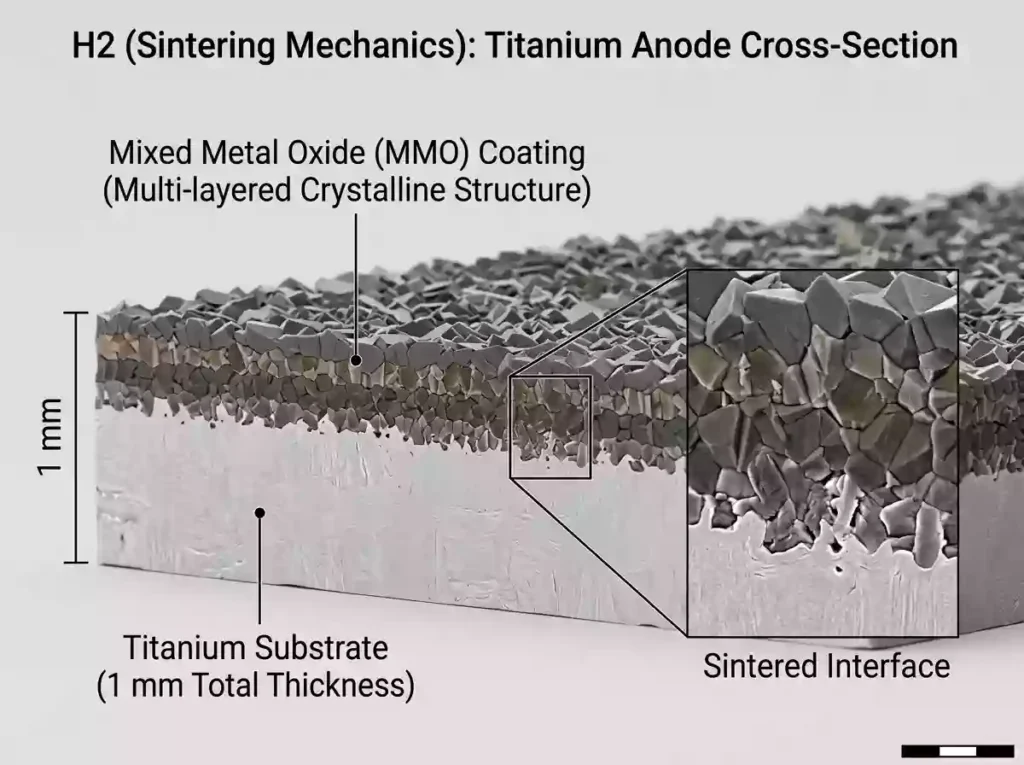
The Sintering Mechanics: Structuring the Mixed Metal Oxide Coating
An industrial mixed metal oxide coating is fundamentally distinct from conventional electroplating. It relies on a meticulous thermal decomposition technique. Noble metal liquid precursors—primarily formulations of ruthenium and iridium salts—are applied over an oxalically etched pure titanium substrate and then fired through multiple automated high-temperature thermal cycles to cross-link the oxides onto the metal.
At a microscopic level, this electrocatalytic barrier is built from dozens of overlapping micro-layers. The thickness of each individual pass, combined with the total cumulative coating profile, dictates both the current density capacity and the baseline corrosion resistance. As a primary mmo titanium anode manufacturer, Century maintains precise control over the high-temperature furnace ramp rates and thermal stabilization curves. This strict thermodynamic management optimizes the crystalline lattice formation and strengthens the interfacial bond between the mixed metal oxide and the titanium substrate. This framework prevents interlayer delamination and crystal shedding under harsh electrochemical stresses, laying a stable structural foundation for long-term field deployment.
The Consumption Paradigm: How MMO Coating Thickness Directs Titanium Anode Lifespan
Under a continuous, unvaried operational current density, the chlorine evolution reaction subjects the active electrode surface to constant chemical and hydraulic wear. The precious metal oxides within the MMO matrix undergo slow, irreversible electrochemical ionization alongside minor physical erosion from the electrolyte stream. This consumption paradigm causes the absolute mmo coating thickness to deplete at a predictable, linear rate over years of operation.
https://szcenturytech.com/salt-chlorine-generators/Once the noble metal loading falls below a critical minimum threshold, the protective matrix can no longer sustain the charge transfer. The underlying raw titanium is then exposed directly to the harsh electrolyte. Under these conditions, the bare substrate rapidly oxidizes into a non-conductive titanium dioxide ($TiO_2$) passivation layer. This insulation barrier causes localized electrical resistance to spike, halting the electrolysis reaction and permanently freezing free chlorine production. This exact transition from active catalyst to a passive insulator is the physics-driven reality governing the actual titanium anode lifespan. It underscores why initial coating uniformity and structural density are so critical to the performance of any sodium hypochlorite generator parts.
Value Engineering: Why Thicker is Not Always Better for OEM Applications
A common misconception persists among equipment buyers who believe that a thicker MMO layer automatically equals a superior component. In engineering reality, blindly increasing the coating thickness accumulates massive internal residual stresses during the thermal quenching phases. When deployed into a reverse polarity salt cell or subjected to high fluid velocities, these over-layered coatings frequently develop macro-cracks and suffer catastrophic sheet delamination, prematurely ending the component’s life.
True value engineering requires balancing the electrochemical formula against the specific application context. Municipal drinking water treatment systems run under unvaried polarity and stable current feeds; they are best paired with a high precious-metal mass loading and a moderate-to-high coating thickness to achieve an uninterrupted service life exceeding five to eight years. Conversely, commercial pool systems utilize routine polarity reversal cycles to automatically shed calcium scale. This mechanical and electrical shock requires exceptional coating adhesion rather than raw thickness. Here, optimizing the oxide ratio and tight sintering execution are far more critical to sustaining long-term electrochlorination cell efficiency while balancing raw durability with low power consumption.
Verification Protocols: How Century Guarantees Micro-Level Coating Uniformity
The aftermarket is heavily compromised by low-tier components featuring reduced noble metal concentrations and uneven manual brushing, both of which cause localized current crowding and premature cell failure. Century eliminates these quality risks by implementing strict automated manufacturing alongside advanced, non-destructive validation protocols.
Our facility replaces manual painting lines with automated coating and robotic sintering systems, ensuring perfect, repeatable oxide distribution from the start. We utilize non-destructive X-ray fluorescence (XRF) spectroscopy to scan the finished surfaces across multiple target coordinates, checking the mmo coating thickness and noble metal loading at a micron level. Furthermore, random samples from every production lot undergo destructive Accelerated Life Testing (ALT) in our quality control lab, simulating decades of aggressive electrochemical stress within a compressed timeframe. This intensive validation architecture ensures that every shipment delivered to our global OEM partners exhibits uniform micro-level coating stability and predictable operational performance.