
Expert Guide: How Long Do Salt Water Pool Cells Last & How to Maximize Their Lifespan
There is a clear industry benchmark when people ask how long do salt cells last: under normal operating conditions, a standard unit will yield an average lifespan of 3 to 7 years, which translates to roughly 10,000 operating hours. However, judging a titanium plate’s health strictly by years on a calendar is fundamentally flawed.
In reality, the true lifespan of a titanium pool salt cell is not dictated by time, but by two critical metrics: the total cumulative operating hours and the physical depletion of the ruthenium-iridium coating. Daily water hardness, run times, water temperature, and the frequency of acid washing all directly dictate how fast that coating burns off and how quickly your operating hours are exhausted.
The Baseline: What is the Average Salt Cell Lifespan?
Looking at industry data, a legitimately manufactured pool cell will generally last between 3 to 7 years (approximately 10,000 hours of active electrolysis). This is the recognized benchmark. Your actual mileage will vary based on water chemistry, salinity, and your pool salt cell maintenance routine. Dial in your water chemistry, and you push closer to year seven; run it hard in bad water, and it’s dead in three.
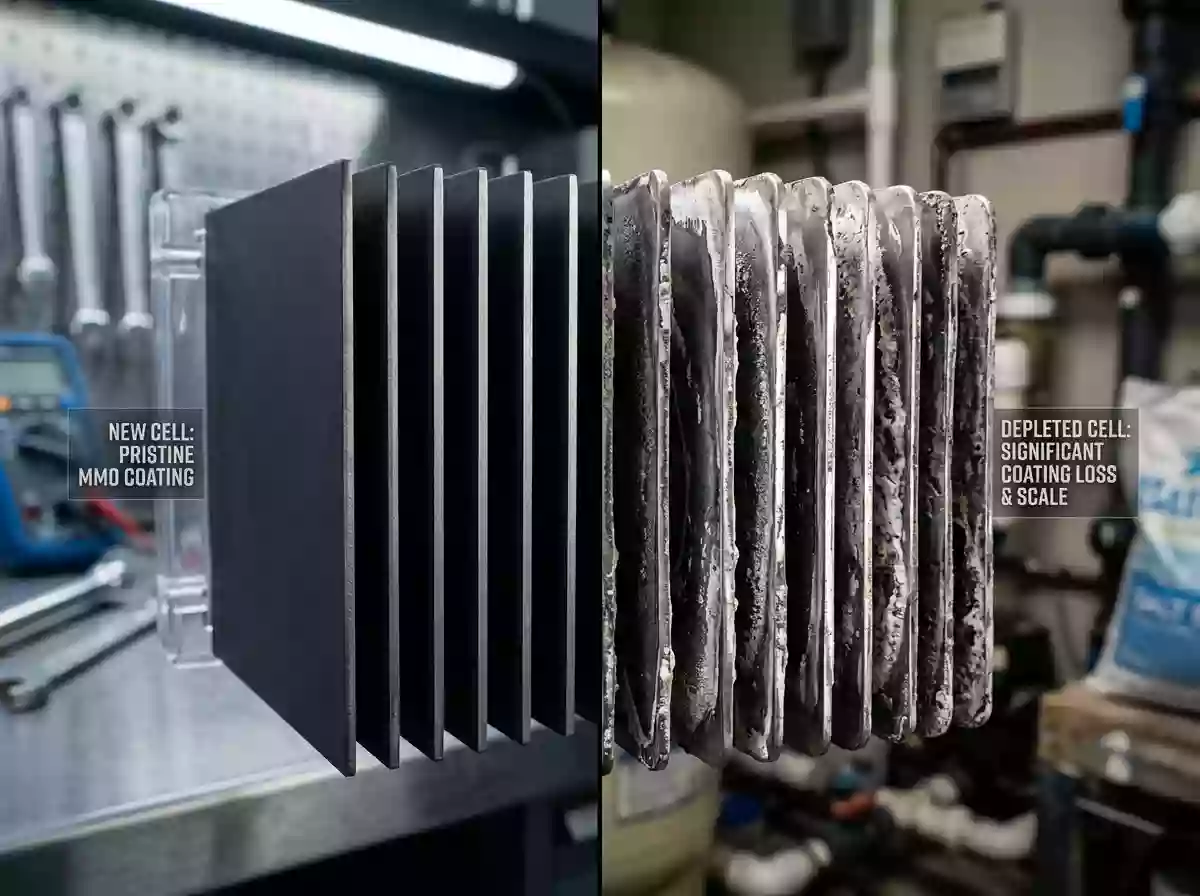
A massive misconception plagues the industry: when chlorine production drops, operators assume the hardware is “broken.” In most cases, there is zero structural failure. Instead, the ruthenium-iridium coating on the titanium plates has simply been depleted. This precious metal coating is the core functional layer. Its gradual loss during electrolysis is exactly like the wear on a car’s brake pads—it is a consumable item. When the coating is gone, efficiency tanks and chlorine production stops. This is natural wear and tear, not a manufacturing defect.
The Science of Failure: Understanding MMO Coating Depletion
From an electrochemical standpoint, the titanium substrate itself is virtually immortal. Because titanium forms a natural passivation layer, it strongly resists corrosion in pool water and electrolytic environments. What actually dictates the salt cell lifespan is the Mixed Metal Oxide (MMO) coating baked onto the titanium.
During operation, the constant reduction-oxidation (redox) cycles create a stable electric field. This process causes continuous, microscopic electrochemical stripping of the MMO layer. This is not a sudden flaking off; it is a slow, molecular-level depletion. As the operating hours rack up, the active catalytic compounds wash away. Once the coating reaches a critical depletion threshold, chlorine production plummets, and the cell is considered functionally dead. This is standard MMO coating depletion, an inevitable physical and chemical reality.
4 Primary Factors That Destroy and Shorten Salt Cell Life
- Factor 1: Running at 100% Output. Many operators set their chlorinator to 100% output year-round. This puts the cell under relentless electrolytic stress. Running at maximum capacity accelerates coating depletion, often burning through a 10,000-hour design life in just two or three years.
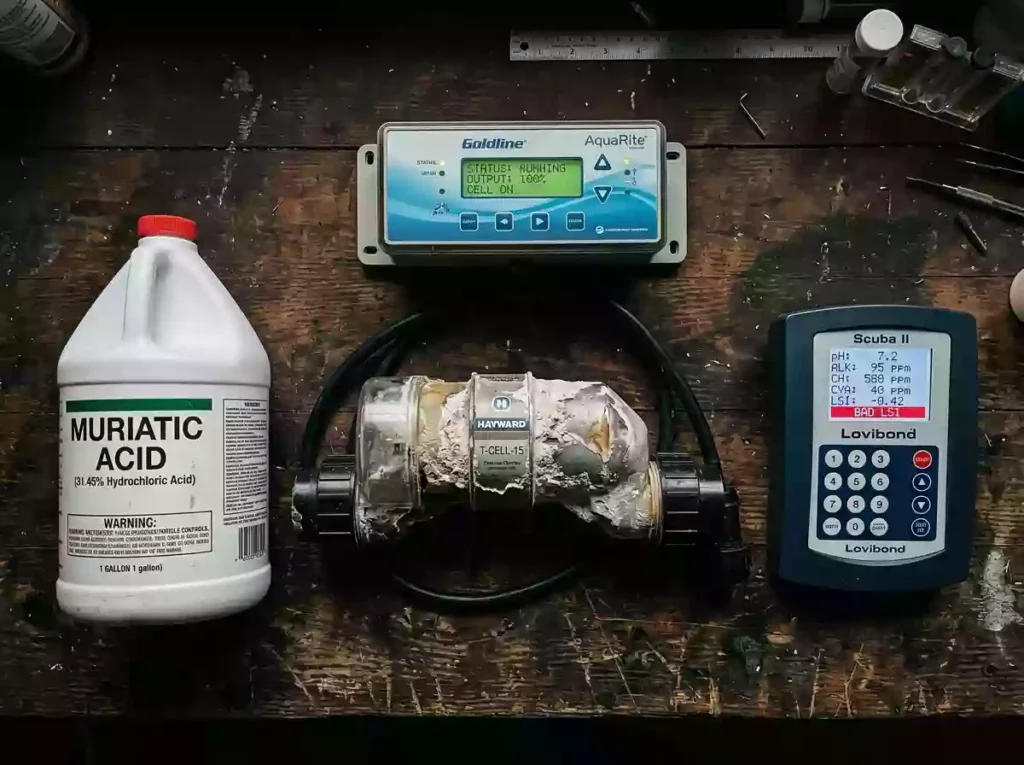
- Factor 2: Aggressive Acid Washing. Using an excessively strong muriatic acid mix or soaking the plates too long is catastrophic. Highly corrosive acid physically attacks and strips the noble metals right off the plates. This causes irreversible damage and severely truncates the unit’s life.
- Factor 3: LSI Imbalance and Scaling. High calcium hardness and poor pH control lead to rapid scale formation on the plates. Scale disrupts the electrical field, forces localized corrosion, and necessitates frequent acid washing—which, as mentioned, destroys the coating.
- Factor 4: Chronically Low Salinity. When salt levels drop, the water’s electrical resistance spikes. To maintain output, the control board forces higher voltage through the cell. Running a cell “hot” like this aggressively accelerates the microscopic stripping of the MMO layer.
Proven Maintenance Strategies to Extend Salt Cell Life
Here are the field-tested strategies to extend salt cell life:
- Strategy 1: Oversize the Equipment. When sizing a system, always specify a chlorinator rated for 1.5 to 2 times your actual pool volume. This “oversizing” allows you to run the system at 40% or 50% capacity rather than maxing it out at 100%. Lower intermittent loads drastically reduce coating wear and stretch out the replacement timeline.
- Strategy 2: Upgrade to Reverse Polarity. Prioritize a reverse polarity salt chlorinator. These systems automatically flip the electrical current, shedding early-stage calcium deposits. This self-cleaning action drastically reduces the need for manual acid washes, preserving your coating from acid damage.
- Strategy 3: Enforce Cold Water Shutdowns. When water temperatures drop below 60°F (15°C), conductivity plummets. The cell has to work exponentially harder (higher voltage) to generate chlorine, devastating the coating. Turn the cell off during the winter. Cold water requires very little sanitization anyway, and liquid chlorine is a safer bet for the equipment.
When to Replace a Salt Cell: 3 Undeniable Signs
Stop guessing. Look for these three clear signs of a bad salt cell to confirm when to replace a salt cell:
- Sign 1: Phantom Error Codes. If your water temperature and manually tested salt levels are perfect, but the panel constantly flashes “Low Salt” or “Inspect Cell,” your cell is likely dead. A depleted coating reduces conductivity, tricking the sensors into thinking the water lacks salt.
- Sign 2: Flatlining Free Chlorine. If you crank the output to 100%, run the pump for 24 hours, and your Free Chlorine (FC) levels still won’t hold, the catalytic power of the plates is gone.
- Sign 3: Visual Metal Exposure. Look closely at the edges of the titanium plates. If the dark grey or bluish-black coating has visibly faded, exposing the shiny, silver titanium substrate underneath, the cell is exhausted. You need a replacement to restore sanitation.
The Century Quality: Engineered for Maximum Commercial Durability
As a dedicated water treatment manufacturer, Century doesn’t cut corners on raw materials or chemistry. To guarantee our operating hours, we employ a rigorous thermal decomposition process. First, we aggressively sandblast the ASTM-grade titanium substrate to maximize surface roughness. Then, we apply multiple, precise coats of MMO, ensuring an unbreakable mechanical bond.
We engineer our plates to endure the harshest commercial environments, and we can customize coating thickness based on specific lifespan requirements. If you are a distributor or operator looking for a superior salt water pool cell replacement, contact us today for direct factory pricing.