
The Electrochemistry of Reverse Polarity: How Self-Cleaning Salt Cells Actually Work
Many people harbor a common misconception about self-cleaning salt cells, imagining a tiny mechanical brush inside the housing actively scrubbing the plates. This is far from the reality. The core mechanism of “self-cleaning” is not physical; it is an electrochemical process known as Reverse Polarity. It is a pure reaction-based system with no moving mechanical parts.
As a specialized B2B manufacturer in the water treatment industry, Century understands the technical gap in understanding these systems. In this guide, we will move past the marketing jargon and analyze the physics and electrochemistry behind the reverse polarity salt cell. We will explain exactly how polarity switching removes scale and how it affects the long-term durability of the titanium anode MMO coating.
The Cathode Problem: What Causes Calcium Buildup on Salt Cell Plates?
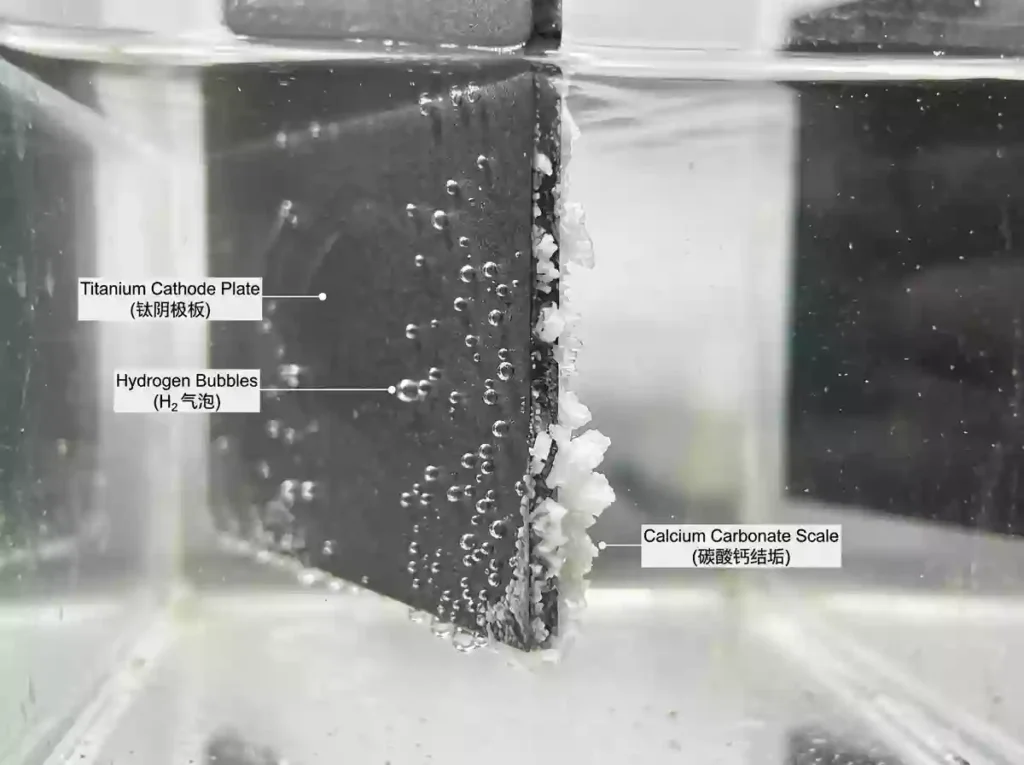
To understand self-cleaning, we must first identify the root cause of scaling. Before discussing how to clean it, let’s analyze why it gets “dirty.” During the electrolysis of brine (NaCl + H2O), specific reactions occur at each electrode. At the cathode (the negative plate), a reduction reaction takes place: water molecules are reduced, generating hydrogen gas (H2) and hydroxide ions (OH–).
The high concentration of hydroxide ions at the cathode surface causes the local pH to spike, creating a highly alkaline micro-environment. Most pool or municipal water contains dissolved calcium and magnesium ions. In this high-pH environment, these ions react and precipitate as calcium carbonate—a hard, white solid that bonds tightly to the salt cell titanium plates. This calcium buildup on salt cell plates is not a manufacturing defect or a sign of poor quality; it is an inevitable byproduct of the how does a salt cell work process.
Reversing the Current: The Mechanics of a Reverse Polarity Salt Cell
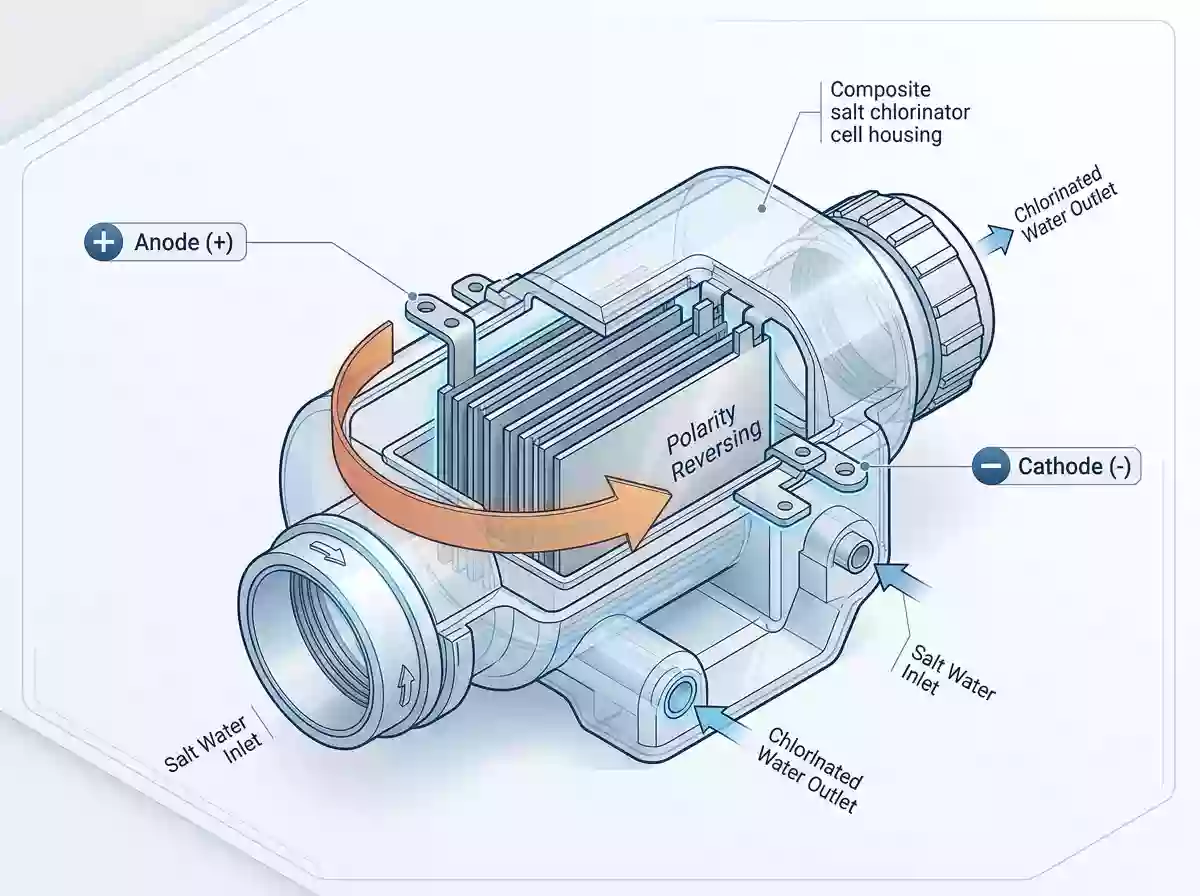
The engine of a self cleaning salt chlorinator is the control board’s ability to switch the direction of the direct current (DC). Under normal operation, the DC flows in one direction, establishing fixed anodes and cathodes. Once the pre-set cleaning cycle is reached, the motherboard reverses the current flow.
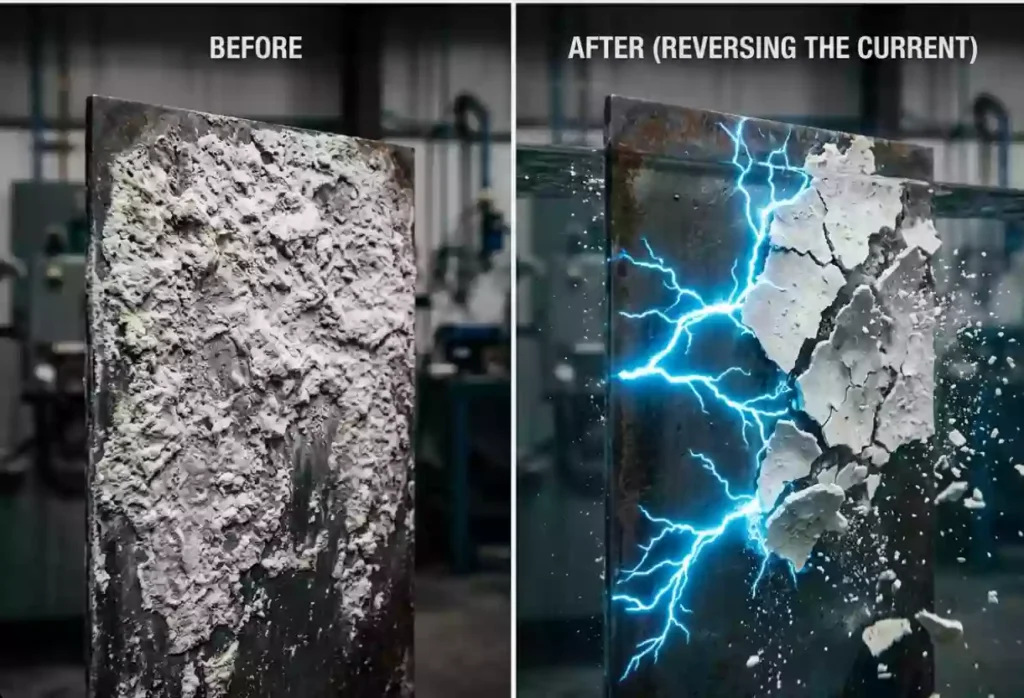
At the moment of reversal, the plate polarity flips. The heavily scaled plate, which was the cathode, instantly becomes the anode. This shift triggers a new chemical environment. As chlorine gas is generated at the new anode, the local pH drops, creating a mildly acidic environment at the plate surface.
This micro-acidic environment dissolves the calcium scale from the root, softening the buildup until the water flow flushes it out of the salt cell housing. This is the truth behind self-cleaning: no physical scrubbing is required. The system leverages electrochemical switching to automate maintenance and extend the interval between manual cleanings.
The Hidden Cost: How Polarity Switching Impacts the Titanium Anode MMO Coating
It is a mistake to view reverse polarity as a “cost-free” cleaning method. Every time the current reverses, the titanium anode MMO coating (Ruthenium-Iridium) sustains an electrochemical shock.
This shock challenges the structural stability of the precious metal oxides. During reversal, the plate momentarily transitions into a cathode environment, causing a rapid shift from an oxidizing to a reducing state. This can lead to “hydrogen embrittlement” or mechanical stress within the coating layers. In low-quality cells, this leads to rapid delamination and powdering of the coating—the primary reason why cheap replacement cells have such short lifespans.
Century’s anodes utilize advanced surface roughening and a proprietary multi-layer thermal coating process. This enhances the bond between the substrate and the MMO layer, allowing our plates to withstand the repeated stress of automatic salt cell cleaner cycles without the premature failure seen in inferior products.
Finding the Optimal Switching Cycle: Balance Between Cleaning and Lifespan
For an effective self cleaning salt chlorinator, the goal is to find the perfect salt cell self cleaning cycle—balancing cleanliness against the wear and tear of the MMO coating.
In field operations, these cycles can typically be set to 2, 4, 8, or even 12 hours. A cycle that is too short (frequent switching) will keep the plates pristine but will accelerate coating wear due to constant electrochemical stress, increasing long-term replacement costs.
Conversely, a cycle that is too long allows heavy calcium buildup. This can restrict water flow or even cause a short circuit between plates.
- Hard Water Areas: We recommend a shorter cycle (2–4 hours) to prevent excessive buildup.
- Soft Water Areas: A longer cycle (4–8+ hours) is preferable to protect the coating and maximize the pool chlorinator cell lifespan.
Why the Control Board is the True Engine of Reverse Polarity
In a self-cleaning system, the titanium plates are merely the “actors” performing the chemistry. The “director” is the OEM salt chlorinator power supply and the control board.
A high-quality power supply must manage the “soft-switch” transition. This ensures the current doesn’t spike or oscillate during the polarity flip, which would otherwise damage the delicate MMO coating or fry sensitive electronic components.
As a professional B2B partner, Century does more than manufacture premium electrodes. We specialize in providing custom power supply brands for OEM partners. We can tailor the reversal logic and current management to your specific brand requirements, ensuring your systems provide the reliability and longevity that B2B clients demand.