
Ruthenium Depletion Mechanisms: Understanding Anode Degradation in Commercial Water Treatment
In large-scale commercial water treatment and municipal electrochlorination systems, mixed metal oxide (MMO) titanium anodes—specifically those utilizing ruthenium-iridium (Ru-Ir) formulations—are the functional core that facilitates high-efficiency chlorine production. During prolonged continuous operation, the active ruthenium component within the coating matrix undergoes progressive consumption, a phenomenon scientifically identified as the primary driver of electrode failure.Ruthenium depletion serves to diminish the active catalytic surface area, driving up overall cell voltage and ultimately inducing premature anode passivation and plant shutdowns. For waterworks engineers and operations managers, mastering the underlying mechanisms of anode degradation is essential for predictive maintenance scheduling and preventing catastrophic system outages. This technical white paper analyzes the specific evolutionary phases of ruthenium dissolution and trans-passivation, alongside the advanced manufacturing protocols used by Century to stabilize long-term electrochemical performance.
Electrocatalytic Wear: The Kinetics of the Chlorine Evolution Reaction and Active Layer Dissolution
The fundamental engineering purpose of a ruthenium-based coating is to drastically lower the overpotential required for the chlorine evolution reaction kinetics. However, under low-salinity conditions or high-amperage operational loads, a competitive secondary reaction—oxygen evolution—manifests on the electrode surface, creating an aggressive electrochemical environment.
During high-current-density cycles, the stable RuO2 (Ruthenium IV) sites can be over-oxidized into higher-valency Ru(VIII) species, which present as either soluble ions or volatile ruthenium tetroxide (RuO4).
This process leads to a continuous mass loss of the catalytic layer. As the active ruthenium is progressively exhausted, the density of functional catalytic sites across the anode matrix declines. This electrochemical wear is irreversible, causing a permanent drop in systemic chlorine generation efficiency and a steady degradation of the electrolytic unit’s baseline power performance.
Thermodynamic Stress: How Oxygen Evolution Accelerates Ruthenium Depletion
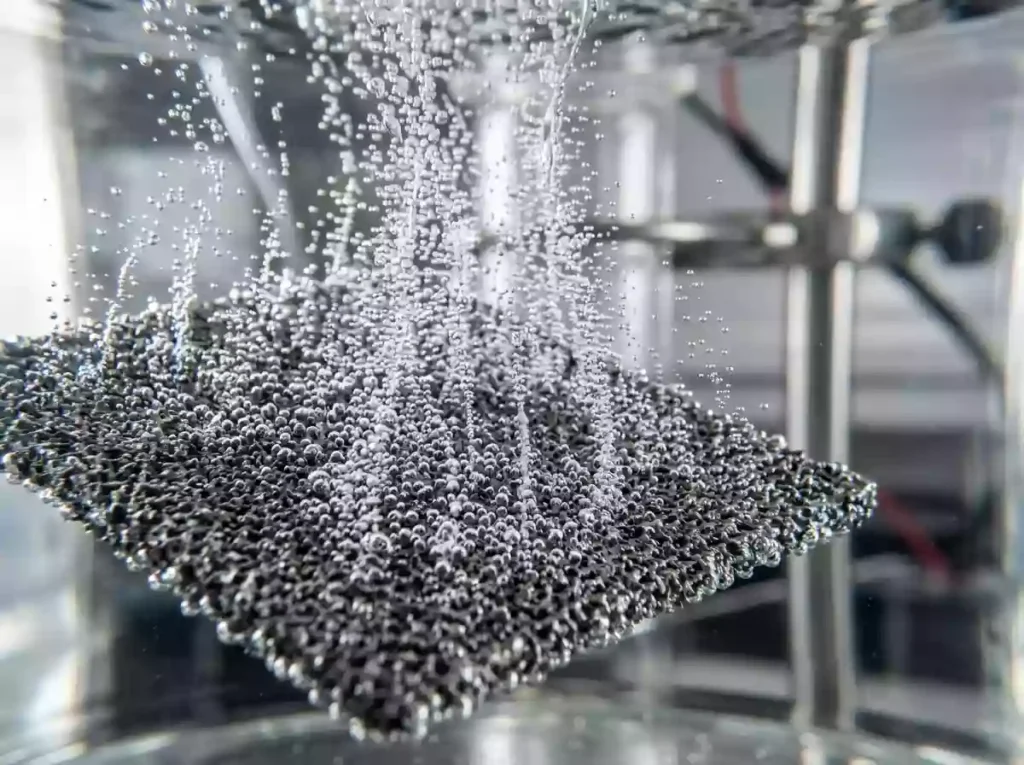
Operating parameters such as low-salinity water in commercial pools or low-temperature inflow in municipal waterworks force the anode into a state of thermodynamic stress. This enhances the oxygen evolution side-reaction, creating localized oxidative strain that pushes the mixed metal oxide titanium anodes into a state of trans-passivation.
Intermediary products of oxygen evolution, including high-energy free radicals and nascent oxygen species, continuously attack the RuO2 crystal lattice. This aggressive erosion destabilizes the internal structural bonding of the coating, ultimately leading to localized catalytic layer delamination and stripping from the titanium base metal. The higher the ratio of oxygen evolution relative to chlorine production, the faster the rate of ruthenium depletion. Consequently, precise operational management—including water chemistry stabilization and current density control—is required to mitigate this decay and safeguard the long-term reliability of the disinfection plant.
Microstructural Passivation: The Mechanism Behind Anode Degradation and TiO2 Barrier Formation
Once the ruthenium concentration within the coating matrix drops below a critical threshold, the active layer loses more than just thickness; its microscopic architecture is fundamentally compromised. The inherent mud-crack morphology of the MMO film loses its catalytic defense, allowing oxygen and aqueous electrolytes to penetrate the fissures and reach the raw titanium substrate.
These corrosive agents react directly with the base metal, facilitating the formation of a non-conductive titanium dioxide (TiO2) dielectric barrier at the interface between the coating and the substrate. This insulating wall blocks electron transfer, causing the interfacial resistance to spike exponentially.
This sudden resistance surge often results in localized current density overloading, which further generates destructive heat and accelerates systemic failure.
The formation of this TiO2 barrier marks the final stage of anode degradation, leading to a complete and unrecoverable loss of electrochemical activity.
Real-World Operational Factors: Water Chemistry and Reverse Polarity Impact on MMO Coatings
Commercial pool systems frequently utilize automated reverse polarity (RP) cycles to strip calcium and magnesium scale from the cathode. This operational shift forces the active anode to become a temporary cathode, subjecting the ruthenium-iridium coating to intense electrochemical “tugging” and current transients that accelerate the physical stripping of active mass.
Furthermore, water chemistry variables—including fluctuating pH levels, organic pollutant loads, residual organic chlorine, and low salinity—create a multi-valent corrosive environment. These factors synergistically attack the coating’s microstructure, further compounding the rate of electrode aging. While generic titanium anodes frequently experience drastically shortened lifecycles under these conditions, only high-specification MMO coatings with rigorous quality controls can endure these electrical transients and chemical shocks, maintaining structural integrity in the field.
Century’s Engineering Mitigations: Optimizing Formulation Microstructures for Commercial Water Treatment
To maximize asset life in demanding commercial water treatment applications, Century utilizes an advanced iridium-tantalum (Ir-Ta) interlayer beneath a reinforced ruthenium-iridium topcoat. The exceptional corrosion resistance of the tantalum-iridium matrix acts as a stabilizer for the ruthenium lattice, creating a multi-valent crystalline structure that structurally slows the rate of active component dissolution.
During manufacturing, we implement a multi-stage, high-temperature thermal decomposition and sintering process. This optimizes the coating’s surface morphology and closes a substantial percentage of through-layer micro-fissures, creating a physical barrier against oxygen ion ingress.
This nanotechnology-driven layering ensures that ruthenium consumption rates remain at the industry’s lowest benchmarks.
This engineering approach secures a stable, long-term cell voltage profile and minimizes maintenance frequency, providing global water projects with a reliable, high-yield asset that delivers sustained value throughout its entire lifecycle.