
Ensuring Regulatory Compliance: Meeting Health Department Standards with Commercial On-Site Hypochlorite Generation (OSHG)
For commercial pool operators, few scenarios are as high-stress as a surprise water quality inspection by the local health department. A single failed test—whether due to fluctuating free chlorine levels or excessive chloramines—can result in an immediate shutdown order. This leads to lost revenue, a tarnished brand reputation, and operational headaches that can last for weeks.
While standard inline salt cells are suitable for residential or small-scale pools, they often struggle to maintain consistency in high-traffic commercial environments. When faced with heavy bather loads and salt-sensitive infrastructure, these systems frequently fail to keep up with the demand for rapid disinfection.
This is where On-site hypochlorite generation (OSHG) systems redefine the standard. Unlike traditional inline chlorinators, OSHG is a specialized industrial solution designed for large-scale, high-load facilities. By generating a continuous supply of fresh disinfectant on-demand, OSHG systems lock in free available chlorine (FAC) levels and aggressively eliminate chloramines. For facilities where compliance is non-negotiable, Century’s OSHG technology provides the most reliable safeguard for water quality standards.
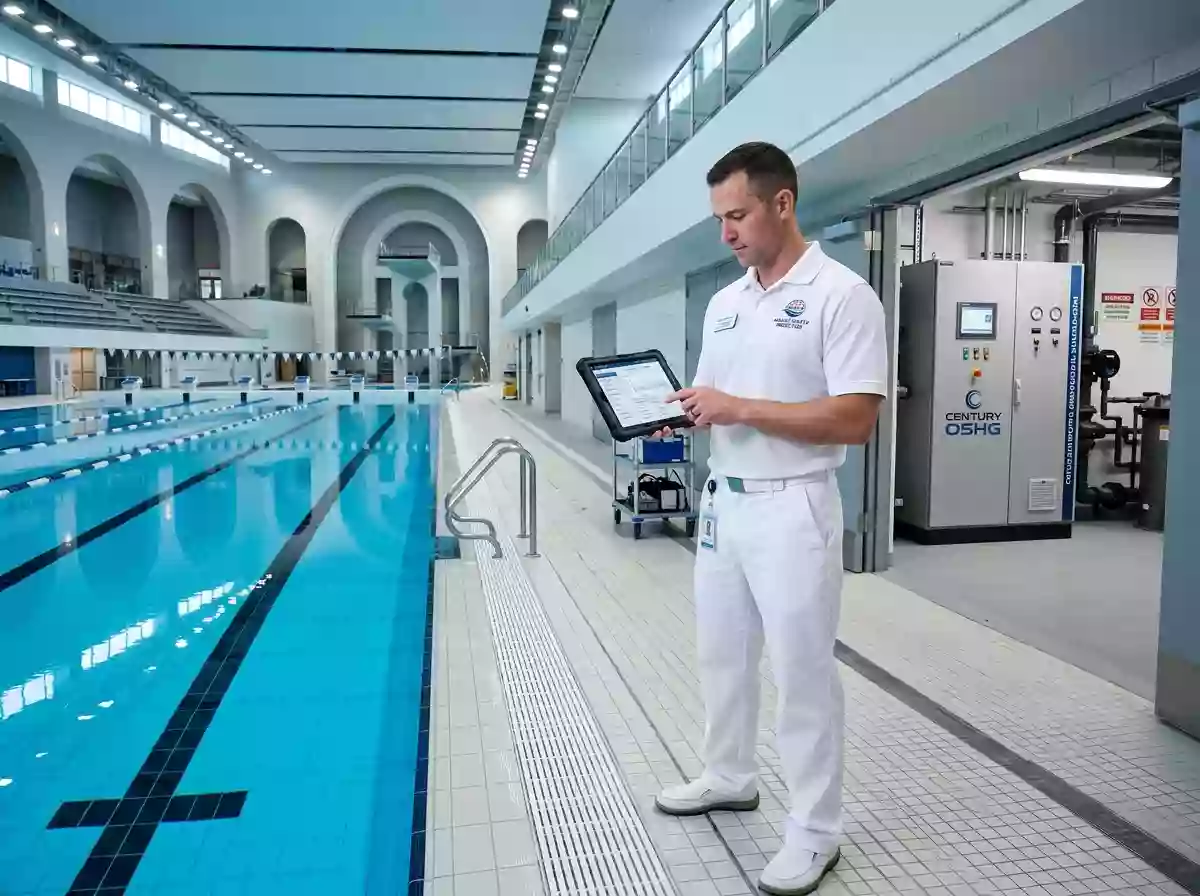
OSHG vs. Inline Salt Cells: Why Commercial Facilities Choose Brine-Based Systems
In the commercial sector, the choice between on-site hypochlorite generation and traditional inline salt cells represents a critical fork in technical strategy. This decision impacts not only day-to-day disinfection but also the long-term integrity of the facility’s physical assets.
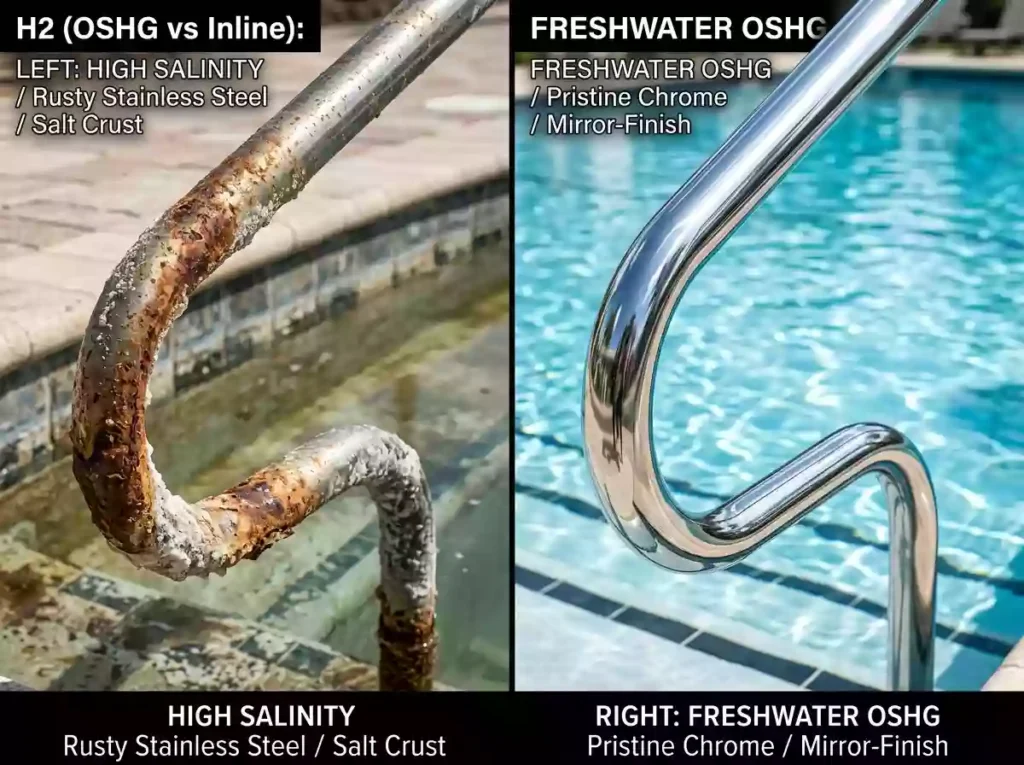
Standard inline salt chlorinators require the entire pool volume to be maintained at a high salinity level—typically above 3,500 ppm—to facilitate electrolysis. For a commercial facility, this high-salt environment is a silent enemy. It accelerates the corrosion of stainless steel ladders, specialized lighting fixtures, and metal plumbing. Furthermore, it causes “efflorescence” (white salt deposits) on premium stone finishes and deck surfaces. The result is a cycle of expensive repairs and a shortened lifespan for the facility’s hardware.
Century’s brine-based OSHG systems utilize a completely different logic. The electrolysis occurs in a separate, isolated brine tank to create sodium hypochlorite, which is then injected into the pool at a very low concentration. This keeps the overall pool salinity below 500 ppm—virtually indistinguishable from fresh water. You gain all the benefits of salt-based chlorine production—stability, safety, and purity—without the destructive corrosive profile. This balance of disinfection efficacy and asset protection is why major commercial aquatic centers are pivoting to OSHG systems.
Meeting the MAHC Standards: Maintaining Constant Chlorine Residuals
The Model Aquatic Health Code (MAHC), published by the CDC, sets rigorous benchmarks for commercial water quality. The core of these regulations is the requirement for “constant and stable” chlorine residuals. Health departments have no tolerance for “disinfection dips” or high levels of chloramines, as these are the primary indicators of a safe (or unsafe) swimming environment.
Traditional salt cells generate chlorine at a steady, slow pace, making them slow to respond to sudden changes. When a facility hits peak capacity—such as during holiday weekends or scheduled swim meets—the disinfection demand spikes. Standard systems often fall behind, leading to dangerous FAC drops and spiked chloramines. In contrast, an OSHG system combined with a buffer tank operates like a miniature, on-site chemical factory. It maintains a ready-to-use reserve of high-activity, fresh sodium hypochlorite that can be deployed instantly to neutralize bather-load spikes and stabilize water chemistry.
From a chemical stability standpoint, the 0.8% sodium hypochlorite generated on-site is superior to the 12.5% bulk liquid bleach typically found in the market. Bulk bleach is highly unstable and can lose over 20% of its potency within weeks of storage. Freshly generated chlorine from an OSHG system is more consistent, less volatile, and has a much lower impact on pool pH. By locking your water parameters within the MAHC-approved range, Century ensures your facility passes every health inspection with ease.
Beyond Disinfection: The Role of OSHG in Secondary Disinfection Systems
For high-traffic indoor pools and public aquatic centers, basic chlorination is often insufficient to meet modern health standards. Given the high circulation load and the presence of chlorine-resistant pathogens, a single-layer disinfection strategy is no longer enough to satisfy high-level safety audits. A multi-barrier approach is required to ensure total water biosecurity.
OSHG systems serve as the foundation for high-tier secondary disinfection systems. When integrated with UV (Ultraviolet) or Ozone technology, the OSHG unit provides the essential long-term residual protection. While UV and Ozone are excellent at deactivating stubborn pathogens like Cryptosporidium by rupturing their cell walls, they offer no “staying power” in the water.
The sodium hypochlorite generator bridges this gap. It provides a constant, fresh output of chlorine that maintains the protective baseline throughout the pool and plumbing. This synergy ensures that pathogens are hit twice: first by the intense immediate action of the secondary system, and second by the persistent residual of the fresh hypochlorite. This combined architecture meets the strictest public health standards for secondary disinfection, virtually eliminating the risk of waterborne disease outbreaks.
Operational Risk Mitigation: Eliminating Bulk Chemical Hazards
Compliance in the commercial sector extends far beyond water chemistry. During joint inspections by health and fire departments, the storage and management of hazardous materials (Hazmat) are high-priority items. Traditional disinfection relies on pressurized chlorine gas cylinders or bulk tanks of 12.5% liquid bleach—both are highly corrosive and potentially explosive. Managing these requires specialized containment zones, explosion-proof ventilation, and rigorous OSHA safety training for staff.
Storing these chemicals creates a massive liability for facility managers. One leak can trigger an emergency evacuation and a heavy OSHA audit. The paperwork, safety equipment maintenance, and risk mitigation costs associated with bulk chemicals can be overwhelming.
Century’s OSHG systems eliminate these risks at the source. By switching to on-site generation, the only “chemical” you need to store is ordinary food-grade salt. Salt is non-hazardous, non-combustible, and has zero leak risk. This transition simplifies your Hazmat compliance overnight. It removes the need for specialized safety gear and simplifies the OSHA auditing process by removing several high-risk line items from the checklist. You reduce your insurance premiums, lower your management costs, and create a safer environment for both staff and guests.
Conclusion: Future-Proofing Your Facility with Century’s Professional OSHG Solutions
Compliance is more than just passing a surprise inspection; it is a long-term strategic investment in your facility’s future. By stabilizing water quality, preventing the slow destruction of your infrastructure via corrosion, and eliminating hazardous chemical risks, you are protecting your bottom line. As global water quality standards continue to tighten, legacy disinfection systems are becoming obsolete. Investing in a forward-thinking system is the only way to ensure asset preservation and operational longevity.
Century is a leader in electrochemical water treatment technology. We are not just equipment assemblers; we own the core technology behind titanium electrode coatings and electrolytic system integration. Leveraging our advanced R&D and vertical manufacturing capabilities, we provide professional, customized OSHG solutions for B2B clients worldwide. Our systems ensure stable disinfection and precise chlorine control while strictly protecting your architectural stone and metal assets. Whether you need a standard unit or a complex project-specific adaptation, Century delivers factory-grade craftsmanship to help you achieve effortless compliance and a future-proof water treatment infrastructure.