
How to Choose a Reliable Salt Cell OEM Manufacturer in China: A B2B Buyer’s Guide
For many pool equipment brands and water treatment distributors in North America and Europe, sourcing a salt cell OEM in China is a high-stakes balancing act. The “Sample vs. Mass Production” nightmare is a recurring story: the initial samples are flawless—beautifully finished with perfect chlorination rates—but the actual container-load of goods arrives with failing coatings, cracked housings, and unstable performance. This “bait and switch” in quality doesn’t just delay your project; it erodes your brand’s reputation and leads to catastrophic warranty costs.
As a manufacturer deeply rooted in the electrochlorination industry, we believe in transparency over buzzwords. Finding a reliable partner in China requires looking past the glossy photos on Alibaba and digging into the technical bedrock of production. This guide will teach you how to audit a potential partner’s real manufacturing capability and secure a supply chain that delivers consistency, not just promises.
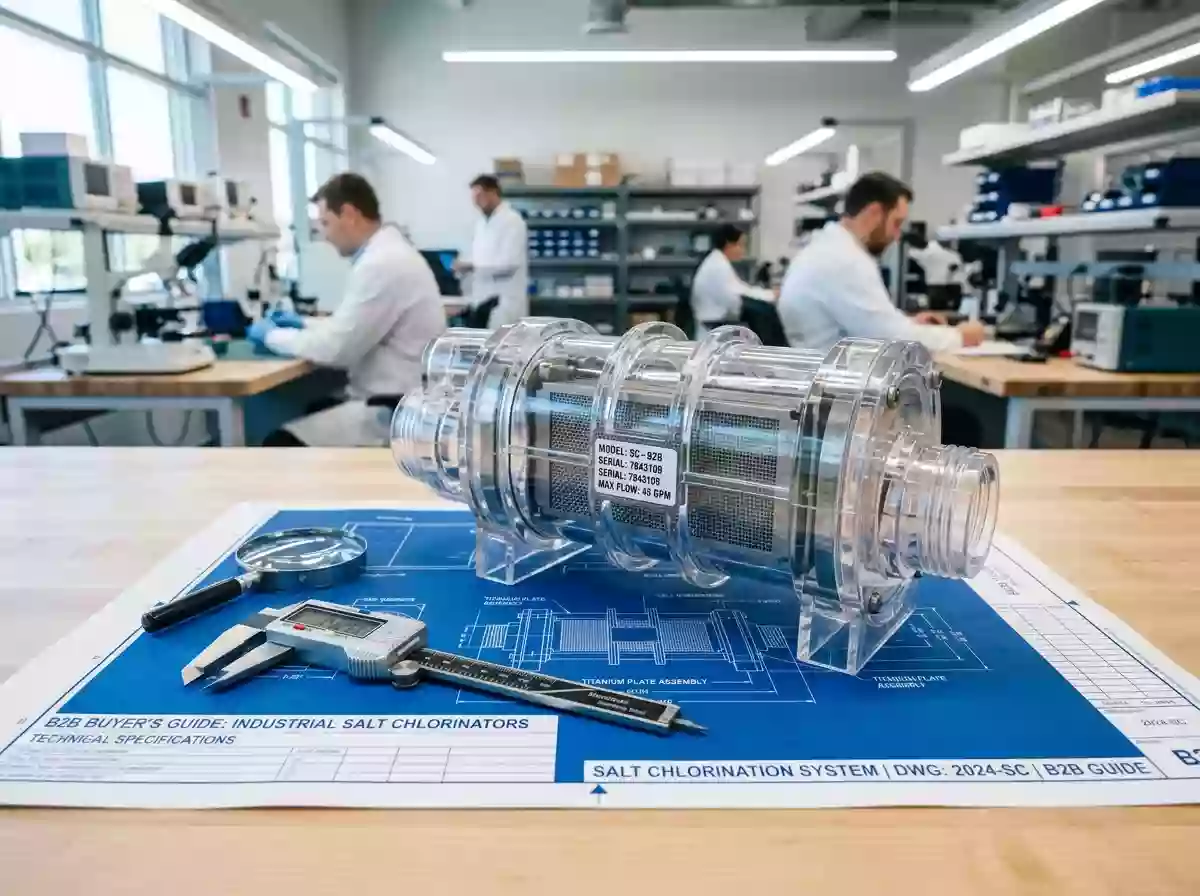
The Trap of Trading Companies: Finding a True Pool Salt Cell Manufacturer
The first hurdle in Chinese procurement is the prevalence of middle-men. Statistics suggest that nearly 70% of “factories” listed on major B2B platforms are actually trading companies. While they might have sleek English catalogs, they are not a true pool salt cell manufacturer. They do not own the injection molds, the sintering furnaces, or the electrolytic testing labs. Instead, they outsource components from various small workshops and assemble them. When quality issues arise, they lack the technical authority to fix the root cause, leading to endless finger-pointing and delayed resolutions.
To verify a true manufacturer, use these two “acid tests”:
- Audit the ISO 9001 Scope: Don’t just check if they have the certificate. Look at the “Production Scope.” If it says “Sale of” or “Trading of,” walk away. It must explicitly state “Manufacturing” or “Production” of electrolytic cells or water treatment equipment.
- The “Live Shop Floor” Video Call: Forget the pre-recorded promotional videos. Request a spontaneous video walk-through of the facility. Demand to see the injection molding machines, the coating clean-room, and the assembly line in action. A middle-man will make excuses; a real salt chlorinator factory will show you their operation with pride.
Core Technology Evaluation: Sourcing a Real Titanium Electrode Manufacturer
The heart of any salt cell is the titanium plate stack. This is the single most expensive and technically demanding component. Many assembly-only factories source their plates from external workshops without any understanding of the metallurgical grades involved. If your supplier isn’t a specialized titanium electrode manufacturer (or doesn’t have a dedicated, in-house coating department), you are gambling with your product’s lifespan.
When auditing technical competence, move past surface-level questions. Ask for specific data:
- Coating Precious Metal Loading: Ask for the exact grams of Ruthenium-Iridium per square meter. A low-cost OEM will shave this down to the bare minimum, causing the cell to fail in 12 months.
- Sintering Cycles: How many times are the plates baked in the furnace? A high-quality plate requires multiple cycles to ensure the coating is thermally fused to the titanium substrate.
- Substrate Grade: Ensure they are using Grade 1 or Grade 2 pure titanium.
A reliable partner like Century maintains an in-house electrochemistry R&D team. We don’t just buy parts; we control the molecular bond between the coating and the metal. This is the only way to guarantee a 10,000-hour service life for your B2B clients.
Strict Quality Control in the Salt Chlorinator Factory: Beyond Just “Looks Good”
A common mistake is assuming that if a cell “looks” like a name-brand unit, it will perform like one. In a salt chlorinator factory, visual inspection is the bare minimum. Because these units operate in high-pressure, highly corrosive environments with fluctuating electrical loads, the real quality control happens in the lab.
A professional OEM must demonstrate a “Hardcore QC” protocol, including:
- Pressure Testing: Every housing must be tested to withstand 50 PSI or higher. Ask for their pressure-testing logs.
- Accelerated Life Testing (ALT): How do they know the cell lasts 5 years? They should have a lab where cells are run at extreme current densities to simulate years of wear in weeks.
- 100% Wet Testing: Before packing, every unit should be connected to power and water to verify the chlorine output and sensor calibration.
If a factory relies only on manual visual sorting without specialized testing equipment, they are a workshop, not a professional OEM partner.
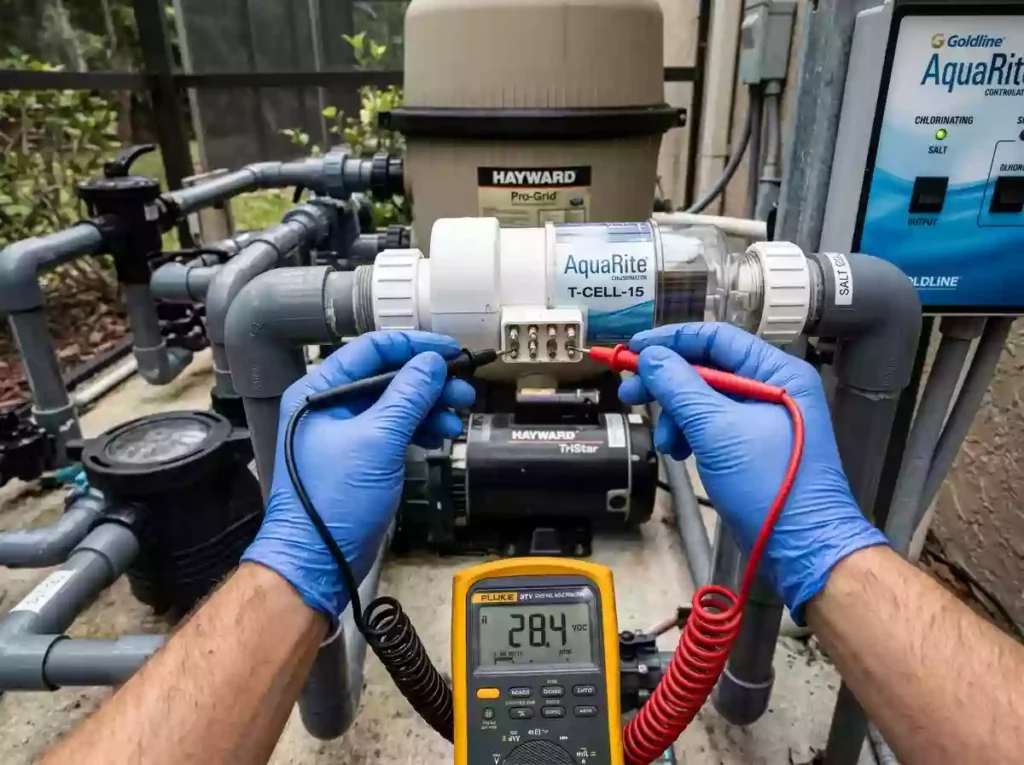
Custom Salt Cell OEM Capabilities: From Private Label to Joint R&D
Many buyers think custom salt cell OEM services just mean “logo slapping” (private labeling). However, for a serious B2B brand, you need deep engineering integration. Your manufacturer should act as an extension of your own engineering department.
True customization includes:
- Hydraulic Optimization: Can they adjust the plate spacing to handle high-calcium water in specific regions like Arizona or Southern Europe?
- Tooling & Molds: If you want a unique housing design to differentiate your brand, can they handle the mold flow analysis and injection molding in-house?
- Electronic Compatibility: Can their sensors (temperature and salinity) communicate accurately with your existing control boards?
- Standard Compliance: Do they understand the difference between NPT and BSP threads? Do they know the specific plug requirements for the Australian versus the European market?
A manufacturer that understands these nuances will save you months of rework and thousands of dollars in shipping errors.
Why Century Tech is the Preferred Water Treatment OEM in China
Choosing a water treatment OEM China partner comes down to three pillars: proprietary technology, standardized QC, and verified manufacturing scale.
At Century Tech, we have pioneered a vertical integration model in Shenzhen. We don’t rely on a fragmented supply chain. We develop our own molds, formulate our own precious metal coatings, and manage our own injection molding and assembly. This “all-under-one-roof” approach eliminates the communication gaps that lead to quality drift.
By controlling the entire process—from the purity of the titanium substrate to the final pressure test—we provide our partners with OEM-grade reliability without the “Brand Tax” of major labels. We are the “invisible manufacturer” behind some of the world’s leading pool distributors because we prioritize the technical specs that matter to the pro-installer: durability, ease of installation, and stable chlorine production.