
Pool Salt Cell Diagnostics: Why a “Low Salt” Error Often Means a Dead Cell
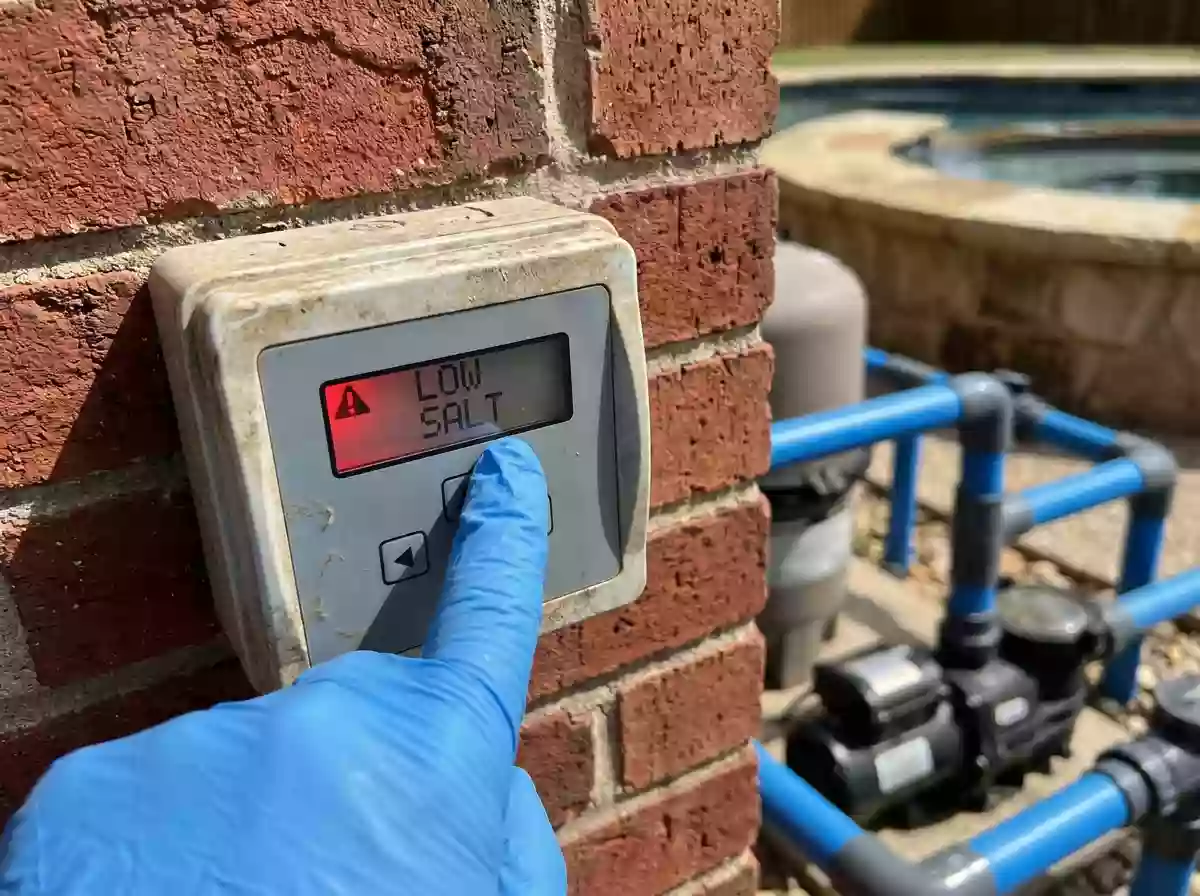
You’ve calculated the perfect pool salinity (e.g., 3400 ppm), dissolved the bags completely, and powered up the system. Yet, the control panel immediately flashes a “Low Salt” or “Inspect Cell” warning. It’s a frustrating scenario for any pool professional. The reality is that the control board cannot “taste” salt; it calculates salinity by measuring electrical resistance. While high resistance usually indicates low salt levels in the water, if you’ve already verified the chemistry, the true culprit is likely a failing titanium anode plate. As the cell dies, electrical resistance spikes, causing the system to misdiagnose the issue, explaining exactly why your salt cell says low salt.
How a Salt Water Generator Actually “Measures” Salinity
To understand this error, you must look at the physics. There is a strict mathematical relationship between water salinity, temperature, and electrical resistance. The rule is simple: higher salt concentration equals better salt cell conductivity, which results in lower resistance and higher amperage across the titanium plates. By checking salt cell amperage and voltage, the control board determines the water’s resistance. By applying specific programmed algorithms that factor in these variables, the system calculates the estimated salinity. It’s a precise calculation, but it completely relies on the physical integrity of the electrode plates.
The Ru-Ir Coating: The Hidden Culprit Behind False “Low Salt” Alerts
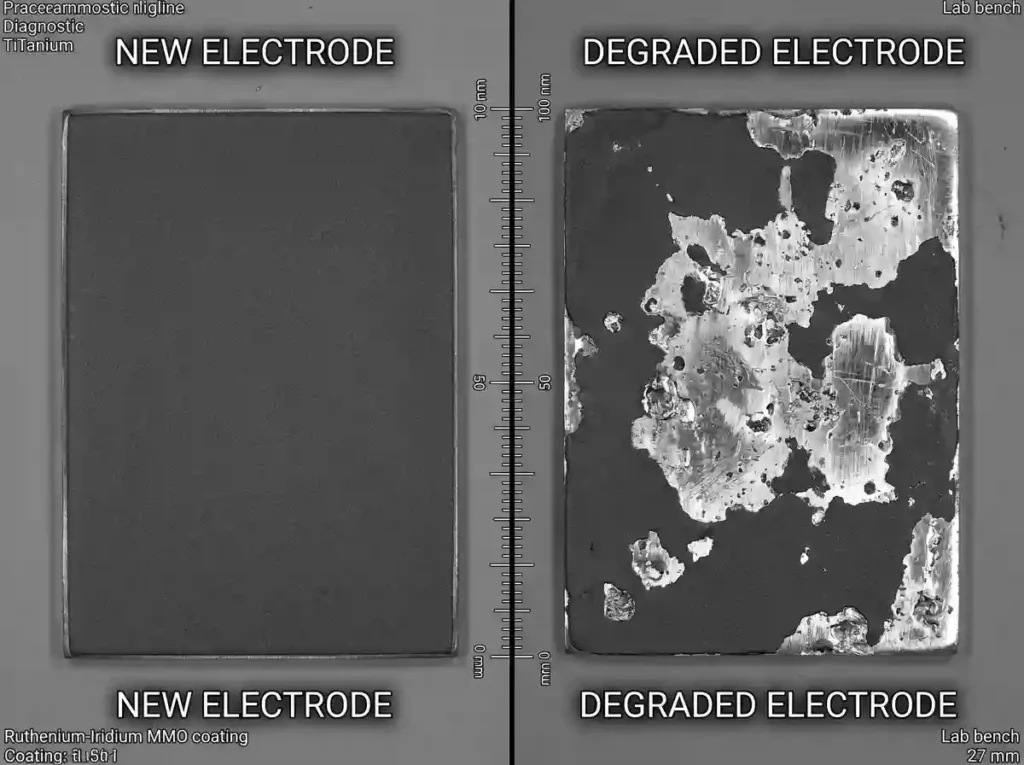
The base material of the titanium anode is a “valve metal.” When used as an anode without surface treatment, it is essentially non-conductive with near-infinite electrical resistance. However, when the titanium substrate is coated with an MMO (Ruthenium-Iridium) coating, the overall electrical resistance drops dramatically, allowing current to flow efficiently into the water for electrochemistry.After 3 to 5 years of operation, this surface coating gradually degrades and wears off. As the coating depletes, the cell’s electrical resistance significantly increases, causing the operating current (amperage) to drop. Once this current falls below the control panel’s programmed minimum threshold, the system incorrectly assumes the water lacks conductivity. This degradation is the primary hidden culprit causing the salt cell low salt light on error, even when water chemistry is balanced.
Scale Buildup vs. Coating Depletion: How to Tell the Difference
Aside from MMO coating depletion, calcium scale buildup on the electrode plates can also cause this issue. Calcium scale is a white, non-conductive insulator. As it accumulates on the plates, it restricts current flow, increasing resistance and prompting the control system to report “low salt.”
To differentiate between scale buildup and MMO depletion, start with a visual inspection. If you see white scaling, clean the salt cell using a standard acid wash procedure. If the error clears after reinstalling the clean cell, scale was the issue. However, if the pool salt level is correct but the cell says low after a thorough cleaning, the MMO (Ruthenium-Iridium) coating is fully exhausted. At this point, a salt chlorinator cell replacement is inevitable. (For further verification, refer to our manual diagnostic guide: How to Test a Salt Cell: The Bucket Smell Test and Diagnostics for Technicians).
The Danger of Over-Salting: Why Adding More Salt Can Ruin Your Power Supply
A common and costly field mistake is blindly trusting the system’s “low salt” prompt without independently verifying the water chemistry (e.g., using a bucket test or drop reagents). If a technician simply dumps more salt into the pool to clear the error, they create a hyper-saline, highly conductive environment.
When you eventually install a replacement salt cell into this over-salted water, the results can be catastrophic. The excessive salt concentration causes the new cell to draw massive amounts of amperage. This power surge can overload and blow the capacitors or rectifiers inside your power supply unit. Even if the power supply survives, running a cell well above its designed operating current will rapidly burn through the new MMO (Ruthenium-Iridium) coating, severely shortening the lifespan of your newly installed equipment.
Upgrading Your Route with Reliable Replacement Salt Cells
Once diagnostics confirm your hardware has failed, you need to execute a salt cell replacement quickly to keep the pool sanitized. Choosing OEM replacement salt cells from Century is your most strategic business move. As a direct source manufacturer, Century eliminates high brand premiums while delivering exceptional reliability.
Our titanium cells feature precisely engineered MMO coating thicknesses, strict quality control, and extended lifespans. By upgrading your route with Century hardware, you ensure highly accurate electrical resistance readings. This drastically lowers the rate of false “low salt” alarms for your commercial and residential clients, saving you time and protecting your profit margins.