
The Complete Guide to Buying a Replacement Salt Cell: Compatibility, Costs, and OEM Options
A salt cell is a consumable item. Unlike a vehicle that can run for decades with basic maintenance, a cell has a finite lifespan. Its core is the titanium anode plate—specifically, the Ruthenium-Iridium (Ru-Ir) coating. If the manufacturing quality is poor, you might notice failures, such as severe edge pitting on the titanium plates, after just 720 hours of operation.
Under normal usage, a high-quality cell lasts about 5 years before the Ru-Ir coating naturally depletes. However, some budget options use dangerously thin coatings that burn out in just 1 to 3 years. This guide will teach you how to diagnose a failing unit, select the right model to avoid plumbing mismatch, and reveal how sourcing a generic salt cell replacement directly from an OEM salt cell factory like Century can save you money.
How Do You Know It’s Time for a Replacement Salt Cell?
Start by checking your control panel for error lights (like “Low Salt” or “Inspect Cell”). If triggered, follow this troubleshooting process:
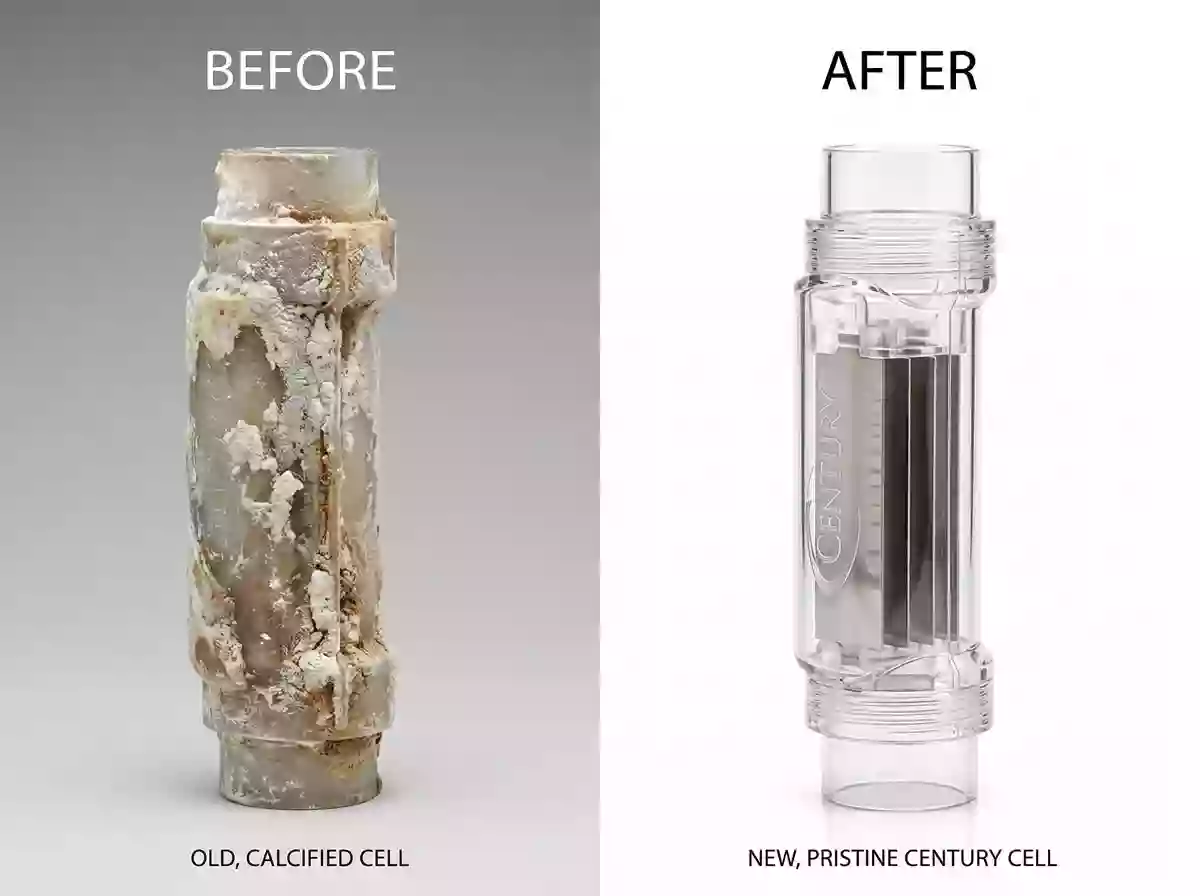
- Inspect: Look closely at the titanium plates (both anode and cathode). If the black coating is peeling off or the titanium substrate is physically pitted, the anode is permanently ruined. If you only see white calcium scale, it simply needs cleaning.
- Wash & Retest: Clean the plates with a mild acid wash. After cleaning, inspect again. If the coating looks black or flaky, the cell is dead. If it looks fine, reinstall it. Run the system for 5–10 minutes and test the water for free chlorine using a standard DPD test kit (or fill a bucket, run the cell, and safely check for a strong chlorine odor).
- Rule Out the Power Supply: If the cell still doesn’t produce chlorine, do not immediately assume it is broken. The power supply might be failing. Connect the cell to a verified DC power source. If it still fails to generate chlorine after 10 minutes, the cell is officially dead.
In short: If it doesn’t produce chlorine after a thorough cleaning, the power supply is verified working, and the unit is over 5 years old, it is time for a replacement.
Matching Chlorine Output to Your Pool Volume
For residential users, you must confirm two critical points:
- Pool Size Capacity: Your chlorine output (grams/hour or lbs/day) must match your water volume. The golden industry rule: always buy a cell rated for 1.5 to 2 times your actual pool volume. For example, for a 20,000-gallon pool, buy a 40,000-gallon cell. This prevents the power supply from running at 100% capacity constantly, massively extending the titanium anode’s lifespan.
- Existing Power Supply Limits: Chlorine output is directly tied to your controller. Buying a massive cell is useless if your existing power board lacks the wattage to drive it.
For B2B wholesalers: Simply tell us your target chlorine output, and Century will engineer a salt water chlorinator replacement cell with the exact lifespan and output capacity you require.
Hardware Check: Salt Cell Plumbing Compatibility and Power Cords
Before purchasing, verify your physical connections to avoid installation headaches.
First, check your salt cell plumbing compatibility. Confirm the outer diameter of your existing PVC pipes (typically 1.5″ or 2″). If you buy a drop-in replacement, you simply cut the old pipe and glue the new threaded unions—a very fast process.
Second, verify the physical power cord plug. Confirm the pin layout with the seller and understand the function of each wire. Wiring a replacement incorrectly can instantly fry your power supply.
Electrical Specifications: Voltage and Controller Compatibility
Beyond the physical plug, you must consider sensor compatibility. Many systems incorporate flow switches or temperature sensors directly into the cell housing or wiring harness.
You must confirm these sensor details with your replacement supplier. If your new cell lacks the specific sensor signals your controller expects, the system will trigger an error and refuse to operate. Unless you are replacing the controller at the same time, perfect electrical matching is vital. At Century, if you provide your exact controller model, we guarantee a perfectly matched, plug-and-play product.
Name Brand vs. Generic Salt Cell Replacement: Why OEM is the Smart Choice
The heart of any salt cell is the titanium anode. The truth is, major name brands (like Hayward, Pentair, or Zodiac) often outsource their manufacturing to OEM factories.
As a source factory specializing in titanium anodes and water treatment equipment, Century utilizes the exact same commercial-grade plastic housings and premium Ru-Ir coatings as the major brands. Because our B2B operational overhead is lower and our quality control is incredibly strict, our product quality equals—and often exceeds—the original factory specs. You can purchase a replacement salt cell from Century for 30% less than the name brand, achieving the exact same lifespan and chlorine efficiency.
3 Pro Tips to Maximize Your New Salt Cell’s Lifespan
- Maintain Proper Salinity (3000-3500 ppm): How long do salt cells last? It depends heavily on salt levels. Excessively high salinity lowers water electrical resistance, causing current density to spike. This pushes the titanium plates beyond their design limits, drastically reducing lifespan.
- Don’t Over-Wash: Acid washing strips the coating. Only clean the cell when calcium scaling physically blocks water flow, and always use the correct acid-to-water ratio. Acid reacts with the Ru-Ir coating just as aggressively as it does with the scale.
- Watch Water Hardness: High calcium hardness in residential pools leads to rapid scaling on the cathode. Whenever possible, pair your cell with an automatic reverse polarity power supply to minimize scaling frequency.