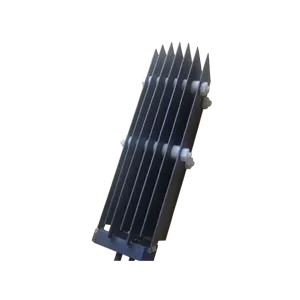
Industrial Electrochlorination Cell Cores & Parallel Arrays
When engineering on-site sodium hypochlorite generation (OSHG) skids for municipal water treatment or industrial cooling towers, the internal electrode array must withstand extreme electrical and chemical stress. Century is a primary metallurgical manufacturer providing heavy-duty industrial electrochlorination cell cores to global system integrators and skid builders.
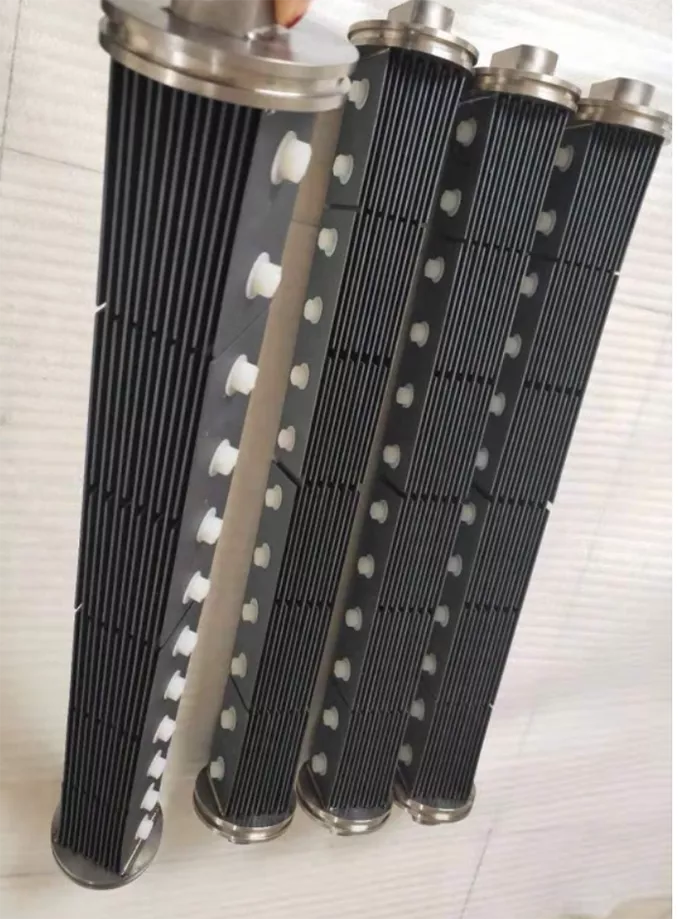
We bypass the limitations of standard commercial components to deliver massive, custom-fabricated parallel plate titanium electrodes. Designed specifically to drive high-capacity chlorine evolution, our industrial arrays provide the structural rigidity, thermal stability, and precise catalytic loading required to operate continuously under massive DC loads. By outsourcing your core fabrication to Century, your engineering team receives a pre-assembled, drop-in engine ready for integration into your custom tubular or flanged electrolyzer vessels.
The Engineering Challenge: High-Amperage Thermal Degradation
Designing a sodium hypochlorite generator electrode array for industrial applications involves managing extreme electrical currents. While residential systems operate on mere fractions of an amp, industrial skids frequently push 500A, 1000A, or even 2000A through the cell core.
If an electrode array is not mechanically engineered for these loads, the system will fail catastrophically. The primary failure mode is thermal degradation at the terminal connections. When massive current is pushed through undersized titanium hardware, electrical resistance generates extreme heat. This heat can melt internal PVDF spacers, warp the titanium plates, and eventually cause the potting epoxy or flange seals to breach. Furthermore, uneven current distribution across poorly assembled plates leads to rapid, localized depletion of the ruthenium-iridium (Ru-Ir) coating, destroying the cell’s Faraday efficiency.
Heavy-Duty Parallel Plate Architecture
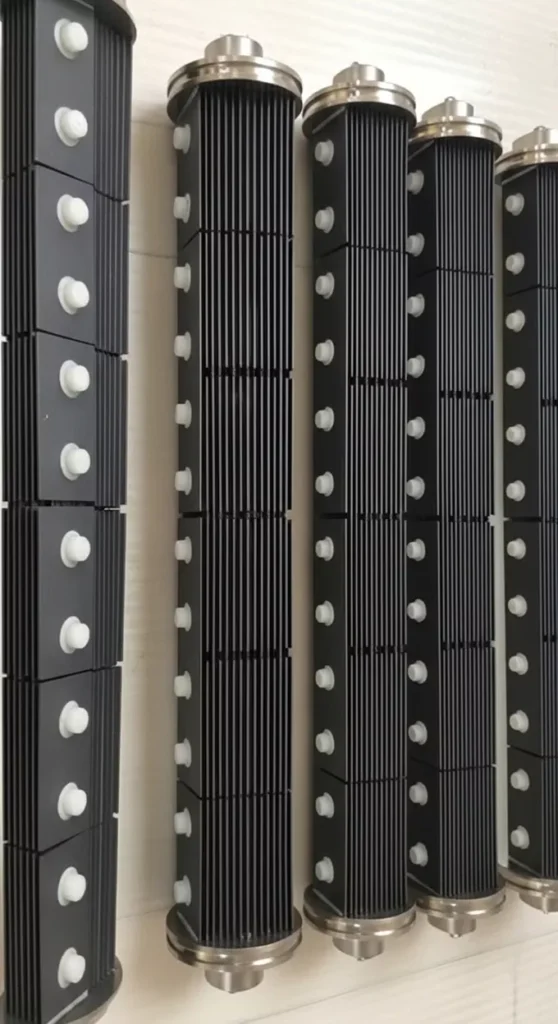
Century engineers our high amperage electrolyzer cores specifically to eliminate these thermal and structural bottlenecks. We do not adapt small-scale designs for large applications; we build from the ground up for heavy industry.
- Massive Titanium Busbars: Instead of standard threaded posts, our industrial arrays utilize ultra-thick, solid Grade 2 titanium busbars. These heavy-duty conductors ensure even current distribution across the entire multi-plate array, drastically reducing electrical resistance and preventing localized hot spots.
- Precision Fluid Dynamics: Industrial brine systems require significant gallons-per-minute (GPM) flow rates. We space our solid titanium plates using custom-machined, heavy-duty PTFE or UPVC blocks. The gap tolerance (typically 2.0 mm to 3.0 mm) is rigidly maintained even under the high hydrodynamic sheer of industrial pumps, preventing scale bridging while maximizing the active catalytic surface area.
- Premium Ru-Ir Coating Matrix: Because these arrays operate on continuous 24/7 duty cycles, we apply a specialized, high-loading Ruthenium-Iridium coating matrix (up to 25 g/m²). This ensures the array maintains a low chlorine evolution overpotential over a guaranteed multi-year lifespan.
Technical Specifications: Industrial Cell Cores
(The following parameters represent our baseline capabilities for industrial arrays. Every core is built-to-order based on your specific skid P&ID and output requirements—from 100g/h up to 3 kg/h capacities.)
| Engineering Parameter | Industrial Parallel Plate Arrays |
|---|---|
| Cell Architecture | Bipolar or Monopolar Parallel Plate Configurations |
| Substrate Material | ASTM B265 Grade 1 & Grade 2 Pure Titanium |
| Catalytic Coating | Heavy-Duty Ruthenium-Iridium (Ru-Ir) Formulation |
| Operating Current Density | Engineered for 1000 A/m² to 1500 A/m² continuous loads |
| Terminal Connections | Machined Titanium Busbars / Heavy Flanged Lugs |
| Internal Gap Tolerance | 2.0 mm to 3.0 mm (Customizable for flow dynamics) |
| Insulating Spacers | Heavy-Duty PTFE, UPVC, or Custom Fluoropolymers |
| Chlorine Output Scale | Supporting systems from 100g/h to 3000g/h (3 kg/h) |
The Century Fabrication Advantage
Procuring massive titanium arrays from generic metal fabrication shops is a high-risk endeavor. Standard welders do not understand the delicate electrochemistry required to keep the Ru-Ir coating intact during the mechanical assembly of the busbars.
As a fully integrated electrochemical manufacturer, Century controls the entire process. We shear the Grade 1 titanium, apply the multi-pass thermal decomposition coating in our own atmospheric furnaces, and assemble the heavy-duty busbars using specialized, localized TIG welding techniques that protect the catalytic surface. Before shipment, every massive core undergoes rigorous resistance testing to verify that the electrical load will distribute perfectly evenly across the entire array.
Frequently Asked Questions (FAQs)
Yes. We act as a contract manufacturer for skid builders. If you provide the internal diameter (ID) and flange dimensions of your tubular vessels, we will design a parallel plate array that slides perfectly into your housing with the necessary clearances for brine flow and gas venting.
For heavy industrial applications involving extremely high amperage and potentially elevated brine temperatures, we typically upgrade from PVDF to custom-machined PTFE (Teflon) or high-grade UPVC spacers. These materials provide superior thermal stability and structural rigidity against the mechanical stress of large multi-plate stacks.
Due to the custom CNC machining required for the heavy busbars and the specialized high-loading Ru-Ir coating cycles, initial prototypes or small batch orders typically require 25 to 35 days for engineering, fabrication, and quality assurance testing.